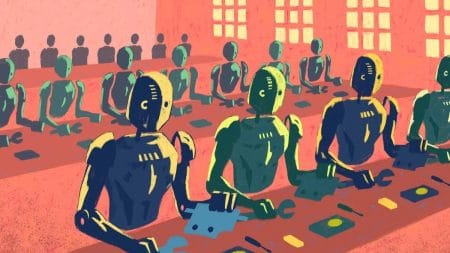
“Agentic AI” is the sort of term that might inspire scepticism amongst non-engineers. It sounds vaguely anthropological and faintly corporate. Yet it is being taken seriously in boardrooms and beta tests (trial phase of a product before its full public release) across the globe. That is because behind the jargon is a simple idea: AI systems that respond to prompts, initiate tasks, make decisions and execute work—much like interns, though with better stamina and no lunch breaks.
The latest frontier in the artificial intelligence race is autonomy, a new modality focused on enabling systems to act independently. Whereas chatbots wait to be asked questions, agents (armed with access to calendars, emails, databases and workflows) march off to complete tasks with minimal supervision. These digital assistants are already being deployed to approve expenses, onboard new hires and suggest sales strategies, among others. They might even schedule a meeting to explain it all.
OpenAI’s recent release of its ChatGPT “agents”, capable of trawling a user’s digital environment and proposing action plans, marks a pivot in emphasis from language models to labour models. Microsoft has embedded similar functionality in its enterprise tools. Smaller firms, typically more flexible in their deployment of experimental technologies, are peppering customer service and operations teams with prototype agents.
Executives appear to be keener than their employees. According to Microsoft’s Work Trend Index, though staff initially led experimentation with AI, the past year has seen a reversal: leaders are now pressing ahead, even as only 1% of companies claim to have fully implemented an AI strategy. This nascent enthusiasm is partly defensive. Research firm Gartner reports nearly half of surveyed business leaders are planning conservative investments in Agentic AI, though motivated by an ambient fear of being left behind.
The technology itself is still catching up with the narrative. Much of what is marketed as “agentic” would be better described as “workflow automation with delusions of grandeur”. A fully autonomous agent—able to understand goals, work across systems, handle new situations—is still more promise than reality. At present most agents require careful prompting and frequent corrections. Left to their own devices, they tend to generate either useless outputs or expensive errors, sometimes both.
The discrepancy between marketing and reality has given rise to a new term: agentic washing. It describes the process by which companies rebrand relatively dumb automation as artificially intelligent independence. This is useful for raising prices, less so for lessening workloads. The engineering challenge is still formidable. Agents must not only execute multi-step processes but also interpret ambiguous instructions and handle exceptions, something even human workers struggle with.
Even so, early adopters are staying bullish. Zig Serafin, CEO of experience-management firm Qualtrics, argues the addition of agents will make organisations more creative and less rigid. Humans will, in theory, spend more time on strategic thinking and complex judgement, and less on submitting invoices or rescheduling meetings. He envisions hybrid teams where agents handle the repetitive, rule-based work, leaving the messy bits like innovation and diplomacy to their flesh-and-blood colleagues.
Critics raise a number of objections. They note people are not inclined to embrace tools they do not understand, describing “trust leaps”: moments when individuals are asked to rely on new systems without sufficient familiarity. While previous leaps—from horse-drawn carriages to cars, or from banknotes to cryptocurrencies—came with visual cues and social rituals, the AI agent is invisible and impersonal. It might book your flights but it cannot reassure you.
Others worry misplaced trust in agents could trigger poor oversight and worse outcomes. The distinction between human and machine contributions is becoming harder to discern, more so when agents are allowed to communicate directly with clients or colleagues. If a sales report is written by a language model based on figures retrieved by a software agent, who is accountable for the analysis?
There is also the question of employment. Notwithstanding headlines predicting mass redundancy, the real shift may be structural rather than numerical. Rather than sacking staff outright, firms may forgo hiring additional workers or restructure teams around agent-enhanced roles. A graphic designer might work with a suite of agents that, say, handle layout and proofreading. An operations manager might rely on an agent to triage support tickets before they hit a human inbox.
The traditional organisational chart, dating from the 19th century, is poorly equipped to accommodate this evolution. It was designed for vertical command and control; agents work laterally and continuously. If agents occupy positions within workflows but not within hierarchies, it is unclear who manages them, or how their performance is measured. One suspects they will not be invited to the Christmas party.
Some technologists dream of a one-person unicorn—a firm whose founder is augmented by enough AI agents to scale without hiring a team. That may sound utopian or dystopian, depending on one’s view of venture capital. In practice, the statistical average outputs generated by agents make them better at handling volume than originality. Language models excel at predicting the next likely word not the next big idea. True creativity for now remains a human function.
There is, of course, a more prosaic reason for the push: economics. Developing advanced AI is costly. The pursuit of artificial general intelligence has consumed billions in venture funding with little short-term revenue to show for it. Selling agent subscriptions to corporate clients provides a convenient, if temporary, way to monetise those efforts. In this sense the enterprise agent is less a revolution than a revenue model.
Still, revolutions tend to arrive slowly, and then suddenly. Although most agents today are more intern than executive, their trajectory is upward. The technology is imperfect, though improving; the use cases are limited but expanding. Leaders would do well to experiment cautiously and integrate thoughtfully as well as manage expectations accordingly. The future of work may not belong to the machines, but they will be attending the meeting. ■