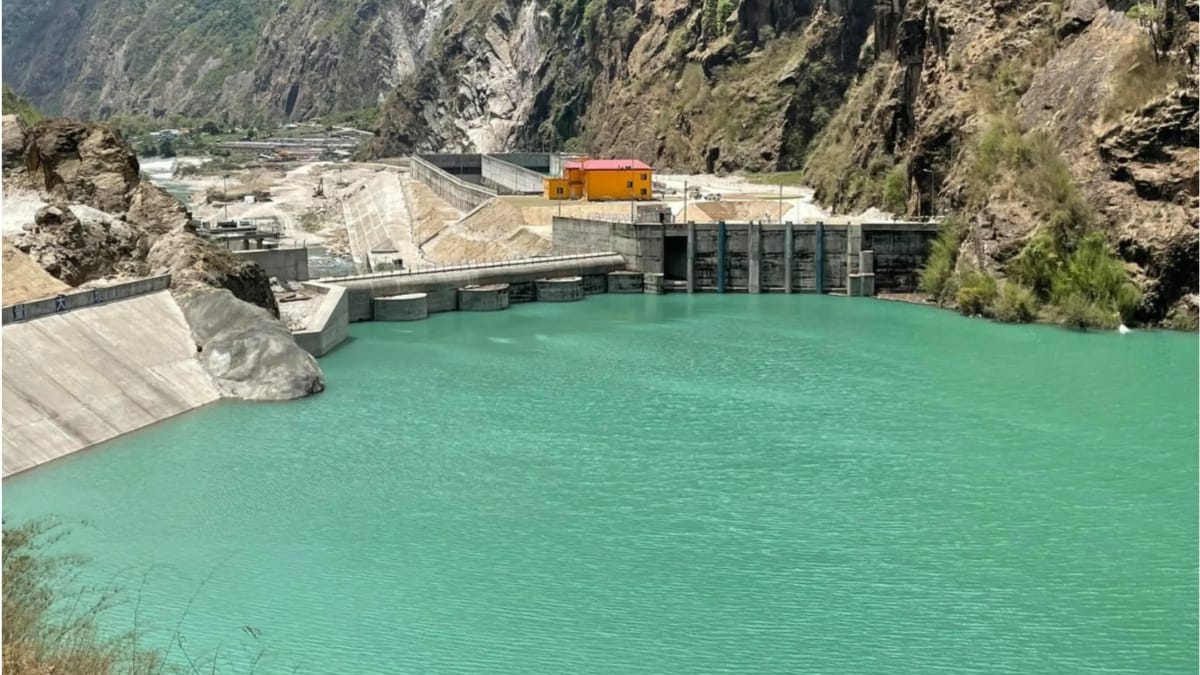
Image: Reuters/Kedar Shiwakoti
The writer is a Kathmandu-based consultant specialising in energy regulation and policy.
When Nepal unveiled its “Energy Development Roadmap 2081” last December, the number that grabbed attention was 28,500 megawatts, the installed hydropower generation capacity it hoped to reach by 2035. That would represent a ninefold rise from today’s output, and a feat for a country that only recently ended chronic power cuts. The ambition is to reposition Nepal from energy-starved backwater to renewable exporter, supplying clean electricity to a carbon-conscious region. But there is one problem: even if Nepal builds all that capacity, who will buy the power?
Domestic electricity demand is leaping but not fast enough. By official estimates, peak demand may hit 13,500 mw by 2035 (versus some 2935 mw at present). That would still leave 15,000 mw dependent on foreign markets. Power exports on that scale could be worth over $7bn a year at current rates. But such a trade assumes buyers as well pricing and infrastructure, all of which remain hazy. Without firm offtake agreements, banks will likely not finance big hydropower projects. And without capital, Nepal’s energy ambitions risk dying on the drafting table.
In recent years the sector has shown signs of life. Installed capacity crossed 3,100 mw in 2024, up from under 1,000 mw a decade ago. Once a national curse, load-shedding has ended. Private developers—lured by power purchase agreements (PPAs) with the Nepal Electricity Authority, the state-owned utility—have driven much of the growth. Climate-focused financiers have taken notice. A few marquee projects backed by Indian, Chinese and multilateral investors are in motion. But the business case is still fragile.
PPAs in Nepal guarantee long-term payments, typically with take-or-pay clauses, regardless of whether the power is used. With limited domestic demand, however, the NEA is nearing the limits of what it can underwrite without offloading supply abroad. It has already signed PPAs totalling more than 10,000 mw, many of which will possibly come online by the early 2030s. Without clear rules for selling power and guaranteed buyers abroad, the country may produce electricity it cannot use or sell.
India, by geography and grid, is Nepal’s only viable route to market. It already exports more than 1,000 mw to India, mostly during the rainy season when rivers swell and domestic demand dips. The two countries have agreed in principle on a 10,000 mw export target over the next decade. In June Nepal began selling 40 mw to Bangladesh via India’s transmission corridors—a diplomatic first.
Yet trade flows remain small and seasonal. Most power exports to India are sold on the Indian Energy Exchange (IEX), a short-term spot market with volatile prices and no guarantees. Few banks will finance multi-billion-rupee hydropower schemes on the back of spot revenues. Nor are there cross-border equivalents of long-term PPAs, which would allow developers to lock in stable cashflows. Without them, the country’s bet on becoming a regional power hub looks increasingly speculative.
India’s ambivalence deepens the trouble. Its policy rhetoric now centres on “atmanirbharta” (self-reliance), with solar, wind and, more recently, nuclear power at the forefront. India has ample renewable potential of its own, along with ambitious storage plans. Imports from Nepal may help balance seasonal supply, but they are not central to India’s energy strategy.
Uglier still is the fact that South Asia lacks a coherent regional power market. Bilateral deals dominate, shaped by politics rather than price signals. Other regions offer models. The Nordic countries grew Nord Pool, a shared electricity market, from a small Norwegian exchange into a cross-border system covering most of northern Europe. Central America’s SIEPAC system and the West African Power Pool (WAPP) also offer precedents for regionally governed markets.
In South Asia attempts at cooperation are still embryonic. The Bangladesh-Bhutan-India-Nepal (BBIN) framework offers a diplomatic shell, but little regulatory muscle. An independent regional market operator—setting rules, clearing payments, enforcing contracts—would help lessen political risk and attract private capital. But Delhi shows no urgency to build such institutions.
Nepal’s energy potential is both vast and dispatchable. Unlike solar or wind, hydropower with storage can be turned on when needed. It provides peaking power and grid stability, services that India and Bangladesh increasingly require as their renewable share rises. Yet Nepal’s current hydropower mix is heavily skewed towards run-of-river (RoR) plants, which generate most power during monsoon months and very little in winter. This creates a glut during the wet season and deficits during the dry.
To fix that imbalance, Nepal must shift towards storage-based generation, plants that can hold water and release it on demand. Such projects cost more and take longer to build, but they provide the firm, year-round capacity needed for serious export. They also lower reliance on India’s spot market by enabling predictable bilateral trade.
Nepal’s ambition, if realised, could turn it into South Asia’s largest per-capita electricity exporter. But scale cuts both ways. Without reliable demand, new plants could become stranded assets. Transmission lines may sit idle. Tariffs may need to rise to cover fixed costs, undermining the political case for hydropower development. A “build it and they will come” strategy may work for football fields, but less so for grid infrastructure.
The government’s roadmap assumes the world will value Nepal’s green electrons. That assumption needs testing. If India and Bangladesh see Nepal’s power as a core part of their own energy security, they must help build the institutions to make trade viable such as pooled markets and long-term contracts, for example. If not, Nepal must scale back and re-optimise its energy strategy. ■