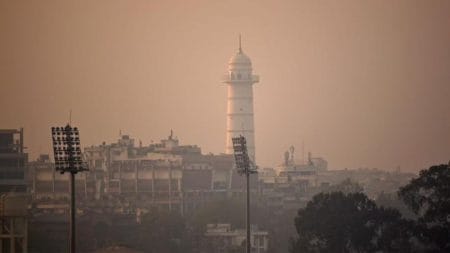
A new kind of revolt shook Kathmandu in September. It was coordinated on social media, executed with precision and directed at government buildings, the homes of political leaders and the businesses seen as tied to them. Public anger turned towards politics and the economic order that supports it. Nepal is one of Asia’s youngest countries, with a median age of 25. Yet its economic model has turned the nation into a waiting room for departure.
The frustration comes from a puzzling condition: economic growth without job creation. Nepal’s economy has been expanding at a reasonable pace. Services such as hospitality and retail account for more than 60% of output. Yet the formal job market is a fortress. About half a million young people join the workforce a year. Only one in ten finds a steady formal job at home. The remainder face a bleak choice: backbreaking subsistence farming, which employs most Nepalis but produces little, or emigration.
Money sent home by workers abroad now equals a quarter of the country’s entire economic output. These remittances act as a sedative, numbing the pain of unemployment and funding a consumption splurge. This spending, in turn, fills the state’s coffers through taxes on imports. Yet the remittance boom has caused a version of what economists call Dutch Disease, after the problems that followed a natural-gas discovery in the Netherlands. The influx of foreign currency has made the local rupee stronger than it otherwise would be, hurting exporters and making it hard for domestic manufacturers to compete with imported goods. Industry’s share of the economy has shrivelled to just 13%.
The core of the problem is a private sector that praises competition in theory but avoids it in practice. The economy is dominated by a handful of family-run conglomerates (Chaudhary Group, Golchha Group, Khetan Group, Laxmi Group and so on), known locally as business houses, with interests in banking, insurance, cars and hotels. This concentration warps the financial system. Ten to twenty large groups receive as much as 40% of all bank loans, reckons Biswo Poudel, governor of the Nepal Rastra Bank.
The ties between these groups and banks are uncomfortably close. When times are tough, banks tend to “evergreen” loans—issuing new credit to cover old interest payments—to avoid labelling them as failures. This zombie lending protects established firms but strangles the new, innovative companies that might generate employment. A promising startup finds itself begging for scraps while incumbents receive fresh loans against vast holdings of land. Business leaders lobby loudly for “growth”, which typically means state handouts and cheap credit, but shudder at the mention of “competition”.
This inward focus is baked into policy. Foreign investment is treated with ugly wariness. Rules on the minimum amount foreigners must invest change frequently, a sign that their capital is desired but their involvement is not. Even the Non-Resident Nepali community, a diaspora with money and skills, is kept at a distance, denied the economic rights offered by China or India to their overseas citizens.
Holding this unsteady structure together is a currency peg. Since the 1990s the Nepali rupee has been fixed at 1.6 to the Indian rupee. The central bank sees this as an essential anchor for stability. With India accounting for two-thirds of Nepal’s trade, the peg does guard against the runaway inflation that has afflicted other small, open economies.
Yet the peg has also become a constraint. As India’s economy becomes more efficient, thanks to huge infrastructure spending and digitalisation, Nepal’s productivity falls behind. The fixed exchange rate makes Indian imports artificially cheap, undercutting Nepali producers. Devaluing the currency would not be a real solution, however. The brutal problem lies in the mechanics of trade. Shipping a container from Kathmandu to Kolkata costs more than sending one from Kolkata to Singapore. Customs delays, poor roads and sudden new barriers from India do more harm than the exchange rate ever could. When Nepali industries do find an export niche—ginger or cardamom, say—they can be undone by abrupt changes in Indian trade policy, which Kathmandu has little power to influence.
A possible route out of this bind runs through the Himalayas. Nepal possesses enormous hydropower potential. After years of blackouts and stalled projects, the sector is finally making progress. Installed capacity has passed 3,000 megawatts. The government wants to reach 28,500 megawatts by 2035.
The goal is for Nepal to become South Asia’s green battery, exporting clean power. This year, for the first time, electricity flowed from Nepal to Bangladesh through Indian transmission lines. The initial amount was a small 40 megawatts but the symbolism was big. It pointed to a future where Nepal could trade energy as Bhutan does, using it to offset its giant trade deficit.
Even here, geopolitics intrudes. India, the logical main buyer, has built a “great electric wall” against Chinese involvement. It will not purchase power from projects with Chinese ownership or contractors. That forces Nepal into an awkward commercial segregation, reserving projects aimed at the Indian market for Indian developers while seeking Chinese investment for domestic needs. It is a balancing act needing diplomatic skill, which the political crop has seldom shown.
Domestic businesses are also battling for a piece of the action. Private firms generate much of Nepal’s electricity but are prohibited from selling it directly across the border. They must sell to the state monopoly, the Nepal Electricity Authority, which then deals with India. Companies want the right to trade power themselves, arguing they could secure better prices and move faster than a sluggish state utility. The government, wary of losing control and income, resists.
The quiet that has returned to Kathmandu is fragile. The grievances that drove young people to the streets—no jobs, cronyism and the humiliation of having to leave—continue. Official responses have involved forming committees and pledging “stability”, a word that to young ears sounds like “stagnation”. Nepal faces a choice. It can continue as a remittance-fed oligarchy, exporting its youth to import a living standard, leaving the economy fragile and shallow. Or it can find the political will to dismantle cartels, welcome foreign capital and connect with the wider world. The protesters have shown they have the means to organise and the desire for change. They seek not a political revolution but an economic one: a chance to succeed by ability, rather than connections. If the establishment will not open the door the youth may well break it down—again. ■