Image: Aris Messinis/AFP/Getty Images
A week before Americans sit down to their Thanksgiving dinners, their government has served up a foreign-policy ultimatum. On November 20th President Donald Trump demanded that Ukraine respond to a 28-point draft peace plan, largely negotiated between his envoy and a Kremlin insider, by November 27th. The holiday deadline shows America’s new approach to a war that has raged for nearly four years. The Biden-era principle that “Ukraine decides” its own future is gone: America wants the war over, and is prepared to force its ally to the table.
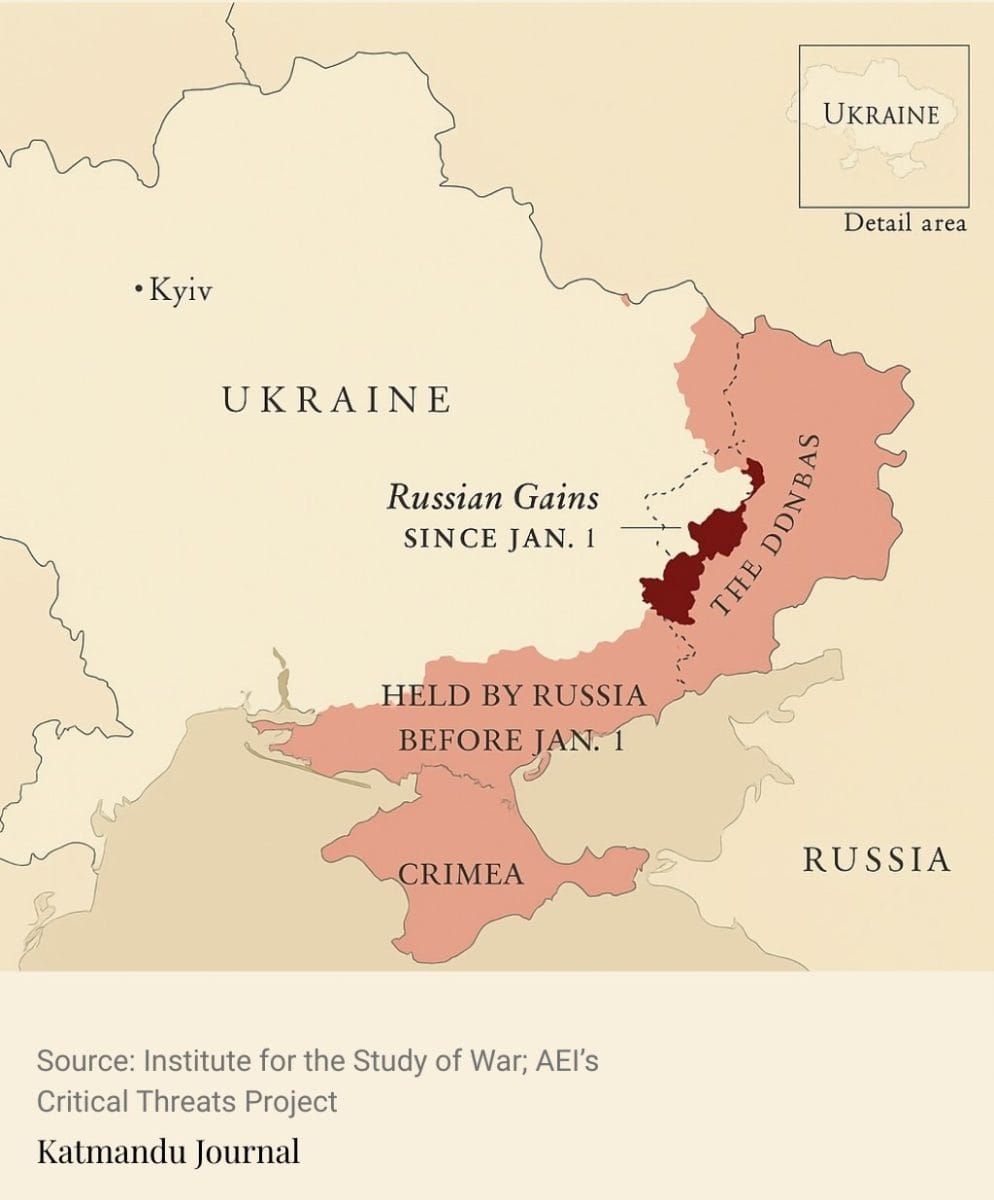
The document, delivered to a beleaguered Kyiv, was drafted by Steve Witkoff, Mr Trump’s envoy, and Kirill Dmitriev, a long-standing Kremlin fixer, bypassing not only Ukrainian officials but also America’s own State Department and European allies. It reflects a brutal convergence of interests. Russia, making its fastest territorial gains in two years, sees a chance to lock in its military advances. America, eager to end a costly conflict, wants a headline-grabbing deal. Ukraine, the country doing the fighting, finds itself with dwindling leverage and a gun to its head.
The plan’s demands are severe. Ukraine would be required to recognise Russian control over occupied parts of the Donetsk and Luhansk regions, including territory it still holds. Its army would withdraw from key eastern cities, which would become demilitarised zones, and accept a cap on its troop numbers, shrinking its military by about a quarter. The country would amend its constitution to enshrine permanent neutrality, forswearing NATO membership and foreign bases. Perhaps most painfully, it would have to hold new national elections within 100 days of signing—a clause tantamount to political suicide for any Ukrainian leader who agrees to such terms.
In return, the plan provides Ukraine a security guarantee from America, a thinner version of the NATO alliance’s mutual-defence clause (it says that an attack on one member is an attack on all) that lacks detailed enforcement mechanisms. The rewards, by contrast, are huge for Russia. Moscow would see sanctions lifted, be welcomed back into the G8 and the global economy, and gain access to a portion of the hundreds of billions in frozen Russian assets for reconstruction projects, some of which would be steered towards American and joint US-Russian ventures. Russia faces no equivalent military restrictions and is not required to reverse its earlier land grabs. The deal resembles the Minsk accords of 2014-15 (ceasefire deals that locked in Russian-held territory), but with terms even more favourable to the Kremlin.
Why would Ukraine countenance such a deal? Its position is deteriorating rapidly. A severe shortage of infantry has allowed Russian forces to press forward along the front. A massive corruption scandal at Energoatom, the state nuclear-energy company, has implicated ministers and members of Mr Zelensky’s own team, crippling his domestic standing. With winter setting in, the country’s battered energy grid is under strain. Public opinion has shifted dramatically: support for a negotiated settlement has surged from 10% in 2022 to around 74% today, according to the Kyiv International Institute of Sociology.
Europe, Ukraine’s other main backer, has been blindsided and sidelined. Leaders in France, Germany and Britain were excluded from the drafting and are furious at being relegated to what one diplomat called “chequebook status”. The European Union has yet to agree on how to use the €235bn ($255bn) in frozen Russian central-bank assets it holds, and the American plan lays claim to a share of them. President Volodymyr Zelensky immediately convened a call with European leaders, seeking to build a counterweight to American pressure. But European divisions and bureaucratic sloth mean that, for now, Kyiv faces Washington and Moscow alone.
Mr Zelensky is trapped. He cannot accept the current deal without sacrificing his legitimacy, his parliamentary majority and probably his presidency. Yet he cannot reject it outright without risking a total cutoff of American intelligence support, the last crucial form of US aid after military assistance was throttled earlier this year. His response has been to call the document a “vision” rather than a binding plan and to promise Ukrainian counter-proposals. Even his advisers, however, admit the draft is “unworkable—at least for now”.
Washington is turning a grinding war of attrition into a high-stakes negotiation. Russia’s leverage is growing as its forces advance; America’s is growing as it threatens to withdraw support; Europe’s is hamstrung by indecision. Ukraine’s weakens with every kilometre of territory lost. The Thanksgiving ultimatum is the clearest sign yet that the war is entering its endgame, one where the country that did the fighting may have the least say in the peace. ■