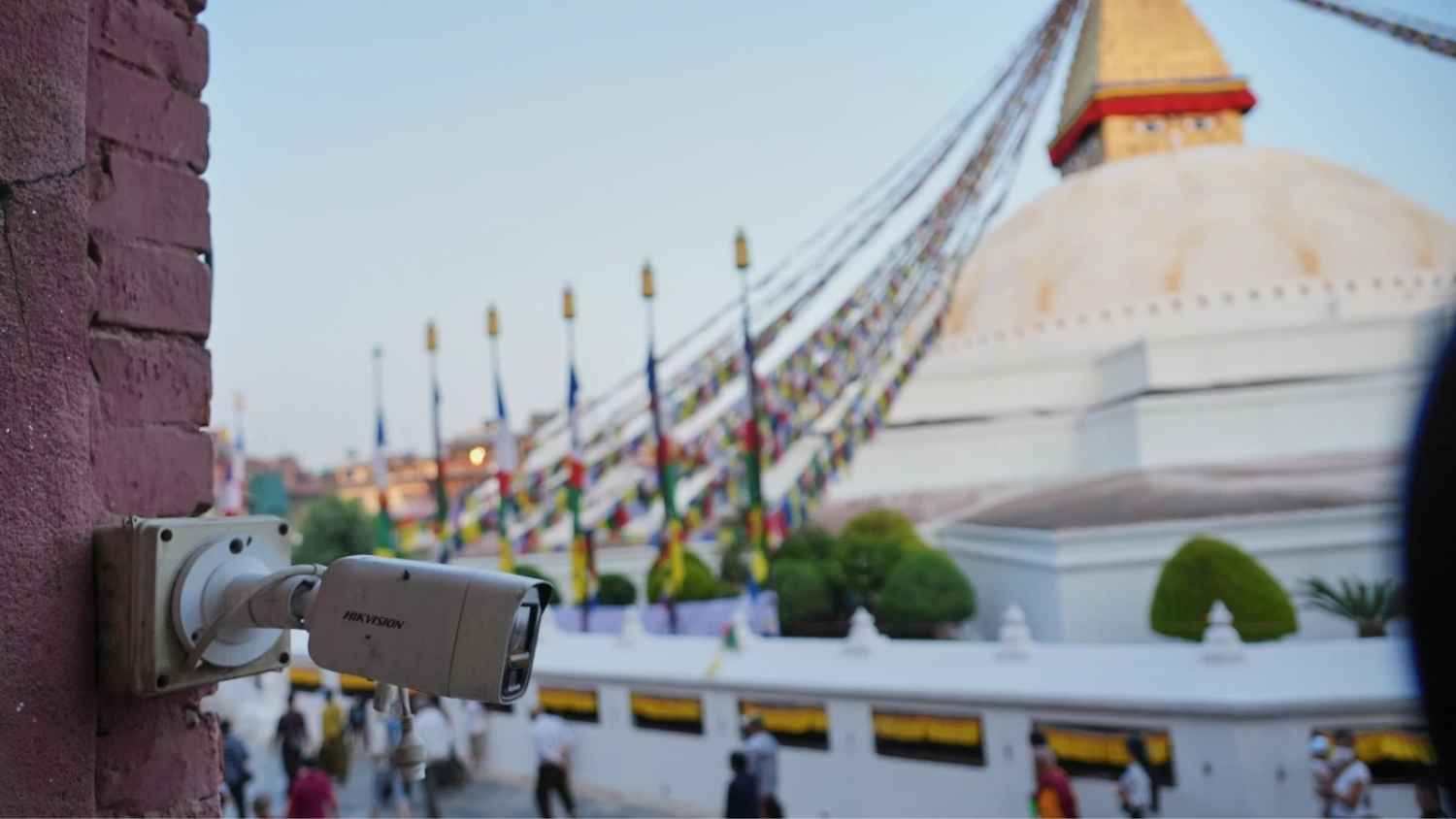
Image: AP Photo/Dake Kang
On a winter morning in Kathmandu, the streets around Boudhanath stupa begin to stir before the sun has climbed above the hazy ring of hills. Monks in burgundy robes circle the shrine, turning prayer wheels that click softly in the chill air. Traders lift shutters and incense curls upward. Pigeons scatter in short bursts across the courtyard. From a distance the scene looks timeless. Up close, it carries a modern alteration: small high-definition cameras hang from poles and rickety shopfronts. Lenses watch the square from every angle.
Local officials say these black-domed installations are for crime prevention and urban modernisation. To many Tibetans who live and worship here, they mean something different. A woman who arrived in Nepal as a child in the 1990s points to one of the cameras and shrugs. She has grown used to its presence, she says, but she chooses her movements carefully around politically sensitive dates. A friend once warned her that police had begun asking questions about people who gathered too frequently near a particular monastery. The friend did not say how the police knew. Everyone had a guess.
Tibetans, who came to Nepal seeking distance from Chinese state control, now are living inside a policing perimeter influenced heavily by China’s anxieties across the border.
To understand why the presence of cameras in Nepal matters so much to Beijing, it helps to remember how Tibetans came to be here in the first place. Tibet, a high plateau kingdom with its own political and religious institutions, was drawn into the orbit of the People’s Republic of China soon after Mao Zedong’s communists took power in 1949. In 1951 Tibetan representatives were pressed into signing what became known as the Seventeen Point Agreement. The document affirmed Chinese sovereignty and pledged reforms while promising to preserve the authority of the Dalai Lama, Tibet’s spiritual and temporal leader.
Promises did not hold. As Beijing extended control over land as well as monasteries and administration, discontent hardened. In 1959 an uprising erupted in Lhasa, Tibet’s capital. The Chinese People’s Liberation Army crushed the revolt. The Dalai Lama fled south across the Himalayas, slipping into India through mountain passes that served as trade and pilgrimage routes. Tens of thousands followed him over the coming years. Many crossed through Nepal, resting in Kathmandu’s valleys before continuing to India, where a government-in-exile eventually took root in Dharamshala. Others stayed, building new communities in camps around Kathmandu and Pokhara, and in neighbourhoods that turned into small worlds of language and ritual.
Beijing dismantled Tibet’s monasteries and imposed strict control over religious practice. It treated displays of loyalty to the Dalai Lama as subversion. Over time restrictions spread across everyday life: travel permits, surveillance of communication, scrutiny of villagers who received visits from relatives abroad and so on. Tibetan identity remained allowed only within boundaries written by the party-state.
Inside Tibet those boundaries have tightened further under China’s leader Xi Jinping. Researchers and diplomats who visit the region describe dense networks of policing. Streets lined with paramilitary patrols. Checkpoints, checkpoints again and more layers of digital monitoring. Possession of a Dalai Lama photograph or a banned song can still bring punishment. Human Rights Watch and other groups have documented the spread of predictive policing tools used to flag people considered a risk before they have said anything aloud. Tibetans, especially those with links across borders, tend to draw heightened attention.
Security in Tibet is not only about Tibet. For China’s leaders it touches the same nerve as Taiwan (a separatist island which it calls as its own) or the memory of the Tiananmen protests: sovereignty and control. Any protest or exodus that creates international visibility for Tibetan grievances becomes a threat by implication. Which is why Nepal matters so acutely. The country shares a long, mountainous frontier with China’s Tibet Autonomous Region. The border is rugged and in places impossible to police fully, even with modern equipment. For decades it served as an escape line, small in scale but symbolically charged. Each family that reached Kathmandu’s monasteries or Indian refugee settlements represented a story of dissent that could travel into the wider world.
In the decades after 1959 Nepal acted as a corridor as well as sanctuary. Refugee camps emerged with the support of international agencies. Boudhanath’s monasteries thrived as centres of religious and cultural life in exile. Demonstrations, especially around anniversaries of the 1959 uprising or the Dalai Lama’s birthday, drew crowds and sometimes placards. Nepali governments were cautious but generally tolerant. They allowed transit to India under what diplomats called the “Gentleman’s Agreement”: a loosely understood pathway that permitted new arrivals to pass through without formal refugee recognition.
That equilibrium has corroded as China’s presence in Nepal has deepened. Beijing has provided loans and aid; financed roads and hydropower dams; and expanded security cooperation. Chinese delegations visit Kathmandu with a regularity once associated only with India. Nepali leaders in turn reaffirm their commitment to the “One China” policy at every opportunity. For Beijing the phrase means more than recognition that Tibet is part of China. It signals a promise to suppress “anti-China activities”, a capacious label that can include cultural gatherings or criticism voiced in public.
Officials in Kathmandu face cross-pressures. American and European diplomats stress human rights and refugee protection. China on the other hand stresses security and sovereignty, and couples those with money and political attention that are hard for a small, aid-dependent country to ignore. Nepal lacks a comprehensive refugee law. Successive governments have chosen to manage Tibetans case by case, generally leaning towards the priorities of the neighbour with the bigger chequebook.
The growth of surveillance technology is one expression of that tilt. The first wave of cameras in Kathmandu arrived around 2012, marketed as tools to cut down crime and improve traffic management. Their expansion coincided with a series of protests by Tibetans against Chinese rule, including one self-immolation in 2013 that embarrassed the Nepali government and infuriated Chinese diplomats. Shortly thereafter, the installation accelerated with a singular focus on the neighbourhoods where Tibetans live, work and pray.
Chinese firms such as Hikvision, Dahua and Uniview—which have become synonymous with the surveillance of ethnic minorities in Xinjiang—won a large share of the supply contracts. Local officials described the equipment as smart-city upgrades and modern policing. The specifications told a fuller story. Many of the systems provided facial recognition and night-vision capability. They can also follow a person’s movements across footage from several cameras.
Nepali police officers have received training from Chinese counterparts and have taken part in joint exercises described as efforts against cross-border crime. A senior officer in Kathmandu says the new command centres allow the force to respond faster to incidents. He adds, with practiced understatement, that they also “reduce the opportunity for unwanted activities”. Tibetan community leaders understand the phrase. Around the anniversaries that matter most to them, arrests tend to take place before gatherings begin. Men and women whom the authorities see as organisers receive warning calls or find officers waiting near their homes at dawn.
At the border, cooperation has advanced further. Drones, sensors and new observation posts dot sections of the Himalayan frontier that were once traversed only by yak herders and traders. Journalists who have travelled in the high valleys describe fenced perimeters and watchtowers where there were none a decade ago. Nepali security forces conduct joint patrols with Chinese units in sensitive areas and share intelligence through liaison channels created under bilateral security agreements. The result is a landscape where flight has become harder, and more frightening, long before a traveller reaches a checkpoint.
Technology has extended that reach much further than physical barriers. Chinese surveillance platforms increasingly depend on cloud computing and data storage that give security agencies a near-instant view across multiple locations. Analysts who track the industry point out that the roots of this ecosystem stretch back to an uncomfortable past: joint ventures with Western firms, forced technology transfer and, in some cases, confirmed theft of intellectual property. Today the hardware and software are overwhelmingly Chinese, but the infrastructure is enmeshed with global suppliers. Companies such as Hikvision and Dahua have used major cloud providers to host services abroad, exploiting loopholes even as they face sanctions in parts of the West.
For poorer states, the allure is obvious. The packages on offer are cheap relative to Western equivalents, tough enough for harsh conditions and come ready to use for policing. A cabinet minister in Kathmandu praises them for giving Nepal “eyes where there were none”. What he does not say is that the systems also bake in the assumptions of the security model from which they originate: prevention before protest, control before consent. Human rights safeguards rarely feature prominently in the sales brochures.
Life for Tibetans in Nepal has changed under this new dispensation. New arrivals are almost never granted refugee status. Children born in the country tend to remain undocumented, unable to open bank accounts or travel freely. Activists say they have been advised to keep a low profile. The prospect of pre-emptive detention has hollowed out public protest. On politically sensitive dates, police vans idle outside monasteries. Some residents choose to remain indoors. Others avoid congregating in groups that might attract unwanted attention from cameras that never sleep.
Consider one case, for example. A former student leader in Kathmandu recounts how his phone began ringing each year in early March, the anniversary of the 1959 uprising. Officers would ask where he intended to be that day. He never tested the boundaries. After his first child was born, he became even more cautious. Without papers, the child could not access formal schooling. The family now lives in Europe. Many friends have left too. Community organisations estimate that Nepal’s Tibetan population, once above 20,000, has fallen by perhaps half. People slipped away quietly.
In remote border districts, the effect has been more intimate still. Herders accustomed to crossing into Tibetan pastures for seasonal grazing describe barriers and patrols that cut across old routes. Religious rituals once performed near frontier shrines have thinned out. Local officials, wary of angering Beijing, discourage displays of images of the Dalai Lama in public settings. A village elder from northern Nepal explains the change like this: “We watch the mountains, and the mountains watch us back.”
To Beijing, the tightening of surveillance in Nepal forms part of a bigger strategy under Mr Xi. Since he came to power, China has poured resources into what officials call “comprehensive social management”: a fusion of policing, data analysis and community monitoring intended to remove uncertainty from governance. The philosophy privileges anticipation over reaction. It treats dissent as a risk to be engineered away. Exporting the tools that support this approach serves several goals. It secures China’s periphery and reduces the chances of embarrassing refugee flows. What is more, it binds neighbouring elites into habits of cooperation with Chinese security services.
Nepal’s leaders would resist any suggestion that they are acting as proxies. They speak instead of order and the legitimate duty to prevent their territory being used for political agitation. There is truth in that. No government, especially one sandwiched between two giant neighbours, enjoys the prospect of protests that could complicate its foreign relations. Yet the choices taken in Kathmandu have consequences that reach much further than diplomacy. They decide whether a small, stateless community can practise its faith and culture without fear, and whether a country known for hospitality wishes to be seen as an extension of the border regime to its north.
As Nepal weighs its place among the world’s rising powers, its streets provide a glimpse of how influence travels today: sometimes through grand infrastructure projects, sometimes through chequebooks and handshakes, and sometimes through a lens that captures a face in the crowd, records it and files it away for later. ■