IMAGE VIA FACEBOOK
IN DECEMBER 2024 K.P. Sharma Oli, Nepal’s former prime minister, flew to Beijing and signed what his government called a landmark framework for Belt and Road co-operation with China. The Trans-Himalayan Multi-Dimensional Connectivity Network (a name that strains under its own ambition) was invoked as a vision for the ages. Then Mr Oli flew home and nothing was built.
Since Nepal signed the Belt and Road memorandum in May 2017, not a single kilometre of railway has been laid, nor a metre of tunnel dug. No project formally labelled under the Belt and Road Initiative—Xi Jinping’s flagship foreign-policy programme promising vast infrastructure investment across Eurasia and Africa—has been completed in Nepal in eight years.
Nepal’s accession to the BRI emerged from a specific wound. The 2015 Gorkha earthquake killed nearly 9,000 people. More immediately galvanising was the 2015-16 economic blockade—five months in which fuel and goods supplies dried up along Nepal’s Indian border, a disruption Kathmandu attributed to New Delhi even as India described it as a spontaneous truckers’ strike.
Whatever its actual origin, the blockade crystallised a political consensus: Nepal’s dependence on Indian routes was a structural liability requiring correction. China, with its vast infrastructure ambitions and conspicuous absence of conditions, offered a narrative. Nepal bought the narrative. That is rather different from buying the infrastructure.
The centrepiece of that narrative is the proposed Kerung-Kathmandu railway, personally championed by Xi Jinping during his October 2019 state visit to Kathmandu—the first by a Chinese head of state in 23 years. The engineering proposition is staggering: the alignment would descend from over 4,000 metres on the Tibetan side to Kathmandu’s 1,400-metre floor, through seismically active terrain that the 2015 earthquake proved is not inclined toward human infrastructure.
Pre-feasibility estimates suggest $2-3bn or more. A new feasibility study, funded by a Chinese grant of roughly $15m, is underway with officials citing 2030 as a target opening date. Engineers who work on Himalayan terrain regard this timeline with the scepticism of people who know what permafrost and active fault lines do to project schedules.
The railway endures because it is not, at its core, an infrastructure project. It is a geopolitical signal—a symbol of ambition that both sides need to exist even if neither side particularly needs it to be built. Around it, ten projects sit in the December 2024 framework: roads, tunnels, transmission lines, an industrial park, a university, urban facilities. The list has traced an arc of declining ambition—35 projects proposed in 2018, nine by 2019, ten today—and this slimmed portfolio is entirely unbuilt.
Three urban projects—a city hall, a sports complex and a scientific centre—have gone no further than concept notes. Yet their locations align strikingly with the home districts of Nepal’s senior political figures. That alignment is unlikely to be accidental. Nor has anything been built.
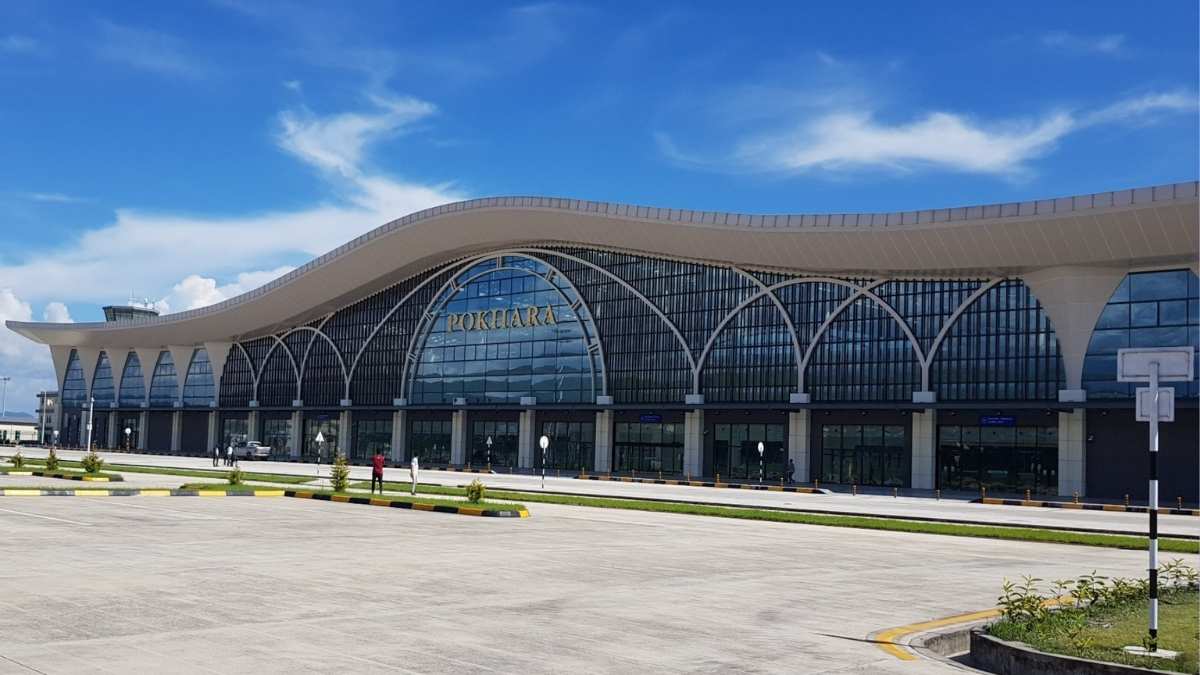
The fault line in every negotiation is financing. Nepal insists on grants or concessional loans no costlier than what the World Bank offers at 0.25-0.75%. China’s Export-Import Bank lent money for the Pokhara International Airport at 2% over 20 years—and that airport, opened in January 2023, has become the cautionary exhibit Nepali politicians invoke whenever Chinese loan terms arise. International airlines have largely avoided it; narrow-body load capacity caps at 80-85 passengers, well below commercial viability. Scheduled international services have been almost entirely absent. Nepal asked China to convert the $215.96m loan to a grant. Beijing declined. Nepal’s anti-corruption commission filed a chargesheet against 55 individuals and China CAMC Engineering, the builder, last year. The Pokhara episode has done more to entrench domestic resistance to Chinese lending than any economist’s spreadsheet could have managed.
Placed beside its peers, Nepal’s record looks peculiar but not unflattering. Sri Lanka handed China a 99-year lease on Hambantota Port after loans at above 6% proved unserviceable. Laos built an operational railway but now carries public debt exceeding 100% of GDP. Nepal has completed zero projects and accumulated no substantial BRI debt.
BRI’s greatest practical contribution to Nepal may be its existence rather than its execution. Nepal conducts more than 60% of its bilateral trade with India, its rupee is pegged to India’s, and virtually all third-country commerce transits Indian ports. The credible threat of Chinese connectivity has given Kathmandu negotiating capital with New Delhi it would not otherwise possess—extracting Indian grants for roads, accelerating the Raxaul-Kathmandu rail link, loosening terms.
A country that ranked 145th on the UN Human Development Index in 2025 and funds its current account through its citizens’ labour abroad has played a weak hand with considerable dexterity. At some point, though, middle paths require someone to actually lay the road. ■