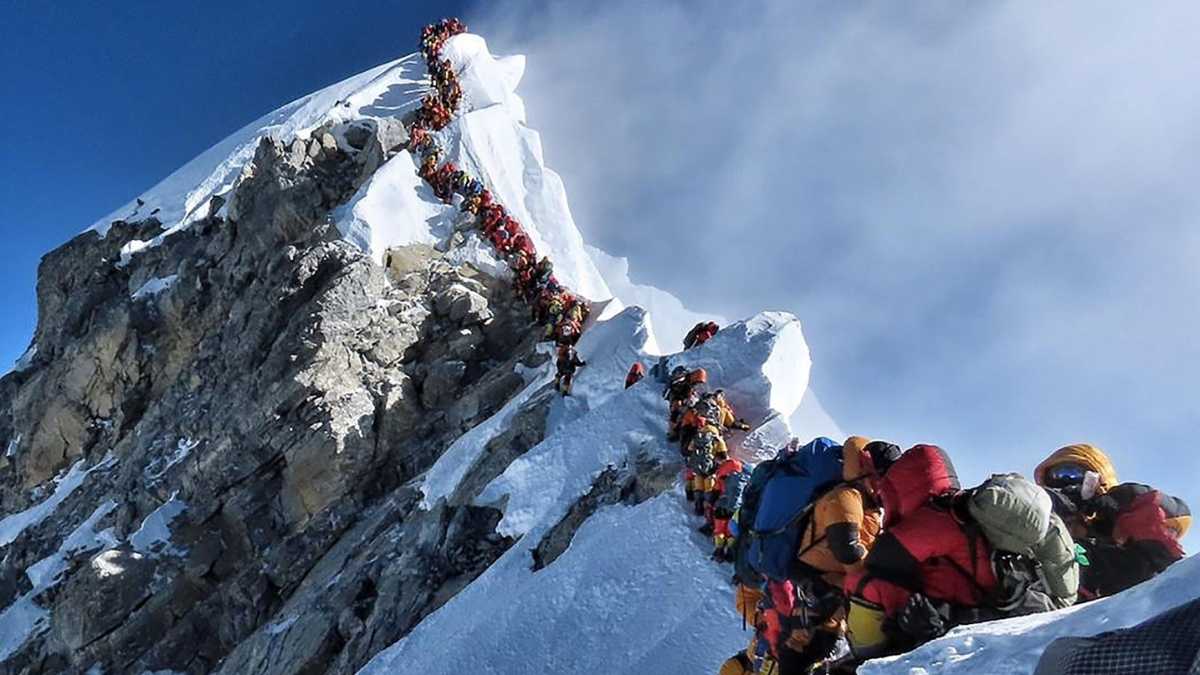
IMAGE: AFP PHOTO/PROJECT POSSIBLE
IMAGINE a queue at 8,000 metres. The temperature is forty degrees below zero. The air holds a third of the oxygen at sea level. You have paid $50,000 or more for this privilege. Ahead of you, a hundred other climbers wait to step on the world’s highest patch of snow. Behind you, more are coming. This is no nightmare. It is the spring season on Mount Everest.
Nepal has just issued 492 climbing permits for 2026, a record, surpassing the previous high of 478 in 2023. Add one Sherpa per foreign client, and nearly a thousand people will head for the summit in the coming weeks. The proximate cause is practical: China has closed the Tibetan (north) side for the 2026 spring season, funnelling all commercial traffic through Nepal’s South Col route. But the bigger story is one of a mountain transforming into tourist infrastructure. The question is: can that infrastructure survive its own success?
Everest is a revenue engine, and a formidable one. Already a new permit fee of $15,000 (up from $11,000) has already brought in $7.1m. Climbing royalties across all peaks top $8.3m. Tourism contributes nearly 7% of Nepal’s GDP. For a poor country, these numbers matter.
Yet the economics hides a bitter trade-off. A handful of budget operators offer cut‑price climbs for around $30,000, though the industry standard for a fully guided south‑side expedition starts closer to $45,000. Cutting costs means leaner guide ratios and fewer weather forecasts, as well as thinner insurance.
The upshot is a two‑tier system where the cheapest expeditions also tend to produce the most deaths. Sherpas, who do the heaviest labour and face the highest risks, earn a fraction of what Western guides take home. The mountain’s wealth flows upward; its dangers flow downward.
The crowding is no media exaggeration. In 2019 a photograph of a human chain stretching towards the summit went viral. Eleven people died that season; several deaths were linked to the queue. This year a massive serac collapsed in the Khumbu Icefall, delaying the season by a few weeks and compressing the weather window. When the window opens, hundreds will push for the top on the same few days. Waiting in the death zone depletes oxygen and invites frostbite. Every extra climber raises the odds for everyone.
Nepal’s government has responded with paper reforms. A new regulation requires one guide for every two climbers. A proposed tourism bill would require Everest hopefuls to first summit a Nepali peak above 7,000 metres but this law has not yet taken effect. Single‑use plastics are banned. A waste deposit of $4,000 is now non‑refundable, paid into an environmental fund rather than returned. On paper this looks like progress. On the mountain, enforcement remains patchy.
No permanent regulator sits at Base Camp, though Nepal’s Department of Tourism has issued active warnings. Compliance often depends on self‑reporting by the same operators who profit from cutting corners. Bribery remains a recurring obstacle. The result is a semi‑privatised governance system: the state collects fees; and the expedition companies manage safety, traffic and waste. It works splendidly until it does not. And it does not with increasing frequency.
The environmental strain is evident to anyone who looks. The Khumbu Glacier is retreating; some reports have suggested the South Col Glacier has thinned, but this is scientifically disputed: a 2023 study in The Cryosphere found no significant thinning between 1984 and 2017. What is not disputed: veteran Sherpas report streams running through the icefall where none existed a decade ago. Melting glaciers release decades of buried garbage such as discarded oxygen bottles, abandoned tents, human waste. In 2024 alone, clean-up crews removed 85 tonnes of rubbish from Everest and its neighbours. New poo‑bags and clean‑mountain strategies address symptoms: but the cause is mass human presence at extreme altitude. Climate change will only worsen the instability.
All this raises an ugly possibility: that the very democratisation of Everest is consuming its reason for being. The peak was once the domain of elite alpinists. Today a person of average fitness with sufficient money can join a fully guided expedition. The vast majority of climbers use supplemental oxygen. Social media has turned the summit selfie into a status asset. The extreme‑tourism market, valued at roughly $30bn in 2024, is projected to nearly triple by 2034.
Everest rides that wave. But as the mountain becomes more accessible, it ceases to function as the extreme frontier that drew climbers in the first place. The queue at 8,000 metres is the logical endpoint of a business model that maximises volume rather than experience.
Three scenarios loom. In the first, Nepal swallows a bitter pill: it caps permits at a scientifically determined carrying capacity, enforces its own rules and accepts lower short‑term revenue for long‑term survival. In the second, the current trend continues: record permits, routine fatalities, a catastrophic season that finally destroys the brand. In the third, demand fragments towards other peaks, leaving Everest as a luxury product for those who can pay for solitude. The third is the most plausible but only after a crisis.
Here is the truth the industry would rather avoid. Everest will survive. The mountain is 60m years old; a few thousand climbers will barely scratch its flanks. What will die, if nothing changes, is the fragile human and natural system that makes the peak meaningful: from the Sherpa communities and the ecosystems to the sense of genuine risk and reward. The record permits are a warning and not a celebration. Nepal can keep selling tickets to the world’s highest queue. Or it can remember that a mountain loved to death is no mountain at all. It is just a very expensive traffic jam. ■