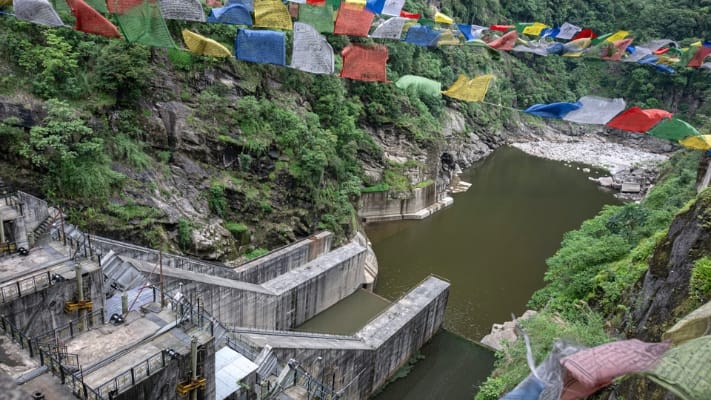
IMAGE: SAUMYA KHANDELWAL/WSJ
FROM THE sky, Nepal’s case for hydropower looks overwhelming. Six thousand rivers or so descend from the Himalayas, carrying snowmelt and monsoon water through some of the steepest terrain on earth. Engineers estimate that this geography could, in theory, generate 83,000 megawatts of electricity—enough to satisfy the energy needs of most of South Asia several times over. Nepal has harnessed some 4.2% of it. The biggest obstacle is not a shortage of money or engineering expertise. It is a political one, and the politics run all the way from Kathmandu to New Delhi to Beijing and, increasingly, to Dhaka.
In 2024 Nepal became a net electricity exporter for the first time. It currently generates over 3,500 megawatts, with significantly more capacity coming online as new projects are commissioned. The government hopes to generate 24,500 megawatts by 2036, a massive surge that would require tens of billions in investment and would produce far more power than Nepal could consume domestically. The plan only makes economic sense if the surplus can be sold abroad, which means selling it primarily to India, the only country that shares a border with Nepal’s power grid.
India, to its credit, has said yes—in principle. In January 2024 Nepal and India signed a long-term power trade agreement under which India committed to work towards importing 10,000 megawatts from Nepal over a decade. The announcement was made with much fanfare and has since been the centrepiece of Nepal’s hydropower export narrative.
Furthermore, in May Nepal’s Supreme Court cleared the final domestic hurdle by ruling that the deal did not require a parliamentary majority to be valid, opening a clean path for execution. But the text of the framework agreement uses the phrase “shall strive to increase” rather than “shall purchase”—and the difference between striving and buying is, in practice, the difference between a diplomatic gesture and an energy contract. Actual power purchase agreements, which are what investors need to finance new projects, are negotiated separately and slowly.
The financing challenge this creates is considerable. A hydropower project developer in Nepal can secure debt only if it has a confirmed buyer for its electricity. A confirmed buyer means a power purchase agreement with an Indian off-taker. An Indian off-taker needs approval from India’s Central Electricity Authority. That approval process is slow, subject to regulatory revision and, since 2018, subject to an additional constraint that has become the central geopolitical fault line in Nepal’s energy sector: India’s cross-border electricity trade guidelines explicitly restrict imports from projects that involve third-country investment. In practice this means Chinese investment.
A dam built with Chinese money, by a Chinese contractor, with Chinese equity—India will not buy the power it generates. This rule does not appear in the 10,000-megawatt framework agreement. It applies to every individual project underneath it. Even so, India has scale-flipped its individual approvals over the last two years, expanding Nepal’s cumulative aggregate export approval to over 1,100 megawatts.
China is Nepal’s second-largest development partner and one of its most active investors in infrastructure and energy. Several of Nepal’s existing and under-construction hydropower projects have Chinese involvement, either as contractors, equity holders or lenders. The Upper Tamakoshi project, one of Nepal’s largest, was built with Chinese company involvement. These projects generate real electricity that Nepal can use domestically or sell in the wet season. They cannot be sold to India under current rules. Former Water Resources Secretary Dwarika Nath Dhungel put the bind plainly: “Geopolitical tensions mean we cannot export much electricity.”
Bangladesh has emerged as a second potential export market, partly for this reason. Under a tripartite power sales agreement finalised in 2024, Nepal began a highly symbolic, seasonal export of 40 megawatts to Bangladesh, which runs annually during the wet season from June to November.
The catch is geography: any electricity Nepal sells to Bangladesh must travel across Indian territory, using the Indian grid as a transit route. India controls that transit. While long-term ambitions exist to scale this trade to 500 megawatts or more via dedicated projects like Sunkoshi-3, India tightly monitors transmission availability. Recently, according to media reports, New Delhi blocked an immediate bid to expand the corridor’s flow by an extra 20 megawatts. In other words Nepal cannot reach Bangladesh, or any market beyond India, without India’s blessing on every trade.
Bhutan, Nepal’s eastern Himalayan neighbour with similar river systems and a smaller population, has navigated this terrain considerably better. It has developed some 8% of its hydropower potential, generates more than twenty times Nepal’s per capita electricity and has sold power to India under long-term bilateral agreements that have been stable for decades. The difference is that Bhutan has a simpler geopolitical position: it has no relationship with China worth protecting, and India has had no reason to complicate its energy trade.
Nepal’s position is more crowded. It has Chinese investment it needs, Indian markets it needs and an open border with India through which millions of its citizens earn their livelihoods. Offending either neighbour by appearing to favour the other in the energy sector carries costs that go far beyond electricity prices.
The upshot is a sector with extraordinary physical assets and a financing model that cannot fully work until the geopolitics around it are resolved; or until Nepal finds a way to grow its domestic demand fast enough that the question of who buys the surplus becomes less existential than it currently is. The rivers keep flowing regardless. The question is who they ultimately serve. ■