IMAGE: KHABARHUB
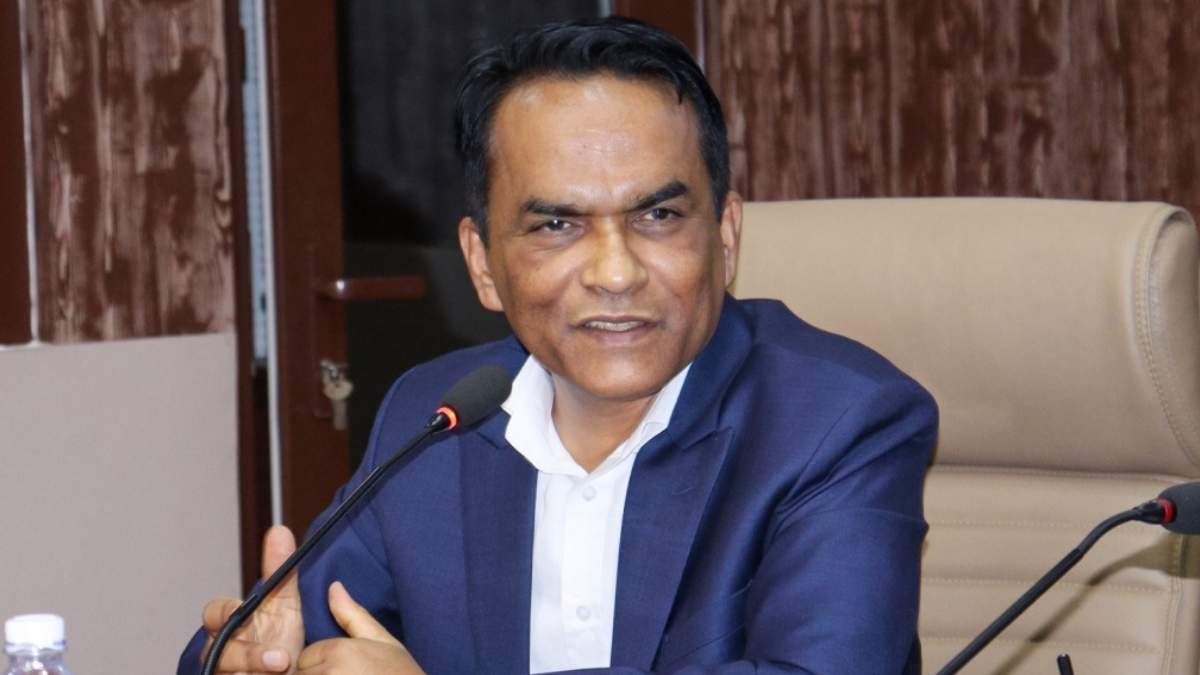
NEPAL’S CENTRAL bank published its monetary policy for fiscal year 2026-27 on July 7th. Governor Biswo Nath Poudel kept all three key rates unchanged: the policy rate, the standing deposit facility rate and the bank rate stay where they were. The cash reserve ratio and statutory liquidity ratio—the buffers banks must hold against deposits—were left alone too. After a year in which the NRB cut its policy rate by 75 basis points to try to move credit into the economy, the bank has decided it has done enough for now.
The inflation number deserves attention. The average consumer price inflation over the ten months of the outgoing fiscal year came in at 2.66%, comfortably low. But the point-to-point reading for Baisakh, which falls in April and May, hit 5.04%.
That jump, which the NRB attributes to supply-side pressures on petroleum products and food, is what is driving the bank’s more cautious tone. The policy projects inflation at 5.5% for the coming year, with the pressure expected to ease from the fourth quarter onwards.
Whether that easing materialises depends almost entirely on what happens to global oil prices and food supply chains—neither of which the NRB controls.
The bank’s description of its overall stance is “cautiously accommodative”, a phrase used in last year’s policy and carried forward unchanged. The logic is the same: foreign exchange reserves remain comfortable, inflation is expected to come down and the private sector needs support.
The NRB wants to maintain what it calls a “low-cost economy”—meaning cheap credit—to keep private sector morale from deteriorating further. The caveat, spelled out in the forward guidance section, is explicit: if inflation keeps rising, or if the low-cost environment fails to produce the public and private investment the economy needs, the interest rate corridor will be gradually narrowed. That is the bank signalling it has not ruled out tightening, without committing to it.
On the government’s 7% growth target for the coming year, the NRB is polite but not credulous. It says the target “appears ambitious based on historical trends” but adds that if the government’s economic reform programmes improve the private investment climate, if capital spending actually reaches the ground, and if external conditions are favourable, it “could be achieved”.
That is a sentence with three conditional clauses: which in central bank language means the bank thinks the target is probably not achievable under current conditions.
One welcome new measure is this: commercial banks will be encouraged to invest in foreign government securities as a way of managing the liquidity that keeps arriving from remittances, and the NRB will conduct what it calls “sterilised intervention” through foreign currency swaps—buying hard currency from banks to prevent excess rupee liquidity from distorting domestic markets.
This is a technical but meaningful step. It acknowledges that Nepal’s foreign exchange reserves, now some $24bn, are accumulating faster than the domestic economy can absorb, and that the resulting liquidity needs active management rather than passive accumulation.
Meanwhile the bank says overall financial stability indicators are “satisfactory” and then immediately adds that some institutions show rising bad loans and capital pressure requiring “close monitoring”. That formulation—satisfactory overall, close monitoring required for some—is the NRB’s way of acknowledging that its own May 2026 loan portfolio review, which found average non-performing loans in the ten largest banks running at 7.6% against a publicly reported 5.6%, is not a problem it can describe as resolved.
Three further reform intentions are flagged without timelines: a personal credit scoring system for peer-to-peer lending is to be studied; directives on lending, interest rates and consumer protection are to be simplified and consolidated in a first phase; and the classification of banks and financial institutions is under review, with regulatory implications to follow.
These are reasonable ambitions. The NRB’s record on completing studies and implementing reforms within the fiscal year they are announced in is, historically, lamentable.
What the 2026-27 monetary policy does not do is change the fundamental tension at the centre of Nepal’s macroeconomic situation. The government wants 7% growth and has a large borrowing programme to fund. The central bank wants to support growth while keeping inflation at 5.5% and watching a banking system whose disclosed bad loans are almost certainly understated. The rates are unchanged. The stance is cautiously the same. The pressure is building on both fronts. ■