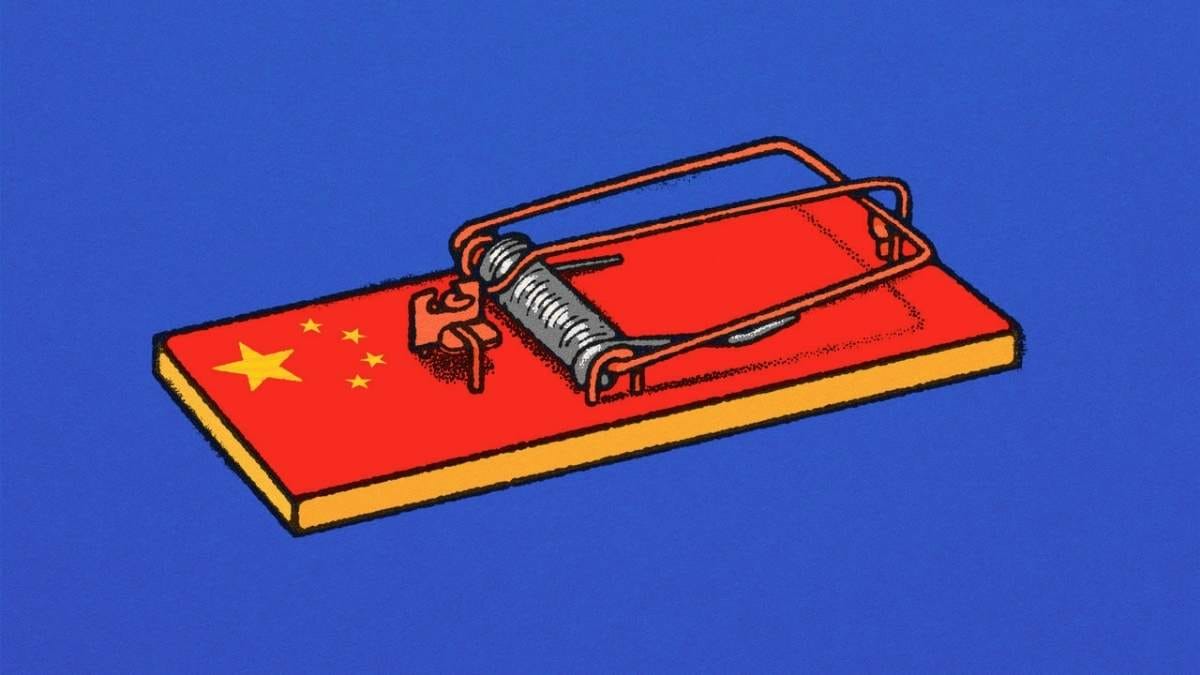
ILLUSTRATION: ALBERTO MIRANDA
NEPAL AND CHINA signed a memorandum of understanding on cooperation under the Belt and Road Initiative in 2017. Nine years later, no new project has been implemented in Nepal under the BRI.
Beijing has conducted pre-feasibility studies as well as aerial surveys and soil-testing on a handful of promising corridors. The Kerung-Kathmandu Railway remains the flagship promise of the relationship. It was announced in 2016-17. A feasibility study funded by Chinese grants is currently underway with drilling and soil testing expected to continue through 2026. The line is not scheduled to open within any horizon that a living government can credibly commit to.
The Trans-Himalayan Multi-Dimensional Connectivity Network, launched between 2017 and 2018, has not moved beyond conceptual discussion. Cross-border transmission lines discussed between 2018 and 2020 remain unexecuted. Northern highway connectivity projects initiated between 2016 and 2018 remain incomplete. The majority of BRI-linked initiatives identified during 2018-2019 have not been implemented so far.
The standard explanation for this is Chinese predatory lending, the debt-trap narrative, or Nepali political instability, with 32 governments in 35 years, each new administration revisiting its predecessor’s foreign policy priorities. Both factors are real. Neither is the core of the problem.
The core is this. “One of the main reasons why the BRI failed to kick off in Nepal is confusion over the conditions under which BRI projects would be implemented,” former Foreign Minister Prakash Sharan Mahat told IANS. By confusion he means a certain negotiating impasse that has been running for nine years: Nepal wants grants. China offers concessional loans, which are cheap but still need repayment. Neither side is willing to formally concede the point, and the resulting ambiguity makes reaching a financial deal impossible.
Dr. Shankar Sharma, former Vice Chairman of the National Planning Commission, articulates the question that has paralysed every project appraisal: “First we should be clear whether Nepal will get grant or loan under BRI. We need to thoroughly assess the cost and its financial modality of the projects. Will we be getting grants, a concessional loan, and how much is the Chinese side willing to contribute to each project?” That question has been asked since 2017.
It has not been answered, in part because Beijing uses deliberately ambiguous language — “aid-assistance” rather than loan or grant, a formulation chosen specifically to sidestep the political sensitivity. Partly it is because Nepali negotiators, having watched Sri Lanka’s Hambantota port transfer and Nepal’s own Pokhara airport debt begin repayment with zero revenue to service it, are not willing to sign loan agreements for projects whose ability to make money is really uncertain.
The Kerung-Kathmandu Railway illustrates the financial logic. More than 98 percent of the 73-kilometre standard gauge railway will burrow under the Himalayas, costing $5.5 billion. That is roughly four times Nepal’s annual government revenue.
The line descends from 4,000 metres on the Tibetan Plateau to 1,400 metres in Kathmandu. Engineers have proposed spiral tunnels to manage the gradient. The construction challenge is among the most technically demanding in the history of railway building. Even at 2 percent interest with 20-year repayment terms, a $5.5 billion loan and the cost of repaying it, on a railway that will primarily serve the tourism market — assuming Chinese tourists can actually get there; the Pokhara airport built specifically to attract them has no scheduled flights — does not generate the revenue to cover principal and interest for decades.
Nepal’s finance ministry knows this. The grant demand is not irrational; it is the only financial structure under which the railway makes sense for Nepal. China’s refusal to call it a grant rather than a loan is partly a worry about setting a precedent — granting infrastructure free in one country invites the same demand from fifty others. It is also a political fact: a loan creates a creditor-debtor relationship that a grant does not.
The Tokha-Chhahare Tunnel, a key link between Kathmandu and Kerung, is still at the preliminary stage for a different reason. Nepal wants to complete the feasibility study first and the environmental assessment afterwards. China wants to do it the other way around.
This may look like a technical dispute over procedure. In reality it is a dispute over control: who decides what information is used to determine if the project goes ahead and on what terms. Environmental assessments in Nepal involve public consultation, land records and analysis of the impact on local communities. If the feasibility study comes first, Nepal sets the cost estimates before China’s environmental team arrives. If the environmental assessment comes first, China shapes the project before Nepal completes its own analysis. The argument over which step comes first is really a negotiation over who gets to set the terms.
The relationship has not collapsed because both sides still want something beyond the stalled projects. Nepal wants the prospect of Chinese infrastructure — and the leverage it gives Kathmandu with India — even if the projects are never built. China wants Nepal formally aligned with its connectivity vision, regardless of how slowly the projects move.
The BRI MoU functions as a statement of intent that serves both parties’ diplomatic interests without requiring either to resolve the grant-versus-loan question that would allow any specific project to reach a final agreement on money.
The Balendra Shah government has said in its Policies and Programmes for fiscal year 2026-27 that it will “work to develop a cross-border railway with China”. Six previous governments have made essentially the same promise. The feasibility study of the Kerung-Kathmandu railway was due to finish by June 2026. Its outcome — and specifically its answer to the financing question, rather than simply confirmation of the engineering challenges — will determine if Nepal’s tenth year of the BRI looks much like its ninth. ■