IMAGE: GETTY IMAGES
FRANCE HAS a problem its wealth can no longer hide. Its streets are angry, its parliament is paralysed and its government is paying more to borrow than at any point in nearly a quarter of a century. On October 22nd the yield on French ten-year government bonds briefly reached 5.14%, its highest level since July 2002. The premium over German borrowing costs widened to levels last seen during the euro-zone debt crisis. On October 23rd the government prepared to deploy 70,000 police officers for another weekend of demonstrations. France is approaching a presidential election with its finances under pressure and its politics increasingly combustible.
These crises feed each other. France needs to restrain public spending to reassure investors. Spending cuts threaten benefits, pensions and public services on which millions depend. Protests make reform tougher. Political paralysis makes the budget tougher to pass. Investors then demand higher interest rates to compensate for the risk that France keeps borrowing without a credible plan to bring its finances under control.
The arithmetic is a bastard. France recorded a budget deficit of 5.1% of GDP in 2025, while public debt stood at 115.6% of GDP. The government had hoped to reduce the deficit, but weak growth and political resistance have made the task harder. Economic growth is expected to be around 0.4% in 2026, well below the pace needed to make a big debt burden easier to manage. Higher borrowing costs now threaten to add billions of euros to the bill.
France is no Greece in 2010. Its economy is much larger, its tax system is powerful and it borrows in euros, a currency supported by the European Central Bank. The euro zone also has stronger crisis-management tools than it did during the sovereign-debt crisis. Yet France matters far more to the monetary union than Greece did. It is the bloc’s second-largest economy and one of its central political powers. A sustained loss of investor confidence would raise difficult questions for the entire euro zone.
The bond market is already delivering a warning. When investors sell existing government bonds, their prices fall and their yields rise. The government must then offer higher returns to attract buyers for new debt. As old bonds mature, France also has to refinance borrowing accumulated during the pandemic, when interest rates were exceptionally low. Reuters reported in September that debt-servicing costs were already expected to top earlier forecasts by €4.5bn in 2026 and rise by another €10bn in 2027. More money spent paying creditors means less available for schools, hospitals, defence or investment.
The political system offers little comfort. President Emmanuel Macron called a snap parliamentary election in 2024, hoping to restore authority. Instead, France ended up with a divided National Assembly and no stable majority. Two prime ministers were brought down during the struggle over budgets. The current prime minister, Sébastien Lecornu, must negotiate with parties that disagree over how to balance the books and have powerful incentives to avoid unpopular decisions.
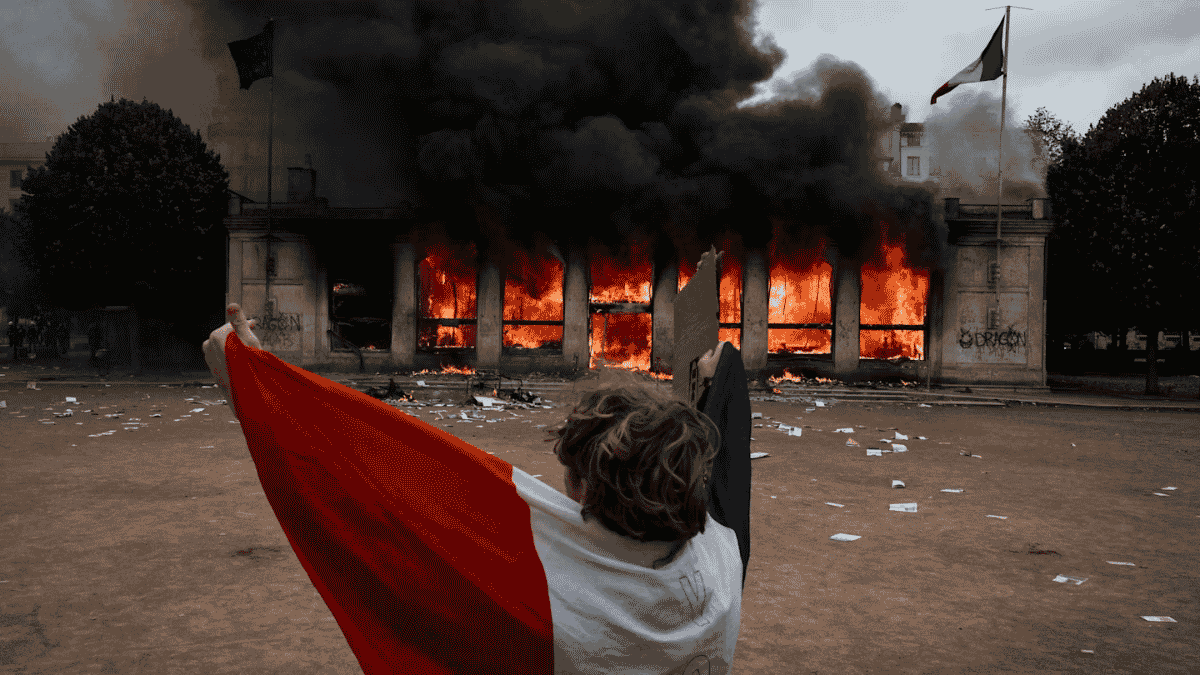
The protests reveal the human side of the impasse. Demonstrations that began with students demanding better school buildings, more teachers and smaller classes widened into anger over the cost of living and declining public services. Recent violence, including arson and looting, has damaged businesses and public buildings. Peaceful protesters, rioters and political parties are different groups with different aims: treating them as one movement would obscure what is happening. But the unrest exposes a wider frustration with a state that collects high taxes while many citizens feel they receive poor value in return.
The state’s size is central to the argument. France spends heavily on pensions, healthcare, social protection and public administration. These services help sustain living standards and limit poverty. They are also expensive commitments in an ageing society. Cutting them quickly could deepen public anger and weaken demand. Preserving them unchanged, while borrowing heavily, would leave future taxpayers with a growing bill. The political dispute is about who should bear the cost: pensioners, workers, higher-income households, businesses or users of public services.
The presidential election, scheduled for April 18th and May 2nd 2027, makes compromise harder. Macron has hit his term limit. Marine Le Pen’s far-right National Rally and Jean-Luc Mélenchon’s hard-left movement have both benefited from public dissatisfaction, though their programmes differ sharply. Le Pen has advocated lower retirement ages for some workers and other costly measures. Mélenchon has called for sweeping changes to economic policy, including cancelling debt held by the central bank. Both approaches raise questions for investors about the next government’s willingness and ability to reduce the deficit.
The danger is that the election becomes a contest in promises while the bill keeps growing. Candidates can promise lower taxes, better services and protected pensions. The bond market will ask how those promises will be paid for. A government that announces spending cuts without parliamentary support may fail to deliver them. One that abandons consolidation could face still higher borrowing costs. A government that raises taxes risks suppressing investment and consumption in an already sluggish economy.
France still has considerable strengths: productive businesses, world-class infrastructure, deep capital markets and a central role in European affairs. Higher yields alone fall short of proving a sovereign-debt crisis inevitable. Markets can overshoot, and political compromises can emerge unexpectedly. But the rising premium over German bonds suggests investors are increasingly charging France for risks they once treated as manageable.
The country’s near-term task is to produce a credible budget and a plausible path towards lower deficits without pretending that years of spending commitments can be unwound painlessly. Its longer-term task is to make the state more effective and the economy more dynamic. Neither can be achieved through police deployments or election slogans.
France is wealthy enough to dodge an instant reckoning. It is also politically divided enough to postpone difficult choices. That combination can be dangerous. Each delay makes the eventual adjustment more expensive, while every new round of protest makes it harder to agree on who pays. The real crisis is the widening gap between what the French state promises and what the country can comfortably finance. ■