IMAGE VIA SETOPATI
WHEN NEPAL’S rivers rise or its mountains collapse, the damage gets inflicted on lives, homes, crops and roads. The financial bill is gruesome enough to calculate. Most of it lands on households and the government because the country has spent far less insuring its assets than building them.
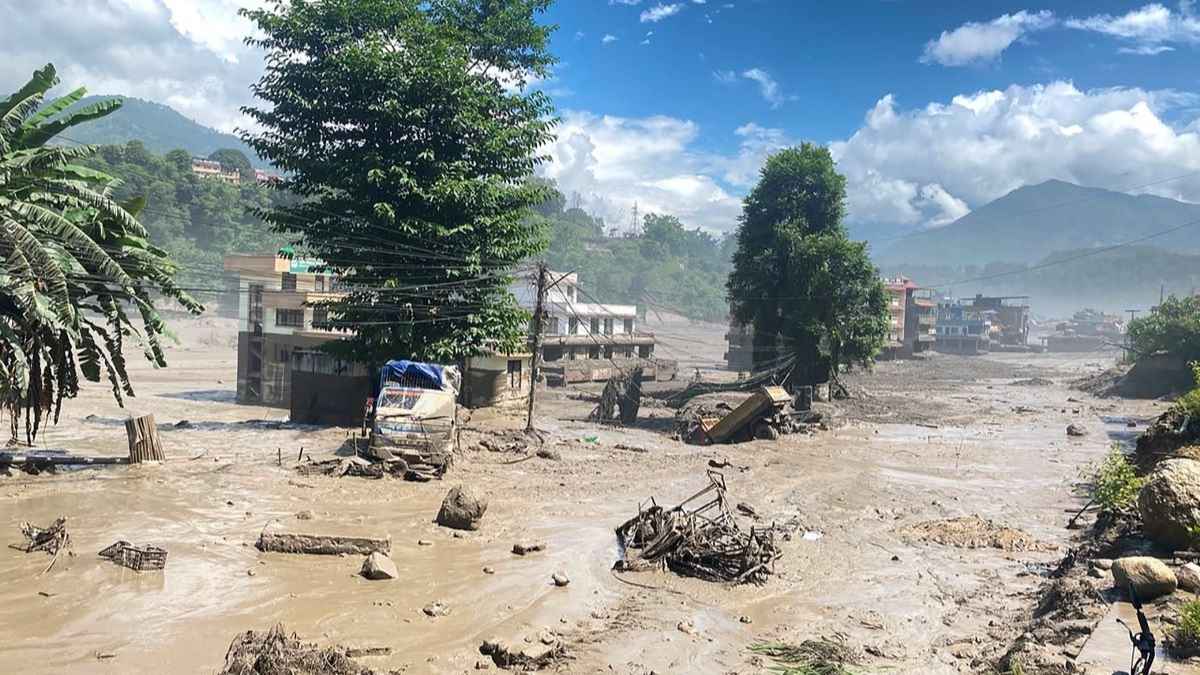
The floods of August 2026 offered a brutal demonstration. A disaster along the Trishuli and Bhote Koshi river systems caused an estimated $2.56bn in economic losses, according to Nepal’s disaster authorities. By August 31st the Nepal Insurance Authority had received 583 claims worth Rs25.87bn, or about $171m.
That figure represented preliminary insured exposure, zero final payouts. Commercial insurance losses alone could top $130m, with hydropower projects accounting for much of the damage. A catastrophe costing billions produced an insured claims figure worth a pathetic fraction of the total.
Insurance claims cover only assets and risks somebody actually insured. They exclude uninsured homes, informal businesses, public infrastructure without adequate cover and livelihoods that vanish after a disaster. A country can suffer enormous economic losses while its insurers face a much smaller bill. That protects insurance companies in the short term. It leaves the wider economy carrying the rotting cost.
Nepal’s insurance statistics lay bare the weakness. In the fiscal year ending July 2025, total insurance premiums amounted to 3.72% of GDP, according to the Nepal Insurance Authority. Non-life insurance accounted for just 0.74%. Life insurance penetration was almost three times as high. Nearly 48.3% of the population was covered by life policies when foreign-employment policies were included. That figure says sweet bugger all about how many homes, shops or farms are protected against earthquakes and floods. Life cover and property protection are different markets.
The 2015 Gorkha earthquake exposed the mess. Aon estimated insured losses at more than $175m against economic losses of roughly $5.1bn. The overwhelming share of the damage fell outside insurance. A decade later, the market has grown, yet the basic imbalance stays. Nepal is still a country where a household can spend years building a home and have zero financial protection when the ground shudders beneath it.
The August floods exposed a second weakness: the concentration of insured risks. Hydropower projects accounted for much of the early claims. Of the Rs25.87bn reported by the authority, engineering and contractor-risk policies represented Rs20.51bn across 52 claims, according to industry reporting. Oriental Insurance alone faced preliminary claims of Rs13.04bn. A handful of large infrastructure policies can therefore place substantial pressure on individual insurers, even when the total national market looks relatively small.
Nepal’s non-life insurers wrote about Rs5.3bn in premiums during July and August 2026. Indian insurers collected roughly Rs314bn over the same period. The comparison is imperfect, given the enormous difference in the size of the two economies, but it illustrates the limited financial depth available at home. Nepal relies on domestic reinsurers Nepal Re and Himalayan Re, alongside foreign firms including India’s GIC Re and Germany’s Hannover Re, to spread large risks.
That arrangement is essential. A small insurer cannot sensibly retain the full cost of a major earthquake or a flood that wrecks several power plants at once. Reinsurance lets it dump part of the exposure on companies with deeper balance sheets and a wider international portfolio. Yet the arrangement also leaves Nepal exposed to decisions made elsewhere. After the August disaster, industry executives warned that reinsurers could demand higher premiums, impose tighter exclusions and cut coverage for Himalayan infrastructure. The risks are becoming more expensive to insure precisely when the country needs more protection.
The problem is not confined to hydropower. Nepal’s settlements are expanding along riverbanks and unstable slopes. Many buildings lack adequate construction standards. Small businesses often operate without property insurance, while farmers face losses from floods and landslides that can wipe out a season’s income. The UN Development Programme’s 2024 assessment identified low awareness and shortages of reliable data as obstacles to expanding inclusive insurance. Without better information about exposure, insurers struggle to price policies accurately. Without affordable products, households stay outside the market.
Regulation has begun to catch up. The Insurance Act of 2022 created the Nepal Insurance Authority, while a risk-based capital and solvency directive issued in 2024 seeks to link insurers’ capital more closely to the risks they carry. These are useful steps. Higher capital requirements alone cannot make a small market capable of absorbing a national catastrophe. The industry also needs credible catastrophe modelling, transparent claims data and stronger reinsurance arrangements.
The government has a role. Public buildings and infrastructure should carry adequate insurance with clear disclosure of what is covered and what remains the taxpayer’s responsibility. Property insurance could be linked more effectively to mortgage lending, and affordable products could be developed for small businesses and farmers. A national disaster-risk financing strategy could combine insurance with contingency funds and pre-arranged international credit. Each instrument serves a different purpose; expecting private insurers to pay for every disaster would be expensive and delusional.
The bigger challenge is political. Insurance premiums are visible costs paid today. The value of protection becomes clear only after a disaster, when governments are forced to find money for reconstruction and families discover their savings have vanished. That makes prevention and insurance easy to postpone—and postponement is exactly what Nepal has done for decades.
Nepal has built an economy in the path of some of the world’s most severe natural hazards. Its financial system still behaves as if catastrophe were an occasional interruption. The next earthquake or flood will test the country’s buildings. It will also test the balance sheets of the companies meant to protect them. ■