Image: Aadarsh Pandey
Nepal’s government is like a cautious diner at an all-you-can-eat buffet, eyeing the food but leaving hungry. Its debt stands at a manageable 44% of GDP (see chart below), a figure that would make spendthrift nations from America to Japan envious. The country has room on its credit card. Yet it is choosing not to use it, repaying more in old debts last year than it took on in new ones. For a land desperately short of roads, power and decent schools, this looks foolish.
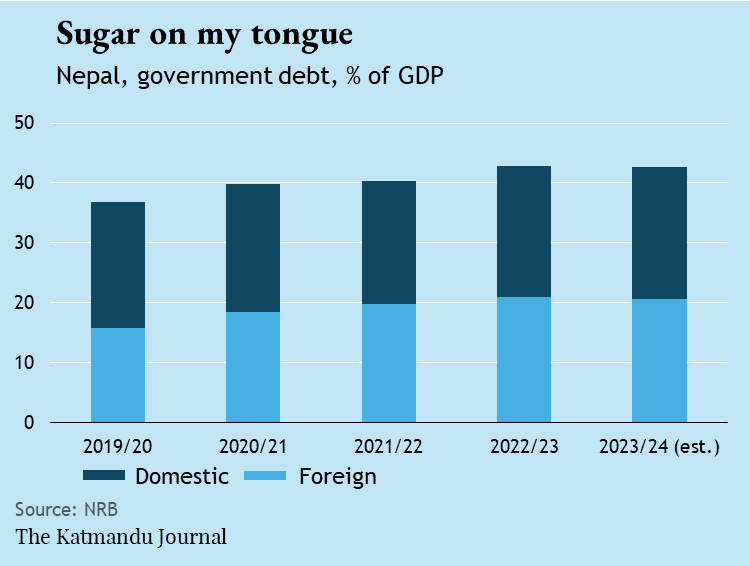
To understand the stakes, step back. In the 1930s British economist John Maynard Keynes revolutionised economic thinking with a powerful idea: governments should borrow and spend during downturns to stimulate demand and break vicious cycles of unemployment. Recessions, he argued, were caused by excess saving and a tumble in spending. To reverse the slide governments had to become spenders of last resort.
Original Keynesians assumed deficits were temporary, a bridge until growth resumed, after which budgets could return to balance. But even early on thinkers like Alvin Hansen warned demand might remain weak even in good times. This laid the groundwork for the idea of “secular stagnation”: the notion modern economies might require persistent fiscal stimulus to maintain full employment.
After the world war II such thinking fell out of fashion. Strong post-war growth lessened the urgency of deficit spending. In the stagflation-plagued 1970s and 80s Keynesianism gave way to monetarism and the idea—championed by economists like Robert Barro—that fiscal stimulus would not work at all. If people expect higher future taxes, they will save more now, offsetting government spending. Thus emerged the orthodoxy: monetary policy should do the heavy lifting and government borrowing should be kept in check.
By the 2000s interest rates across the developed world had fallen to historic lows. Central banks were out of ammunition. Even radical monetary tools like quantitative easing failed to produce robust recoveries. Keynesian ideas returned in the wake of the 2008 global financial crisis.
Economists like Larry Summers and Brad DeLong called for large-scale borrowing to fill the demand gap. Summers revived Hansen’s secular stagnation thesis, arguing chronic weak demand, low innovation and ageing populations meant economies could no longer rely on private spending alone. Modern Monetary Theory (MMT) went even further, arguing governments should borrow freely until full employment is achieved, so long as inflation stays in check.
The covid-19 pandemic sealed the deal. Governments borrowed on an unprecedented scale. Few economists objected. Japan, with an explosive debt-to-GDP ratio, did not implode. Rather a new consensus emerged: borrowing is acceptable and essential if it is spent wisely. That brings us back to Nepal.
Nepal is not burdened by high debt or bond vigilantes. It faces no serious inflationary pressure. Its currency is pegged to the Indian rupee, providing monetary stability. And its foreign creditors—mostly the World Bank’s IDA and the Asian Development Bank—provide concessional, long-term loans.
Yet progress on this front is painfully slow. The government has a tendency to mobilise less than of its annual debt target. Also the problem is not a lack of offers. It is its inability to absorb the funds. Projects are delayed. Procurement is opaque. Ministries are overwhelmed.
Even as debt servicing costs spike, the returns on public investment are underwhelming. Borrowing is cheap but underused. What does get borrowed tends to go to politically expedient, economically wasteful projects: provincial roads with no traffic or hydropower projects stuck in limbo or new airports with no planes.
Rather than “crowding in” private investment by improving infrastructure and services, public borrowing risks crowding it out. Banks prefer lending to the government over financing businesses. Meanwhile job creation stagnates and productivity languishes.
The core insight of Keynesian economics was never only about spending but about spending smartly. Nepal does not need indiscriminate debt accumulation. It needs strategic investment in sectors that unlock growth: power transmission, education, digital infrastructure and urban planning.
If such investments lift productivity, they pay for themselves through higher tax revenues. They also create the conditions for private firms to invest with confidence. In countries like South Korea or Vietnam, public infrastructure paved the way for export-led growth. In Nepal better roads could connect producers to markets. Better schools could equip a future workforce. But only if borrowed money builds them.
There is also a deeper problem: weak structural demand. As elsewhere, Nepali households are cautious spenders. Many save for health emergencies or migration fees. Income inequality concentrates wealth among those less likely to consume. Private sector investment is low because returns tend to be poor and barriers—land, red tape, unreliable power—raise costs.
Targeted public investment could “crowd in” private activity by lowering those barriers. It could also tackle chronic underemployment, especially in rural areas, and make Nepal less dependent on remittance income.
No free lunch but a discounted buffet
None of this is to say borrowing is risk-free. Interest rates could rise, making even cheap loans burdensome. Debt that is sustainable today could become problematic tomorrow. And poorly managed debt can still fuel inflation or corruption.
That is why the emerging borrowing consensus, even among Keynesians, stresses quality over quantity. Policymakers should focus on long-term returns and prepare for a less friendly interest-rate environment. It should also recognise fiscal space is not infinite.
Yet the price of inaction is higher still. Nepal’s current path—timid borrowing, sluggish spending as well as stagnant growth—leaves its people poorer and its potential untapped. The country is not in a debt crisis. It is in a development slumber. It has the fiscal space to act but not the administrative competence to act well. In the end public finance is like construction: it matters little how much cement you buy if you never pour the foundation. ■