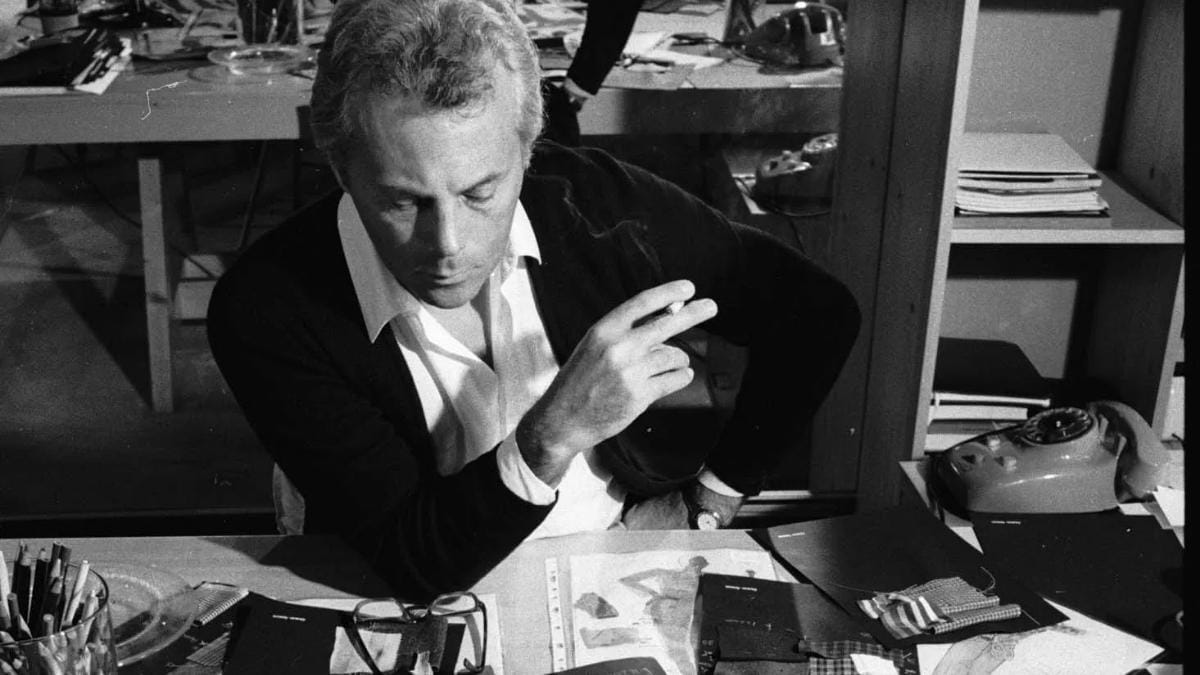
Photographer: David Lees/Getty Images
Giorgio Armani, who died on September 5th at his home in Milan aged 91, spent half a century pursuing an idea so simple it seemed radical: that luxury should be quiet. Whereas rivals built their empires on ornament, spectacle as well as provocation, Mr Armani softened the suit, drained colour from the palette and banished fuss from the silhouette. The result was a new global aesthetic, one of relaxed elegance, as recognisable on the streets of Tokyo or Los Angeles as in Milan’s Via Manzoni.
His breakthrough came in 1980, when Richard Gere appeared in American Gigolo clad in fluid Armani tailoring, an image that would forever entwine his brand with Hollywood. The timing was impeccable. As globalisation accelerated, images travelled faster than garments. Armani understood earlier than most that cinema was not merely entertainment but a distribution channel for style. By the early 1990s, his gowns dominated the Oscars red carpet to such an extent that the ceremony was nicknamed the “Armani Awards”. A decade before Instagram made celebrity dressing into an industrial process, Armani had built the template.
He was, however, more than a canny marketer. Unlike Gianni Versace’s exuberant maximalism or Gianfranco Ferré’s architectural flamboyance, Armani offered deconstruction: jackets without padding, shirts without stiffness, trousers without crease. He turned clothes into armour for those who disliked armour—Hollywood executives, Wall Street dealmakers, later China’s emerging middle class. “Suits should give confidence but not define the personality,” he liked to say. In a century when work and identity blurred, the formula proved irresistible.
The business followed the vision. Founded in 1975 with his partner Sergio Galeotti, the Armani label grew into the world’s largest privately held luxury group, spanning hotels, restaurants, homeware and cosmetics. Its independence became part of the legend. Whereas rivals fell into the hands of French conglomerates such as LVMH or Kering, Armani resisted takeover offers reportedly worth billions. In 2016 he placed the company under a charitable foundation established to protect it from being carved up after his death. The group now employs over 8,000 people and generates revenues of more than €2bn a year.
Such a scale did not make him less exacting. Colleagues recall him adjusting lighting angles before shows or berating an assistant whose tie was 1.5cm too long. Unlike Karl Lagerfeld, he shunned theatrics; unlike Yves Saint Laurent, he disdained scandal. He cultivated instead an aura of reserve. Parties at his Milanese apartment, where Brad Pitt or Cate Blanchett might sip prosecco under Armani/Casa lamps, were exercises in restraint: he himself would stand silently, watching his guests with a half-smile.
The contrast with today’s luxury industry could hardly be sharper. The sector’s growth over the past three decades has been driven by bold logos, conspicuous colour and the relentless acquisition strategies of conglomerates. Armani was the anti-logo designer, sceptical of fleeting trends and unyielding in his insistence on independence. His empire never floated on a stock exchange, never bought up rivals, never diversified into streetwear collaborations. For younger shoppers drawn to the flamboyance of Gucci or Balenciaga, Armani sometimes looked austere. Yet he preferred to be overlooked rather than compromised.
That stubbornness was also patriotic. “Before Giorgio, there was never an Italian fashion industry,” as the model Lauren Hutton once remarked. Milan had textiles but not glamour. Armani, together with Versace and Ferré, turned it into a capital of style. Where others courted Paris or New York, he built patiently at home, helping to establish Italy’s reputation as a design powerhouse. By the time of his death he ranked among the country’s richest men, with a fortune estimated at more than €12bn.
There are unresolved questions. Armani had no children; succession within the foundation-led structure is uncertain. His nieces and long-serving lieutenants may continue, but the brand’s fate in an industry that prizes novelty will test his carefully built independence. Investors, long kept at bay, may find new ways to press their claims. For all his foresight, Armani could not design immortality.
Yet his influence endures. From corporate boardrooms and red carpets to department-store racks and discount outlets in emerging markets, the idea that elegance is better whispered than shouted still owes most to him. In a century dominated by marketing noise, Giorgio Armani proved that silence, too, can be a brand. ■