IMAGE: Reuters/Navesh Chitrakar
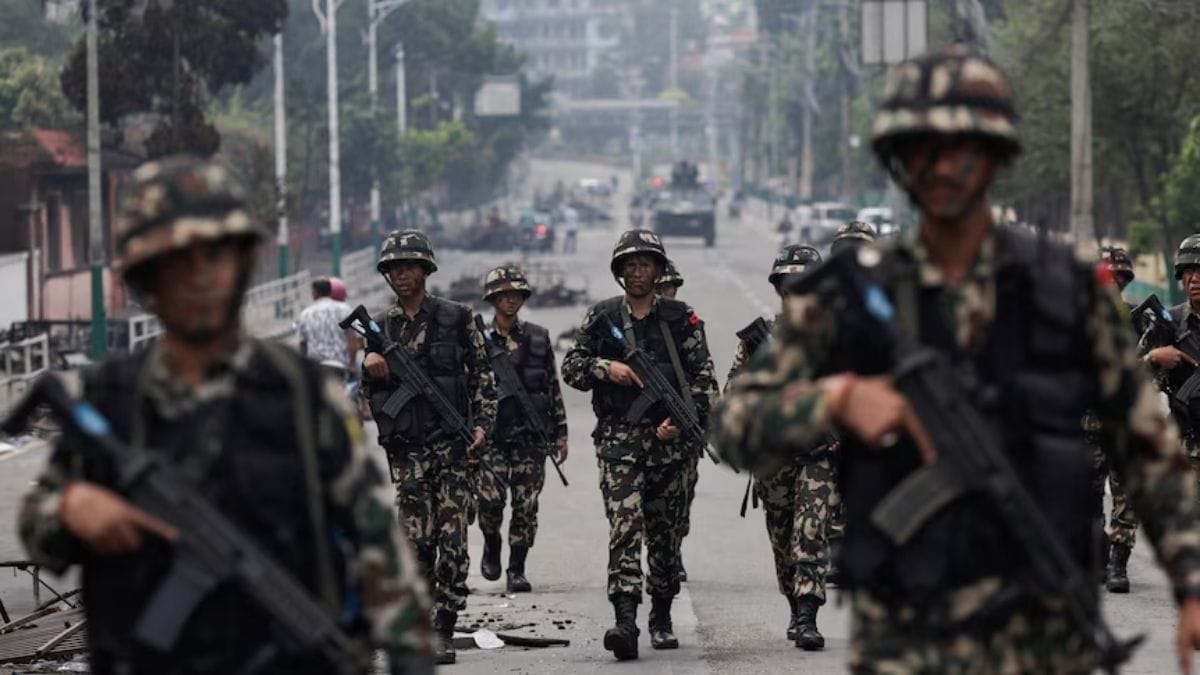
The army is not supposed to rule Nepal. Yet this week it has become the only institution with operational authority and popular tolerance. Following the abrupt resignation of Prime Minister K.P. Sharma Oli—amid violent protests that left more than two dozen dead—senior officials were spirited away by helicopter, reportedly under military protection. Parliament no longer functions. Constitutional actors are missing in action. The President, a ceremonial figure at the best of times, has offered little beyond bromides. The Nepal Army, formally subordinate to civilian command, is now doing what generals across history have done when politics fails: filling the vacuum.
Nepal’s crisis is not merely one of leadership, it is one of political architecture. The trigger may have been generational fury but the detonation has exposed the structural fragility of a democratic project long in decay. The torchbearers of this moment—idealistic and deeply disillusioned Gen-Z activists—have neither unified leadership nor constitutional authority. Yet they have rendered the traditional parties irrelevant and the streets ungovernable. They have also, whether deliberately or not, given the army an opening to broker the next phase of Nepal’s governance.
The movement’s centrepiece is its decentralised power. District representatives, livestreamers and anonymous Discord moderators have supplanted party bosses and union leaders. This amorphous network commands broad support but struggles to cohere. The most widely supported transitional leader—former Chief Justice Sushila Karki—was selected in an online poll, backed by prominent figures including the Kathmandu mayor, then swiftly disowned after protests erupted over her eligibility under Article 132 of the constitution. Calls for a caretaker government have multiplied but no figure enjoys stable legitimacy. Few proposals survive 24 hours of social media scrutiny.
In the absence of consensus, the army has done what armies do best: imposed order and demanded unity. It has convened youth leaders and suggested talks with royalist factions, as well as hinted at technocratic alternatives. But its motives are far from neutral. Chief of Army Staff Ashok Raj Sigdel remains a de facto power centre, and his role in mediating this transition suggests an institutional interest in shaping, if not steering, the outcome. The façade of civilian consultation hides an uncomfortable reality: the military is buying time for a formula that it—not the people—will ultimately approve.
Meanwhile political parties have responded with predictable legalism. The Nepali Congress and CPN-UML, two of the republic’s largest parties and former arch-rivals, have issued joint statements insisting that any transition remain within the strictures of the constitution. But the document they invoke assumes the existence of institutions—chief among them, a functioning parliament—that no longer meaningfully operate. Their calls for constitutionalism sound less like a defence of democracy and more like an attempt to reinsert themselves into a conversation from which they have been excluded.
That exclusion, however justified by past corruption and incompetence, brings its own risks. The absence of institutional ballast leaves the field open to actors with no electoral mandate and varying levels of democratic commitment. Figures like Durga Prasai, a monarchist businessman with a checkered past, circle the edges of the chaos, sensing an opportunity to re-legitimise old orders. The army’s openness to discussions with such actors raises uncomfortable questions about who might ultimately benefit from Gen-Z’s disorganisation.
The underlying tension is stark. The youth demand legitimacy through popularity; the state insists on legality through procedure. Each side regards the other’s basis for authority as insufficient. Without a mediating mechanism—a credible transitional administration, however limited in scope—Nepal risks prolonged dual power: youth on the streets, generals in the barracks and no constitutional thread linking the two.
There are paths forward, but they narrow by the day. A technocratic caretaker cabinet with a fixed 90-day electoral mandate may provide a temporary solution, particularly if it draws from respected, non-partisan figures like Sagar Dhakal or Mahabir Pun. Such a government would need to enjoy broad support—not just from youth activists but also from the army and the parties. This could forestall democratic collapse.
Absent that, Nepal faces either soft military stewardship dressed in civilian clothing or the fragmentation of the youth movement into competing fiefdoms, some more susceptible than others to co-option or extremism. In both cases, the very legitimacy that Gen-Z seeks to restore could end up more tattered than it began. Historical parallels abound: revolutions from Cairo to Caracas have shown that popular mobilisation, absent institutional consolidation, leads to entropy.
The bigger question is one that has haunted Nepal since the fall of the monarchy: who governs when no one governs well? The old parties have failed. The new generation is not yet ready. And the army, for all its competence, lacks democratic sanction. In such terrain, power gravitates not to those with vision but to those with organisation.
The youth are right to demand better. But they must now confront the iron laws of transition: unity matters more than idealism; clarity more than fervour; and compromise, however distasteful, more than purity. A revolution that cannot govern invites forces that can—and usually do so on their own terms.
If this is to be a turning point and not a dead end, the movement must trade momentum for maturity, and agitation for architecture. Should the youth fail to rise to that challenge, what comes next will be a long, dark night. ■