IMAGE: XINHUA
WINSTON CHURCHILL once called the Soviet Union (the communist superpower that collapsed in 1991) “a riddle wrapped in a mystery inside an enigma”. The nuclear riddle for decades was answered by a series of arms-control treaties. These pacts forced America and, first, the Soviet Union and later its successor state, Russia, to be open about their arsenals, creating predictability and safety.
That system is now unraveling. On February 5th the New START treaty, the final pact limiting the long-range nuclear weapons of the two superpowers, will run out. Nothing will take its place. For the first time since the 1980s, the world’s two largest nuclear states can build up their ready arsenals without any legal limits. The old rulebook is gone. What comes next will be more secretive and far more fraught.
America’s defence department is planning for this new world, studying how to quickly add hundreds of reserve warheads to its existing missiles. Russia, already updating its forces, has built new weapons like hypersonic missiles and a nuclear-powered underwater drone, which the old treaty did not cover. The loss of trust is more dangerous than the missiles. Russia stopped allowing on-site American inspections in 2023. With the treaty dead, the last agreed way for each side to count the other’s weapons disappears. When you cannot count, you assume the worst. The risk of a fatal miscalculation grows.
America’s government seems untroubled. President Donald Trump says he wants a “better deal”, one that must include China. He has brushed off concerns, saying if the treaty expires it expires. His team has not answered Vladimir Putin’s offer to extend the pact for one year, an offer that crucially did not include restoring inspections.
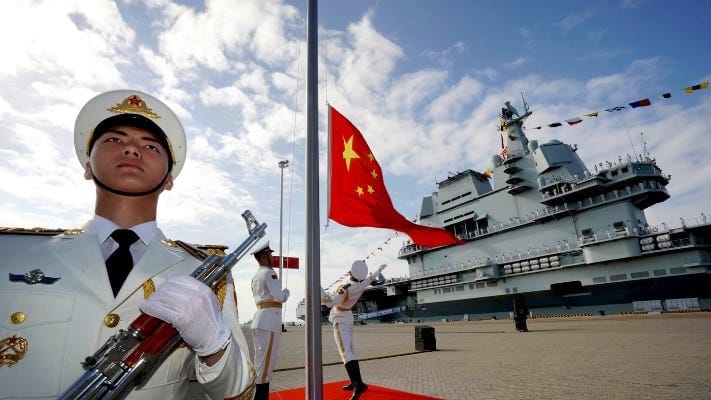
China is now the central problem. Its nuclear stockpile has more than doubled since 2012, to roughly 600 warheads, and is on track to pass 1,000 by 2030. It can now launch nuclear weapons from land, sea and air, and is moving towards systems that could fire on warning of an attack. Yet China refuses to join any arms-control talks, saying its weapons are only for basic defence. This secretive buildup makes the old two-country model pointless. The world has three nuclear heavyweights now, not two. An official in Tokyo calls it three scorpions in a bottle.
The shockwaves will spread. In Europe, alarmed by Russia’s nuclear threats over Ukraine and unsure of America’s promises, leaders are debating a stronger European nuclear shield. Germany, France and Britain are holding unusual talks about the continent’s nuclear future. In Asia, South Korea is deeply uneasy. If America builds up to match both Russia and China, it could set off a chain reaction: India building to match China, Pakistan building to match India. The arms race would spin in multiple directions.
America’s effort to modernise its ageing arsenal is behind schedule and over budget. Russia’s war industry, energised by its invasion of Ukraine, may now be better at producing new missiles. A full-scale buildup would still take years. But the trend is set. The four-decade decline in global nuclear stockpiles is over. Arms control, built on transparency and shared interest, may give way to secrecy as well as speed and suspicion. The world is relearning a grim lesson: when you cannot see the other side’s weapons you must prepare for the worst. ■