ILLUSTRATION: KATMANDU JOURNAL
NEPAL SHARES 1,414 kilometres of border with China and 1,751 with India. It conducts roughly 65% of its trade with one and has signed infrastructure agreements with the other that have yet to produce a single completed project. Every Nepali election is, among other things, a foreign policy event watched from two capitals whose interests in the country’s politics run in almost exactly opposite directions. The March 5th vote is no exception. What is unusual this time is the degree of uncertainty on both sides.
India’s core interest in Nepal has not changed in decades: a stable, democratic neighbour that does not become a platform for Chinese strategic projection. Kathmandu sits astride potential land corridors between the two Asian giants; hosts a Tibetan refugee community that Beijing watches with strong suspicion; and votes periodically in international forums where One China positioning matters. New Delhi has historically managed this through the Nepali Congress, whose social-democratic instincts as well as pro-market economics and Gandhian democratic lineage align comfortably with Indian preferences. That relationship is the diplomatic equivalent of a well-worn trade route: not exciting but reliable.
K.P. Sharma Oli’s CPN-UML embodies the road India has always tried to avoid. Oli signed the Belt and Road Initiative framework with China in 2017, added specific co-operation agreements in 2019, and has used the relationship as a lever against Indian pressure throughout his political career. In 2020 he published a new map of Nepal incorporating territories currently administered by India, including Kalapani, Lipulekh and Limpiyadhura. The Supreme Court eventually reversed his two unconstitutional dissolutions of Parliament, but the map endures in the public record. India greeted his reelection as UML chairman in December 2025 with the kind of silence that speaks volumes.
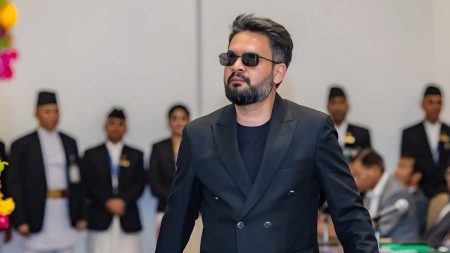
The Rastriya Swatantra Party (RSP) poses a novel problem for India. Balendra Shah, the party’s prime ministerial candidate, has publicly endorsed “Greater Nepal”—a nationalist territorial claim that encompasses parts of present-day Indian territory. Shah is an engineer and a pragmatist; analysts in Kathmandu and New Delhi do not seriously expect him to act on it. But the claim exists, and India’s capacity to apply pressure on a diplomatically inexperienced government is considerable. Nepal buys virtually all its fuel through Indian transit arrangements. Its main trade corridors run south. A government that antagonised New Delhi in its first year, even inadvertently, would find the economic consequences arriving quickly and without ceremony. An American think tank describes the RSP’s foreign policy as “rhetorically sophisticated but untested in practice”.
China’s calculation runs in the opposite direction. Beijing has spent a decade cultivating Nepal’s communist parties as the primary vector for its interests: BRI connectivity; Tibetan border management co-operation; and reliable votes on One China-related UN resolutions. The investment has been patient and substantial. An Oli government would mean continuity of that relationship, even if the BRI’s actual construction record—zero projects after nearly a decade of agreements—suggests the returns have been dismal. A Congress or RSP government would require China to rebuild its diplomatic portfolio in Kathmandu from a weaker position, which Beijing is well-resourced to do over time but would prefer not to.
The RSP’s explicit commitment to rebalancing Nepal away from the communist-dominated diplomatic ecosystem China cultivated is the feature that most concerns Beijing. Shah’s “buffer to bridge” foreign policy framing—repositioning Nepal as an active connector between India and China rather than a passive object of their competition—is rhetorically appealing and geopolitically ambitious for a party that has never governed nationally and whose chairman is currently on bail. China will not panic if the RSP wins. It will just begin the slow work of making itself useful to whoever is in power, as it has done before.
What neither capital has fully priced in is the most probable electoral outcome: a hung parliament in which no party commands a majority, coalition negotiations consume months, and whoever eventually governs does so with a fragile mandate and impatient partners. Nepal has had thirteen governments since 2006. In that environment, foreign policy coherence of any kind—Indian-aligned, Chinese-engaged or “bridge between giants”—tends to dissolve into the daily management of coalition survival. Both New Delhi and Beijing know this. They have watched it happen before, and they have staff in their embassies whose entire job is to wait. ■