IMAGE: TULSI RAUNIYAR
THE NEPALI state was built on a bet: that the weather would behave. Its farmers planted rice when the monsoon arrived, usually on time. Its engineers designed hydropower dams using river-flow records from a stable past. Its road builders routed highways through valleys whose slopes, while steep, stayed put. None of these assumptions seems foolish in hindsight. Every country plans for a predictable climate. But Nepal’s misfortune is to discover that its geography has ceased to cooperate. Can a country survive when the physical foundations of its economy and settlements begin to collapse?
Start with the cryosphere, a word that belongs in scientific journals but describes something very plain: ice and snow that function as a natural water tank. The Hindu Kush Himalaya (a vast mountain region stretching across countries including Afghanistan, Pakistan, India, Nepal, Bhutan and China) is warming twice as fast as the global average. Glacier mass loss has doubled since 2000. Snow persistence has fallen for four consecutive years, with the winter of 2024-25 registering a record low—nearly a quarter below normal.
That matters because snowmelt supplies a quarter of the flow in the rivers that feed Nepal’s farms and turbines. As the tank empties, dry-season flows decline. And as permafrost thaws, slopes that were frozen solid for millennia begin to slide.
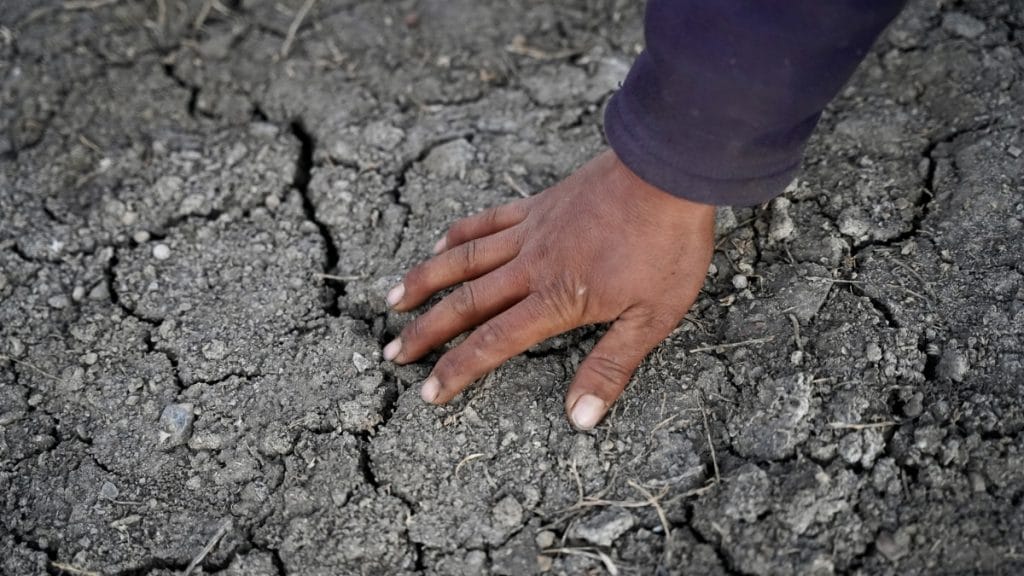
The monsoon, meanwhile, has lost its manners. In 2025 it arrived two weeks early yet its distribution turned erratic. Paddy planting was delayed by a dry spell that followed the early onset; rice production fell by over 4%. And the country’s grain basket, Madhesh province, suffered a drought followed by intense rain—a “too little, too much” pattern that climate scientists call variability and farmers call ruin.
Now the Pacific is tilting towards El Niño, which historically suppresses South Asian monsoon rainfall. A second consecutive dry year would compound the stress on agriculture, which still employs the bulk of Nepalis.
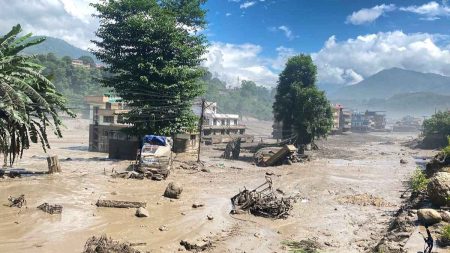
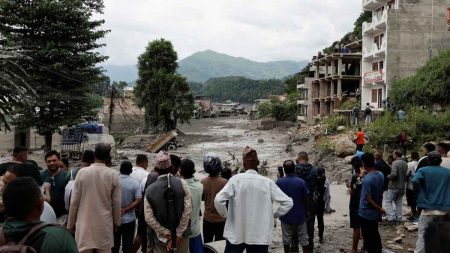
Then come the landslides. In October 2025 three days of heavy rain triggered floods and debris flows that killed nearly 50 people, blocked every major road into Kathmandu and caused over $90m in road damage. The Narayanghat–Muglin highway, the capital’s lifeline to India, was cut repeatedly. Repairing one road after one storm is a chore. Repairing the same road every year, while other roads also break, is a fiscal death spiral. Nepal’s Ministry of Physical Infrastructure spent Rs12.38bn on post-flood reconstruction from a single event. As such events become more frequent, the cost of maintaining connectivity will outrun the economy that is supposed to pay for it.
Nepal has bet its economic future on hydropower. The bet looks shrewd on paper. But run-of-river plants, which lack storage, generate power in direct proportion to river flow. Sedimentation, accelerated by erosion from more intense rainfall and glacial retreat, is already eating away reservoir capacity: up to 25% at projects such as Kulekhani.
Industry analysts describe this as an economic haemorrhage. A hydropower-dependent economy is a hydrology-dependent economy. When hydrology becomes erratic, the revenue stream follows.
So what is Nepal’s real adaptation strategy? Migration. The Limi Valley in Humla district offers a glimpse of the future. Repeated flooding destroyed homes and fields, and in late 2025 the residents of three villages decided to relocate to an ancestral area. One village, Jang, is now nearly empty. Across the hills, youth are moving to the plains and to the Gulf. Overseas remittances already dwarf hydropower earnings. This is adaptation of a sort—households diversifying income, reducing pressure on stressed land—but it is unmanaged, distress-driven and ultimately a transfer of vulnerability rather than its resolution.
The state is struggling to keep pace. A multi-million-dollar early flood-warning system in the Everest region fell into disrepair; officials acknowledged that funds had been redirected elsewhere. International finance flows in—$36m from the Green Climate Fund for glacial-lake monitoring, $2.3bn from the Asian Development Bank for green growth—but the gap between commitment and need remains vast. Worse, external money comes with external priorities. A country that cannot finance its own adaptation is a country whose development trajectory is shaped in boardrooms far from Kathmandu.
Nepal will not vanish, but its development model, infrastructure and settlement patterns may have to be radically rethought. The real danger of climate change is slow reorganisation by forces beyond the country’s control. Can Nepal shape that change or merely endure it? ■