IMAGE: SHISIR KHANAL/X
NEPAL’S FOREIGN Minister Shisir Khanal’s trip to Beijing last month ran from June 14th to June 17th, four days of meetings capped with a press conference at which he told reporters that Nepal hoped to build a relationship with China that was “stronger and better and deeper than what it has been in the past”. The trip came days after he had said almost exactly the same thing about India, following his own visit to New Delhi. Nepal’s foreign ministry calls this “balanced diplomacy”. What it actually involves is a small landlocked country with a Rs1.4trn trade deficit telling both its giant neighbours that each one is its most important partner. The remarkable thing is that Beijing and New Delhi seem to accept the formula, at least in public.
Behind the diplomatic choreography, however, the pull towards China is real and getting stronger: because the economic gravity of what China can offer is becoming difficult to ignore, while the chasm between Chinese promises and Chinese delivery is proving equally difficult to close.
Start with what China already controls in Nepal’s economy, without any grand bilateral strategy being needed. Chinese automobile companies sold 76.4% of Nepal’s electric vehicle imports in 2023-24, falling slightly to 53% or so the following year as other manufacturers entered the market, but still dominant. Chinese brands account for some 73% of all four-wheel passenger vehicles sold in Nepal. Every time Nepal’s government pushes its EV adoption targets—and Swarnim Wagle’s latest budget includes further incentives—it is pushing Nepalis towards buying Chinese cars. Nepal’s EV policy and China’s automobile export strategy have become, without any formal agreement, two parts of the same supply chain.
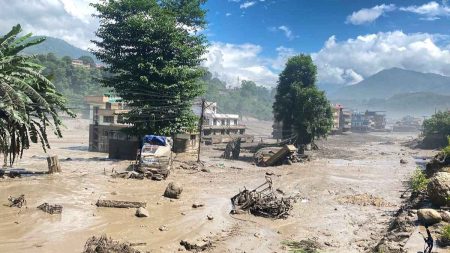
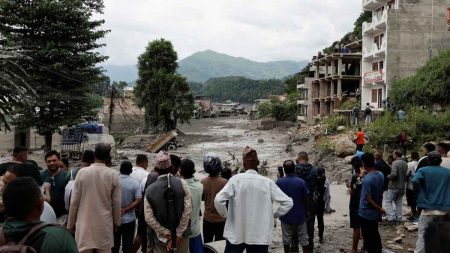
Trade has followed a similar trend. After the Rasuwagadhi border crossing, Nepal’s main overland link with China, spent 38 months in unofficial closure after the 2020 pandemic, it reopened in April 2023 to around 150 trucks a day. That momentum ended abruptly on July 8th 2025 when a glacial lake outburst flood from upstream Tibet washed away the Nepal-China Friendship Bridge and destroyed the customs yard, burying more than a hundred cargo containers. The border crossing is back in operation but at reduced capacity, a reminder that China’s geography imposes risks on the relationship that no bilateral document can insure against. The trade, meanwhile, runs overwhelmingly in one direction: China exports cheap manufactured goods, construction materials and consumer electronics; Nepal has virtually nothing to send back.
That asymmetry is the painful core of Nepal’s northern lean. Khanal’s Beijing visit produced warm words on connectivity, border management, energy, trade and agriculture, but no new agreements. Nepal signed up to the Belt and Road Initiative in May 2017 and has yet to see a single agreed BRI project completed. The December 2024 framework Oli signed in Beijing identified ten priority projects—two fewer than Nepal had originally asked for, the Kathmandu-Hetauda tunnel and a Kathmandu Valley transmission line dropped during negotiations.
As of June 2026 the Torkha-Chhare tunnel has seen some progress and the Hilsa-Simikot road is advancing. The feasibility study for the Kerung-Kathmandu railway was due for completion last month. Nepal’s own analysts describe the RSP government’s approach as cautious: each project will be assessed individually, with the financing modality (grant or loan) determined by economic viability rather than assumed as Chinese preference dictates.
That caution reflects a lesson Nepal has learned from its most embarrassing Chinese infrastructure investment. The $215.96m Chinese Export-Import Bank loan for Pokhara International Airport is now generating repayment obligations on an airport that has no scheduled international flights. Loan repayments to Beijing are expected to begin this year. The feasibility study that preceded construction projected 280,000 international passengers through Pokhara by 2025; the actual figure is approximately zero. Nepal is paying for the airport anyway. When Khanal sat across the table from Chinese officials, the Pokhara debt was the unspoken context behind every discussion of new connectivity financing.
There is also the electricity problem, which cuts straight against the most commercially obvious logic for deepening China ties. Nepal has enormous hydropower potential and India as its only viable electricity export market. India has an informal policy of not purchasing power from Chinese-built projects. This constraint wiped out years of Chinese involvement in the West Seti project: after a Chinese state-owned firm spent years trying to make the economics of a 750-megawatt scheme work, the project was eventually handed to India’s NHPC. Chinese capital cannot build Nepali power that Nepali geography will never let Nepal sell. Beijing’s leverage on connectivity infrastructure runs into a hard wall the moment the asset is supposed to generate revenue.
What the RSP government seems to understand, better than its predecessors, is that closer economic ties with China are worth pursuing on specific terms (cheaper goods, cross-border trade infrastructure, feasibility-funded studies) and resistant to on other terms, including large concessional loans for infrastructure that serves Chinese strategic interests more than Nepali economic ones. Khanal flew to Beijing immediately after flying to New Delhi, and signed nothing in either capital. Nepal is leaning north,but carefully, keeping the accounts open and the commitments light. ■