Image: Visual China Group/Getty Images
WHEN CHINESE officials announced “Made in China 2025” in an obscure policy document nearly a decade ago, few outside the Communist Party’s planning circles took it seriously. The blueprint, which sought to lift China up the value chain in ten strategic industries, was treated as another wish-list. Today it reads like a prophecy.
China now accounts for nearly 30% of global manufacturing value-added, more than America, Germany and Japan combined. It leads the world in electric vehicles (EVs), solar panels, high-speed rail and industrial robotics. In many of those sectors, Chinese firms dominate domestic markets and increasingly foreign ones as well. Supercharging the rise is an old-fashioned tool with new-found credibility: the guiding hand of the state.
Western economies, wedded to market-led growth, are now scrambling to catch up. Across Washington, Brussels and Tokyo, officials are dusting off the playbooks of developmental economists and pouring billions into strategic subsidies. The question is no longer whether industrial policy works but whether it works fast enough to matter.
China’s experiment began in earnest in 2015. Made in China 2025 set out to lessen foreign dependence in sectors deemed vital for national security and economic upgrading: semiconductors, aerospace, biopharmaceuticals, robotics and more. The targets were blunt: secure 70% self-sufficiency in core technologies by 2025. The means were blunter still: cheap credit, generous subsidies, state-guided funds and policy protection.
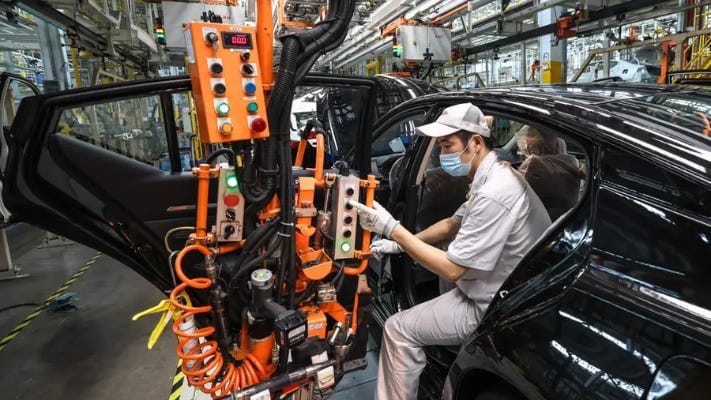
In Changzhou, a city better known for textiles in the past, rows of gleaming EV factories now churn out cars destined for Europe. In Anhui robots assemble other robots for domestic industrial use. In Shenzhen engineers develop advanced drone platforms for global export.
Much of the capital came via so-called “government guidance funds”, state-backed investment vehicles with over ¥2.2trn ($300bn) under management as of 2017. In some provinces local officials competed to subsidise factories, resulting in grotesque overcapacity. In others, firms gamed the system by tweaking corporate strategies to appear policy-aligned. Innovation became a line item on funding applications.
Yet, amid the waste and distortion, something stunning happened. China began climbing the ladder. Domestic firms now supply the bulk of components in power transmission and new-energy vehicles and telecommunications. Huawei’s chip-design arm, HiSilicon, has re-emerged with new workarounds notwithstanding American sanctions. In drones and battery storage China is leading.
Foreign multinationals are now in a bind. Many profited from China’s ascent. Joint ventures gave them access to vast markets even as they ceded technological secrets. In sectors like EVs Western firms now rely on Chinese suppliers for key components. Tesla’s Shanghai Gigafactory, one of its most efficient plants, depends on the same supply chain that props up local rivals like BYD.
Some call this “decoupling”. A more apt term might be “coerced coupling”. Western capital lubricates Chinese industrial ambitions even as Western governments fund strategies to contain them. The consequence is a global manufacturing architecture that is neither integrated nor independent but entangled.
That has had consequences. American policymakers, once dismissive of Chinese state planning, are embracing subsidies. The CHIPS Act commits $52bn to revive semiconductor manufacturing. The Inflation Reduction Act showers clean-tech firms with tax incentives. Europe, slow off the blocks, is now fumbling toward its own industrial response. Even Britain, which used to be allergic to dirigisme, is reconsidering sector-specific support.
Yet replication is proving harder than imitation. China’s model blends market dynamism with centralised ambition in ways liberal democracies struggle to emulate. Western governments may throw money at domestic industries, but they cannot order banks to lend; provinces to co-invest; or consumers to buy local. Nor can they ignore the cost of capital or the wrath of taxpayers for long.
China’s model is not without flaws. Subsidy-driven expansion has created bubbles. In solar panels and batteries, capacity outstrips demand by orders of magnitude. Of China’s 100-plus EV makers, most operate at a loss. Zombie firms linger on life-support, propped up by local governments unwilling to admit failure. The fallout is misallocated capital and industrial bloat.
There are also underlying structural risks. Heavy investment in supply-side capacity has not been matched by domestic demand. Consumption is still sluggish. A sagging property market has dampened household wealth and youth unemployment has surged. Goldman Sachs estimates Chinese households are saving more and spending less than at any point since the global financial crisis.
Some economists speak of a new phase: “China Market 2030”. It envisions a pivot from production-led growth to consumption-driven stability. But the state shows few signs of stepping back. If anything, it is doubling down. Xi Jinping’s latest slogan, “new quality productive forces”, signals a continuation of state-led upgrading; this time focused on artificial intelligence, quantum computing and intelligent manufacturing.
The new targets are more ambitious, and arguably more speculative. Humanoid robots, touted as the next frontier, remain expensive novelties with limited operational use. Autonomous factories still require swarms of traditional robots to meet commercial targets. The Party may dream in algorithms, but factories still run on practical constraints.
Few still would bet against China’s ability to scale. Where Silicon Valley incubates ideas, Shenzhen industrialises them. Rather than in invention, China’s genius is in relentless iteration. Weaknesses are patched, inefficiencies smoothed, scale achieved with astonishing speed. The Soviet Union launched five-year plans into space. China builds them into global supply chains.
What emerges is not a free market, nor a command economy, but a strange hybrid: a techno-industrial Leviathan powered by state capital and entrepreneurial hustle. It may not age gracefully. The fiscal burden is growing. Returns are diminishing. And geopolitical friction is intensifying. But the model works for now.
And it is reshaping the global order. Emerging economies from India to Brazil are rethinking their aversion to industrial planning. Western firms are reassessing the wisdom of offshoring. Governments everywhere are recalibrating the balance between market and state.
The next industrial revolution will not be televised. It will be subsidised. And more likely than not, it will be made in China. ■