‘Cause I’m the taxman Image: Bloomberg
When it comes to sending money home, Nepali migrants in America are the world’s overachievers. On average they send nearly twice as much per person as their peers in Saudi Arabia, the Gulf’s largest remittance hub. That is good news for Nepal, where America has become a big source of foreign currency. In 2023 Nepalis in America wired home about $1.28bn, more than the country earned exporting goods to India. It was also more than the country received from Malaysia, South Korea and Kuwait combined.
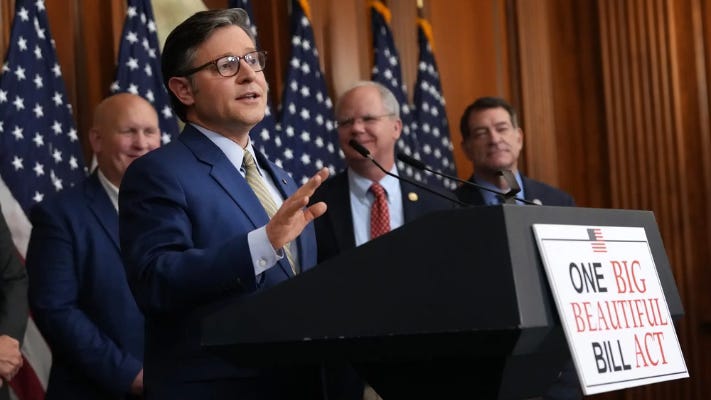
But generosity, it seems, is about to get punished. Buried in the 1,000-page “One Big, Beautiful Bill Act” recently passed by America’s House of Representatives is a measure designed to tax remittances sent abroad by non-citizens, including legal immigrants and visa-holders. If it becomes law, financial institutions will be required to deduct 3.5% from any cross-border transfer above $15, unless the sender proves they are American. Those who are taxed in error can apply for a refund.
The logic, such as it is, runs thus: by making it costlier for migrants to send money home, America might discourage illegal immigration. What it will almost certainly do instead is drive remittances underground: into informal “hawala” networks, cryptocurrencies or even suitcases of cash. The gains for American coffers will be trivial: the projected $26bn in revenue over ten years is less than 0.01% of the federal budget. The costs, however, will be exported, and poor countries will be among the hardest hit.
To some policymakers in Washington, taxing remittances might feel like an under-the-radar way to claw back value from undocumented migrants. But for recipient countries it amounts to a capital-control measure by stealth. At a time when aid is falling and foreign direct investment is skittish, remittances are one of the few reliable financial inflows to developing economies. In the last decade they have climbed by 57%, even as FDI to poor countries shrank by 41%. In 2019 they overtook FDI as the biggest source of external finance to the developing world. Unlike aid remittances come without strings. Unlike loans they do not need to be repaid.
Nepal stands squarely in the firing line (remittances make up 25% of its GDP). The tax would turn America, from which nearly 12% of Nepal’s remittance income already flows, into the most expensive G7 country from which to send money abroad. Transfer fees are already high: sending $200 costs an average of 6.4% globally. The proposed tax would push that close to 10% in America. For a Nepali worker wiring home $500 a month, that’s an extra $210 a year lost to Washington.
In 2024 Nepali migrants in America sent home around $780m, according to estimates by the Center for Global Development. Over $25m of that could vanish: $9.4m to the remittance tax itself, and nearly $16m more to higher transaction fees. That may sound small in Washington but for Nepal it amounts to 0.1% of gross national income, money that would otherwise go toward school fees, medicine, rent and food.
The blow will be felt most acutely not in Kathmandu’s boardrooms but in its backrooms. More than half of US-based Nepalis remit money. A sudden spike in transaction costs could force some to send less or to stop altogether. Worse, the hassle of proving citizenship status may drive many to abandon formal banking channels. If hawala and crypto step in to fill the gap, regulators will lose visibility, and central banks will lose dollars. That in turn would weaken Nepal’s foreign-exchange reserves, widen its current-account deficit and put downward pressure on the rupee.
It would also further strain the already fraying compact between America and its immigrant communities. Though the measure claims to target undocumented migrants, it also burdens green-card holders, students and even H-1B workers. Nearly 70% of Nepalis in America arrived after 2010. They are young, educated and tend to be upwardly mobile. Their remittances are bigger and more reliable than those sent from the Gulf, where workers are low-paid and precariously employed. By contrast, America-based migrants tend to settle down and build careers. They also invest in both homes and hometowns.
Already Nepal has begun to pivot toward higher-quality migration. Outflows for overseas education—mostly to America—now account for 78% of its total export earnings. More than 5 million Nepalis applied for the US diversity visa lottery between 2012 and 2021. The shift from low-skill to high-skill migration was starting to look like a development strategy, albeit an unorthodox one. Now that path looks bumpier.
To be clear, remittances are not a substitute for structural reform. They do not build factories, overhaul schools or fix tax systems. But in the short run they keep economies afloat. For a country like Nepal, with limited access to commercial credit and growing foreign debt, they are a lifeline. Choking that flow may satisfy the nativist instincts of some American lawmakers. It will do nothing, however, to fix the problems they claim to care about while exporting new ones to countries that can least afford them.
For Donald Trump, weaponising the tax code is a political strategy. For Nepal it is collateral damage. As policymakers in Kathmandu weigh the implications, one lesson stands out: when capital flows become casualties of culture wars, small countries must find other ways to stay solvent. ■