To hear India’s foreign ministry tell it, Nepal is a “natural partner” and a “civilisational sibling”. That sibling, however, has taken to inviting other guests for dinner. In December prime minister, K.P. Sharma Oli, travelled to Beijing where he pledged deeper economic integration and echoed Chinese Communist Party lingo by calling Tibet “Xizang” and backing “all” of China’s efforts to achieve “national reunification”: a nod to Taiwan. Delhi, for its part, did not even offer him an invitation.
That diplomatic snub is more than a breach of etiquette. It reflects a deeper incoherence at the heart of India’s regional diplomacy that has allowed Beijing to outmanoeuvre Delhi in a neighbourhood India long assumed to be its own. Mr Modi’s “Neighbourhood First” policy, unveiled in 2014 with considerable fanfare, is now in disrepair. In the last 18 months India-friendly regimes have been unseated in Nepal, the Maldives, Sri Lanka and Bangladesh. Strategic projects have stalled. Anti-Indian sentiment is on the rise. China, though less flashy than before, is again tightening its embrace.
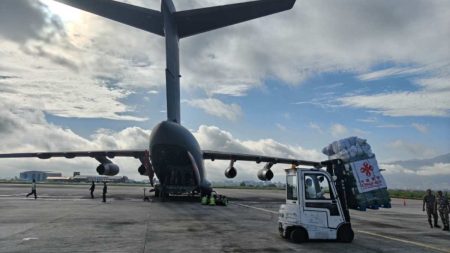
Nowhere is this starker than in Nepal. Sandwiched between the Asian giants, Nepal has long walked a tightrope. But where it once tilted gingerly towards Delhi, today it leans freely towards Beijing. In 2015 following a border dispute over Nepal’s adoption of a new constitution, India imposed an unofficial blockade that choked fuel and medicine supplies—officially denied but universally recognised. The memory lingers, bitterly. China, which promptly airlifted fuel into Kathmandu, has been capitalising ever since.
Beijing’s approach is methodical. Since 2017 when Nepal formally joined China’s Belt and Road Initiative, Chinese firms have built roads, hydropower projects and telecommunications infrastructure. Though many projects are still on paper, the symbolism is potent. China also cultivates a wider net: scholarships for Nepali students, training for civil servants, party-to-party exchanges with Nepal’s fractious communist parties and infrastructure commitments pitched as partnership rather than patronage.
India’s response has been patchy. It has granted aid and credit lines—nearly $2bn since 2015—and is Nepal’s biggest trading partner. But it is perceived as overbearing. Infrastructure projects come with strings; political relationships are highly personalised; and private-sector involvement centres on one company: the Adani Group.
Adani’s prominence in Nepal is telling. The conglomerate has sought to develop an international airport and operate three others. It is also lobbying for hydropower deals. Its chairman, Gautam Adani, is famously close to Mr Modi and faces scrutiny over opaque contracts and inflated pricing in Bangladesh and Sri Lanka. When Delhi’s regional ambitions are seen to ride on a single, politically connected corporate actor, the optics—more so in fragile democracies—are not ideal.
That creates an opportunity for China, which has quietly recalibrated its regional strategy. Belt and Road funding may have slowed, but Beijing is betting on subtlety over spectacle. Rather than outspend India, it is outmanoeuvring it. In Bangladesh it stepped in with $2bn in financial aid after the fall of Sheikh Hasina, a longtime Indian ally, and has pitched a port development plan in Mongla, which India had once hoped to secure. In Sri Lanka it is reviving stalled infrastructure proposals and has persuaded the new president, Anura Kumara Dissanayake, to lift a moratorium on Chinese research vessels, long a sore point for India.
Some Indian diplomats are calling for a course correction. They note India has focused too narrowly on state-to-state ties and failed to build relationships with civil society, opposition parties or youth: groups increasingly decisive in shaping political outcomes. That failure was evident in Nepal, where Delhi’s long bet on Sher Bahadur Deuba, the centrist former prime minister, left it flat-footed when Mr Oli returned to power.
Others see the problem as structural. India’s foreign service is famously small—fewer diplomats than New Zealand’s—and reactive, often. Coordination between Delhi and state governments, particularly those bordering Nepal, is weak. And domestic politics increasingly colour foreign policy. Mr Modi’s Hindu nationalism plays poorly in Nepal, a secular republic with a significant Buddhist and Christian minority. In 2020 when India updated its official map to include disputed territory with Nepal, Kathmandu responded by issuing its own map—and the episode became a nationalist rallying cry.
Yet the deepest trouble may be conceptual. Delhi likes to speak of “South-South cooperation” and its aspirations as a “Vishwa Guru” (world teacher). But many neighbours struggle to discern what India actually stands for. In China there is a pitch—authoritarian capitalism with Chinese characteristics. In the West there is another—liberal democracy, however frayed. India, by contrast, seems to offer nothing more than geography and nostalgia. That may have sufficed when China was seen as an aggressive outsider. But now with China appearing more pragmatic and less ideological, Delhi’s hand is harder to play.
This matters beyond the Himalayas. Western governments increasingly view India as a counterweight to China in the Indo-Pacific. But regional missteps cast doubt on that role. If India cannot anchor influence in Nepal—which it shares open borders, deep historical ties and religious affinities with—how will it shape the wider region?
Mr Modi’s foreign-policy strategists say the region will swing back. Anti-China sentiment can be stirred just as easily. India still holds cultural sway, its television shows watched in Nepali homes, its universities hosting thousands of Nepali students. Geography, after all, cannot be changed. But nor can sentiment be taken for granted. In the great game for Asia’s future Delhi may yet find that the hardest terrain to navigate is its own mental map. ■