Image: Jonas Gratzer/Mongabay
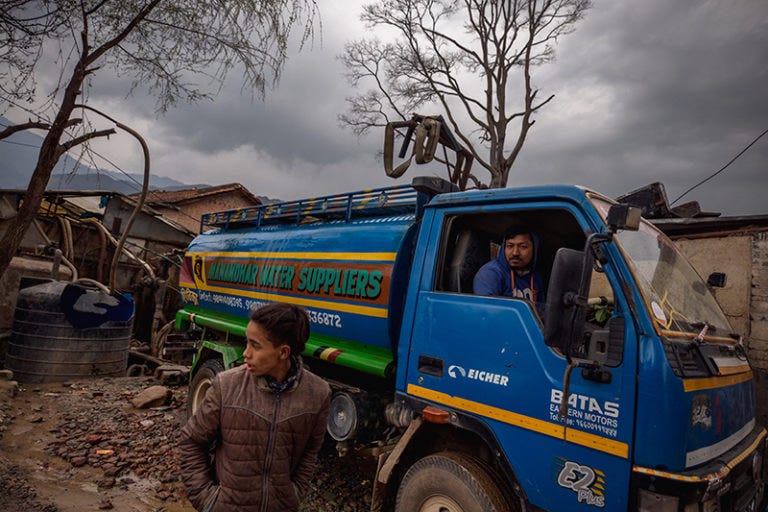
In most cities, tanker trucks are symbols of crisis, deployed in droughts, disasters or war zones. In Kathmandu they are simply how things work. Each day thousands of diesel-chugging vehicles snake through the capital’s chaotic lanes, delivering water to households and businesses. For the better part of 1.6 million residents, running water is a matter of negotiation, not plumbing. It arrives not at the turn of a tap but at the tailpipe of a truck.
This is not a temporary solution. The water tanker economy is a thriving parallel market that supplies a big share of daily water from rivers, aquifers and reservoirs. About 15% of households rely on it as their main source. It is also a textbook case of state retreat. What began as a stopgap has ossified into a durable workaround. In doing so, it is enabling and entrenching the very dysfunction it was meant to mitigate.
The origins of the crisis are, in part, hydraulic. The city’s public utility provides between 73 to 120 million litres of water daily—far below the demand of north of 400 million litres. Leaky pipes, some laid decades ago, squander much of what little flow exists. Water is rationed with the regularity of a ritual: many neighbourhoods receive supply only a few hours a week. As incomes rise and urban migration continues apace, the shortfall has widened into a chasm.
Yet the tanker solution is less a stroke of ingenuity than a symptom of systemic breakdown. The market is neither fully formal nor fully underground. Thousands of operators ply the roads—licensed, unlicensed, loosely regulated. The sourcing of water is opportunistic and often illicit: rivers tapped illegally, wells overdrawn, environmental norms sidestepped. Syndicates—some backed by political muscle—dominate key routes, stifling competition and inflating prices. What emerges is an oligopoly wrapped in informality: freewheeling on the surface but tightly controlled underneath.
Economically, the market is regressive. The wealthy in central Kathmandu command a disproportionate share of tanker deliveries, armed with storage tanks and smartphones. Poorer households, lacking both, pay more per litre for less reliable supply—or make do with contaminated communal taps. The system functions, but at the cost of fairness, transparency and public trust. Water, a basic right, has been converted into a status symbol, rationed not by need, but by purchasing power.
The politics are no less parched. The existence of a viable tanker economy conveniently dulls pressure on the authorities. Why invest in pipes when trucks keep voters just wet enough? The fallout is a feedback loop: informal supply dulls reform appetite, which in turn cements dependence on informal supply.
Environmental costs flow freely. The diesel trucks that deliver relief also deliver pollution in spades, contributing to the already appalling air quality. The over-extraction of groundwater is sapping aquifers at unsustainable rates, with few mechanisms to monitor or recharge them. Meanwhile, studies show tanker water is often laced with microbial contaminants, reflecting slapdash sanitation at source and minimal regulation at delivery. For a city that fancies itself a tourist hub and a capital-in-waiting for South Asian diplomacy, this is hardly a confidence boost.
Kathmandu is not alone. Mumbai’s so-called “water mafia” operates along similar lines. Lagos leans on private vendors to plug gaping holes in public supply. Cape Town’s flirtation with “Day Zero” in 2018 produced the brief formal rise of water trucks under municipal control. What these cities show is informal water economies are not uniquely Nepali. They are what happens when demand surges past state capacity, and when political incentives reward reaction, not reform.
But parallels also point to pathways forward. Cape Town, for instance, responded with regulation, tiered pricing and supply diversification. Here it means formalising without overcentralising. Transparent licensing, digital tracking, water-quality standards and price monitoring could bring tanker operators into the regulatory fold. Infrastructure investment is essential but must be paired with demand management: leak detection, rainwater harvesting and public awareness. Subsidies and community points could buffer the poor from market volatility. Smart meters and GIS mapping might help rebalance accountability.
Eventually, the tanker economy is a product of Kathmandu’s urban reality, caught between modernity and dysfunction. Reform will be politically inconvenient and fiscally demanding. But doing nothing risks turning a workaround into a permanent water regime.
Cities, like pipes, corrode from neglect. The tanker market, flawed though it is, underlines an urgent imperative: to build infrastructure fit for the 21st century—before the city runs dry.