Photo by Anjan Karki
In Nepal the easiest way to get rich is to leave. Foreign labour, not domestic enterprise, has become the default development strategy. Remittance agents outnumber accountants in countless villages, and language schools dedicated to Japanese or Korean have replaced libraries. The country’s most abundant natural resource is not water or herbs but able-bodied young men willing to mop hotel floors in Doha or weld pipelines in Busan.
This export of ambition has yielded a windfall. In 2023 Nepali workers sent home more than $11bn, roughly a quarter of GDP, and well above foreign aid or investment. This torrent of cash has kept the rupee steady, paid for concrete mansions in empty villages and subsidised national consumption. It has also warped the labour market; weakened state capacity; and reshaped the very idea of economic agency. Easy money, it turns out, carries a hidden cost: a slow erosion of the work ethic at home.
Leave to live
Labour migration is not new in Nepal. What is new is its totality. Around 3.5m Nepalis—more than a tenth of the population—now work abroad, mostly in the Gulf, Malaysia and, more recently, South Korea and Japan. Entire regions have been depopulated of working-age men. In some villages the hardest part of conducting a funeral is finding enough men to carry the coffin.
The economic logic is seductive. A job in Qatar pays multiples of what local agriculture or construction provides. For families remittances cover school fees, medical bills and the odd iPhone. For the government they provide hard currency to balance the books—without the political pain of tax reform or industrial policy. Private consumption, mostly funded by such flows, makes up more than 80% of GDP.
But the development model is precarious. Nepal risks the classic symptoms of “Dutch disease”: a strong currency, weak exports and an economy driven by spending rather than production. Imports surge, manufacturing withers and the country becomes addicted to income it does not generate. The inflow of cash is real; the illusion of prosperity is harder to pin down.
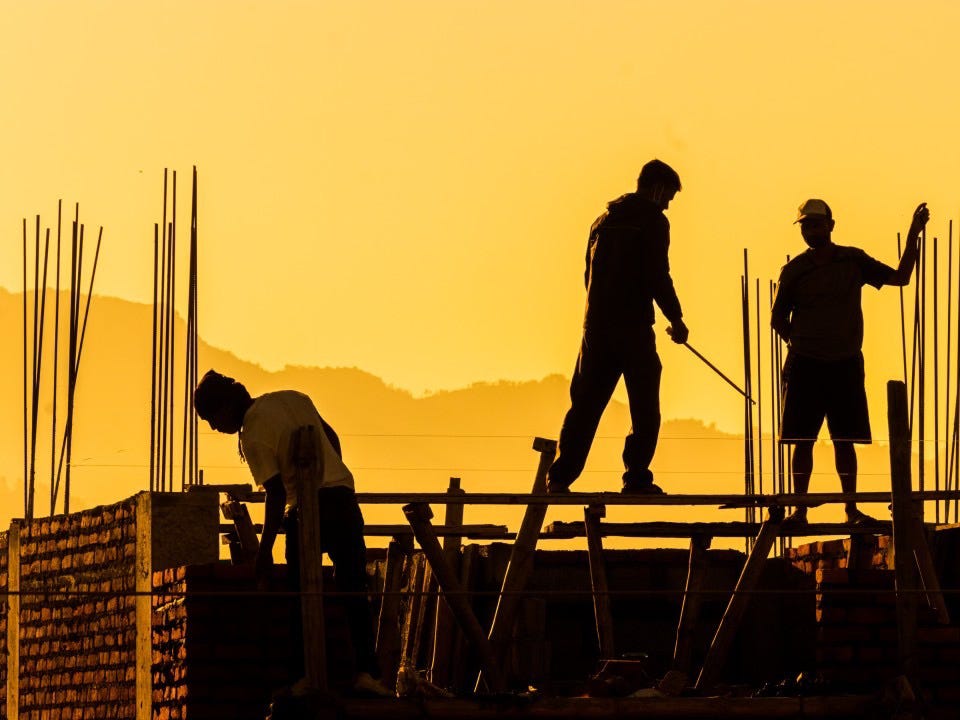
The labour market is both saturated and starved. Construction companies complain of worker shortages: yet jobseekers line up daily outside recruitment agencies. North of 60% of Nepali workers operate in the informal sector, mostly in agriculture or petty trade. The formal economy is thin, and vocational education uninspiring. Many youths prefer to shovel snow in Sapporo than soil their hands in Sindhuli.
The fallout is a mismatch between labour supply and economic need. Technical institutes are undersubscribed while job fairs in Malaysia draw queues around the block. Employers seek skills; workers seek passports. It is not that Nepal lacks manpower, it lacks faith in its own labour market.
This produces curious distortions. A mechanic trained in Seoul returns to Kathmandu, only to find his skills undervalued or irrelevant. Entrepreneurs struggle to hire; the state struggles to retain talent. Even government offices are not immune: some local councils find it easier to replace junior clerks with contractors than to keep them from emigrating.
Remittances have not only transformed the economy: they have reordered society. The new currency of respect is the boarding pass. Parents boast less about their children’s grades than about their visa approvals. The ideal son-in-law is not a doctor but a Gulf returnee with foreign savings and no criminal record.
This has bred a consumer culture long on liquidity and short on purpose. Families invest not in businesses or savings but in status—three-storey homes, imported cosmetics, elaborate weddings. A burgeoning share of the population lives off remittances—not income. When money arrives without work, the link between effort and reward begins to fray.
The toll is not only economic. Children grow up in homes where fathers are voices on the phone. Marriages strain under long absences. Communities lose cohesion, and local leadership atrophies. In some districts school attendance has dropped, as teenagers see more value in preparing for a language test than a school exam.
For the migrants themselves, the cost is usually fatal. Every year over 1,000 Nepali workers return in coffins. Many die from overwork, heatstroke or construction accidents. An estimated 12% of these deaths are suicides. The emotional and psychological burden of overseas labour is rarely addressed; the state prefers to count remittances, not trauma.
You win again
The government, for its part, has outsourced economic policy to the remittance pipeline. Rather than build industries or reform education, it invests in faster visa processing. Ministries compete not to create jobs but to sign new labour agreements. Whereas some programmes support returnee reintegration, most are hobbled by bureaucracy, corruption or neglect.
Politicians are happy to preserve the illusion of prosperity. Remittances delay difficult questions: how to raise taxes, reform land use, industrialise a mountainous country. A government sustained by foreign earnings has little incentive to risk political capital on domestic transformation. Better to export the problem—literally.
Other countries have done better. The Philippines channels remittances into small business grants and pension schemes. Mexico has matched diaspora funds with public investment in infrastructure. Sri Lanka once experimented with returnee entrepreneurship programmes. None has fully solved the distortions of export-led labour, but all have tried harder than Nepal.
Back to work
Can Nepal reverse the tide? Not easily. Migration will remain a lifeline for many. But the country can do more to make staying a viable choice. That means revalorising work at home—through technical education, better wages, visible career paths. The state must pivot from exporting labour to nurturing it.
Remittances should not be vilified. But they should be harnessed. Financial literacy campaigns could encourage savings over splurges. Incentives could steer remittance inflows into productive investments—from agri-tech to tourism infrastructure. Returnees bring skills and savings; they need institutions willing to match their ambition.
More fundamentally, the country must revisit its story of success. So long as prosperity is measured in foreign currency, and dignity in distance from home, the labour ethic will be skewed. A society cannot thrive when its dream is to leave.
As things stand, Nepal is a country that sends its youth abroad to earn money, its middle-aged to manage remittances and its elderly to wait. The economy survives, the society drifts and the plough remains untouched. ■