Image: Share Hub
It is not every day that a city police chief is suspended for locking the boss out of his own office. Then again Kathmandu is not just any city, and Senior Superintendent Rajunath Pandey is not just any policeman. His six-month suspension, handed down on June 3rd, is the latest—and perhaps most comical—chapter in an escalating turf war between Nepal’s most prominent mayor and a bureaucrat backed by the federal government.
On paper the episode is an open-and-shut case of misconduct. Pandey, chief of the Kathmandu Metropolitan City (KMC) Police, stands accused of blocking Chief Administrative Officer (CAO) Saroj Guragain from entering city premises, seizing the attendance register and immobilising the CAO’s official vehicle—all allegedly at the verbal behest of Mayor Balendra Shah. His written defence, submitted in late May, was rejected as unsatisfactory. The Municipal Police Act of 2023, which places the city police under the CAO’s authority, provided the legal justification for suspension.
But in reality this is not about procedure but about power. The real charge against SSP Pandey is not that he overstepped the law but that he waded into a constitutional quagmire: a simmering standoff between a populist local leader and a centralised, top-heavy state apparatus.
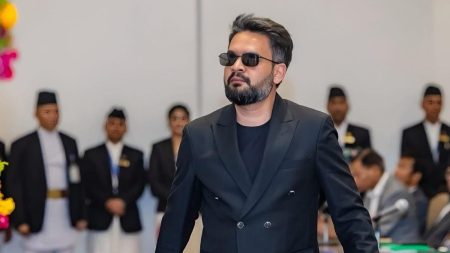
The cast of characters is instructive. Mayor Shah, a rapper-turned-reformer, won Kathmandu’s mayoralty in 2022 as an independent and social media sensation, promising to modernise the moribund capital. His confrontational style has made him a darling of frustrated urbanites—and a headache for entrenched bureaucrats. Opposite him stands Guragain, a career civil servant parachuted in by the federal government, and widely seen by the mayor’s camp as an obstacle to reform.
Their relationship began to unravel over a hubris: a vanity infrastructure project. Guragain stands accused of approving unauthorised alterations to the Kathmandu Tower, a half-built monolith whose revised plans would see it stretch to 19 storeys—seven more than originally sanctioned—without the courtesy of a seismic or structural review. Shah moved quickly, suspending Guragain in what he cast as a defence of due process. The federal government, for its part, refused to send a replacement, leaving key municipal functions like payroll approvals in limbo.
Matters reached a head in early April, when the federal government reinstated Guragain during the mayor’s absence from the city. Video footage showed Pandey’s officers physically obstructing the CAO’s return—while Deputy Mayor Sunita Dangol and a majority of ward chairs formed an unlikely honour guard to escort him back to his desk. The tableau had the look of low-budget farce but it captured a high-stakes constitutional dilemma: who really runs Kathmandu?
The answer, increasingly, depends on whom you ask—and when. Nepal’s constitution, adopted in 2015, promised a bold experiment in federalism, devolving power to local governments for the first time in the country’s modern history. But the transition has been messy. Legal ambiguities abound. The Municipal Police Act makes the CAO the formal superior of the city police: yet it remains silent on what happens when a popularly elected mayor instructs officers to do the opposite. Nepal has decentralised responsibility without fully decentralising authority.
The return of KP Sharma Oli as prime minister earlier last year has only sharpened the tension. Oli, chair of the powerful Communist Party of Nepal (Unified Marxist–Leninist), has shown little appetite for curbing federal oversight. His government’s reluctance to replace Guragain is widely viewed as a political signal: local governments, no matter how vocal or ambitious, must not forget who holds the purse strings.
Yet the episode also lays bare a deeper contradiction. Though the formal structures remain tied to centralised control, political legitimacy is increasingly being earned—and wielded—at the local level. Shah’s popularity stems not from party patronage but from his independent mandate and digital charisma. His battle with the bureaucracy has only burnished his credentials as a civic David facing down a bureaucratic Goliath.
That may be good politics, but it is bad governance. The paralysis triggered by the Shah-Guragain clash has delayed municipal services and eroded trust in public administration. It also exposes the limits of mayoral authority when institutions are caught between overlapping lines of command. Pandey’s suspension, far from restoring order, merely underlines the dysfunction: a police chief is punished not for choosing sides, but for making the sides visible.
Nepal’s federal experiment is still young, and growing pains are to be expected. Yet unless clearer rules of engagement are established between elected leaders and career bureaucrats, the risk is that local democracy becomes a theatre of personality rather than a platform for policy. Kathmandu deserves better than a city government that alternates between reformist zeal and institutional gridlock.
In the meantime if you want to survive in Nepal’s public service, you’d best keep the keys to the office—and the attendance register—close at hand. ■