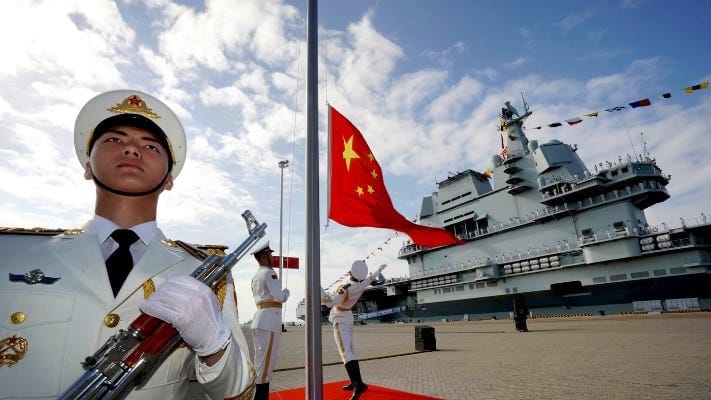
A Chinese invasion of Taiwan, territory Beijing claims as its own, is no longer a hypothetical. It is being scheduled. So warned America’s Defence Secretary, Pete Hegseth, who recently called a Chinese assault “imminent”, the kind of remark that once would have been confined to hawkish think tanks. Gone, it seems, is Washington’s decades-old policy of strategic ambiguity, replaced by open alarm. But the true shockwaves of war in the Taiwan Strait would not be limited to Beijing or Washington. The fallout would extend across supply chains and even into the Himalayas.
Taiwan is an economic linchpin with geopolitical liabilities. The island produces over 60% of the world’s semiconductors and a stonking 90% of advanced chips. Its role is so central that it might as well be the motherboard of modern capitalism. Any conflict would not only devastate chip production but also reverberate through everything from smartphones to satellites, car factories to AI labs. Energy prices would rocket as oil flows through the Strait of Malacca choke. Global inflation would roar.
For Nepal that would be no remote squall. It would be an economic storm. Roughly 50,000 Nepalis work in Taiwan, by some estimates, many in manufacturing and caregiving. A war-induced economic shutdown could send thousands home, drying up a key source of foreign currency. Nepal’s remittances (worth nearly 25% of GDP) would take a hit. Tourism would be mauled: Chinese visitors would vanish; global travel routes would be snarled; and tourist arrivals could halve. Foreign direct investment, tiny to begin with, would likely collapse. For a country perennially starved of dollars, foreign reserves could start to look anorexic.
The real test, however, would be diplomatic. Nepal professes non-alignment, an increasingly quaint notion in a world of binary choices. But neutrality is easiest when no one is asking you to pick a side. In a Taiwan crisis, pressure would come from both directions. America could urge Kathmandu to stand with the “rules-based order”; China might be less subtle in demanding fealty. Either way, Nepal’s balancing act would grow wobbly, given its two giant neighbours watching closely.
In Taipei the mood has turned from denial to defiance. For decades Taiwan’s strategy was to hold off a Chinese invasion for about a month—just long enough for the Americans to arrive. That premise now looks shakier. Donald Trump has cast doubt on automatic intervention. His disparagement of Ukraine’s resistance to Russia has also rattled nerves in Taipei. If the cavalry is late—or never arrives—Taiwan must prepare to survive on its own.
Hence the shift in tone. Taiwan’s leaders now speak openly about civil defence and national resilience. President Lai Ching-te, successor to Tsai Ing-wen, has embraced “whole-of-society” drills and emergency stockpiles. The messaging is blunt: this will be a long war not a short shock. Taiwanese officials are studying civil defence models from Israel and Finland, bolstering cybersecurity, and gamifying resistance to misinformation. The public, once wary of talk that might provoke China, is being slowly inducted into the logic of endurance.
But even the best-prepared island is still an island. Taiwan’s semiconductor industry relies on imports of critical gases, tools and chemicals, many of which would be severed by blockade or war. Western defence analysts debate whether Taiwan’s chip factories— its greatest strategic asset—are also its Achilles’ heel. If the fabs fall silent, the global economy will not merely sneeze. It will convulse.
America, at least rhetorically, is firm. Hegseth has warned Beijing of “devastating consequences”. But the allies are less unanimous. Japan and the Philippines are most directly affected: Japan may contribute submarine patrols and missile strikes, though is unlikely to engage in large-scale combat. Manila, home to 175,000 workers in Taiwan, would tread cautiously. If Chinese forces falter, however, the temptation to settle scores in the South China Sea might prove too strong. Much depends on whether China strikes American bases on their soil, an escalation that would force their hand.
Further afield, South Korea, Australia and India would play secondary roles. Seoul’s priority would be deterring North Korea from exploiting any American distraction. Canberra, increasingly central to US military logistics through the AUKUS pact (which looks increasingly perilous now), might support rear-area operations but stop short of a direct fight. India, still bruised from border skirmishes with China, would focus on its Himalayan front, though it might aid the West via intelligence and naval coordination.
Europe, ever the reluctant stakeholder in Indo-Pacific affairs, is sending mixed signals. Britain and France have dispatched carriers to the region, more as geopolitical pageantry than promise of combat. Emmanuel Macron has admitted he would be “very cautious” about military involvement. Economic sanctions are more plausible. A serious EU ban on Chinese imports could jolt Beijing but consensus would be hard-won.
In Kathmandu such strategic machinations may seem distant. But the ripples will reach Nepali households in the form of costlier food, pricier petrol, fewer jobs abroad and stalled investment at home.
Taiwan, a tiny island of 23 million people, could tilt the fate of billions. ■