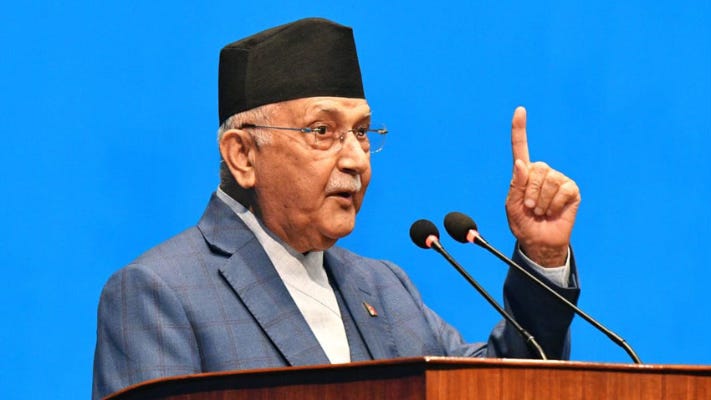
Image via Pardafas
In a country where political careers used to end in exile or obscurity, K.P. Sharma Oli has proven unusually resilient. Four stints as prime minister, countless intraparty feuds and a constitutional crisis or two later, the man who once dismissed republicanism as a “bullock cart to America” now presides over the republic’s chariot with characteristic swagger. For some, he is Nepal’s modern Machiavelli, a master of backroom bargaining. For others, he is a thuggish centraliser in populist garb. Either way, his legacy is impossible to ignore and increasingly hard to pin down.
Born in the eastern hills of Tehrathum in 1952 and reared in the flatlands of Jhapa after floods uprooted his family, Oli’s political baptism came via the Jhapa rebellion, inspired by India’s Naxalite insurgency. He cut his teeth organising against the Panchayat regime, was jailed for 14 years (including four in solitary confinement) and emerged from prison in 1987 a hero of the underground left. Yet even in his militant youth, Oli was never an ideologue’s ideologue. He quickly clashed with armed-struggle hardliners and over time pivoted toward parliamentary pragmatism. When the Maoists took up arms in the mid-1990s, Oli chose the ballot over the bullet.
By the 1990s he had become a rising star in the Communist Party of Nepal (Unified Marxist-Leninist), pushing for internal reform and democratic norms within the party. He championed Madan Bhandari’s “People’s Multiparty Democracy” and backed the controversial Mahakali Treaty with India (moves that split the party but burnished his image as a moderniser). Still, it was not until 2015, during Nepal’s worst political and humanitarian crisis in years, that Oli entered the pantheon of executive power.
His first premiership, born out of constitutional brinkmanship and an Indian blockade, saw a stunning realignment of Nepal’s foreign policy. Frustrated by India’s high-handedness, Oli looked north. Transit and trade treaties were signed with China, and Himalayan connectivity became the new nationalist mantra. He cast himself as the defender of Nepal’s sovereignty, a Himalayan hedgehog rolling up against the elephant to the south. It was an acting but it worked.
Theatrical nationalism has been Oli’s calling card ever since. In 2020 he responded to India’s road construction through the Lipulekh pass by issuing a new political map that included disputed territories (Kalapani, Lipulekh and Limpiyadhura). Parliament rushed through a constitutional amendment to enshrine it. No boots moved but borders were redrawn on paper, to public applause. Critics decried it as performative cartography. Supporters called it strategic boldness.
But there’s more to Oli than map-making. His second and third terms (2018–2021) were defined by internal squabbles, cabinet reshuffles and what many saw as a drift toward executive overreach. The merger of the UML with the Maoist Centre into the Nepal Communist Party (NCP) was hailed as a leftist consolidation but quickly unravelled into a power struggle between Oli and Pushpa Kamal Dahal (Prachanda). Oli’s tactics—dissolving Parliament twice, defying party norms, sidelining rivals—left the judiciary to do the heavy lifting of constitutional interpretation. The Supreme Court duly reversed both dissolutions and annulled the NCP merger, restoring old party acronyms—and egos alike.
Nor was governance Oli’s forte. His covid-19 response veered between denialism and pseudoscience. He claimed the coronavirus could be cured with turmeric and guffawed at imported strains, suggesting the “Indian virus” was more dangerous than the “Chinese or Italian” ones. His foreign ministry made few friends abroad; his health ministry made fewer friends at home.
His relationship with India, always fraught, reached surreal new heights. He claimed Lord Ram was born not in Ayodhya, India, but in Thori, a village in southern Nepal. The Indian Ayodhya, he declared, was “fake”. He called for archaeological excavations, declared the origin of yoga to be Nepali and even launched a semantic offensive to replace “rhino” with “gaida” and “Everest” with “Sagarmatha”. Diplomacy by etymology did not amuse Delhi, or many Nepalis, for that matter.
Yet domestic politics remained his true arena. Oli’s centralising instincts were rarely concealed. Though federalism was enshrined in the 2015 constitution, Oli treated it as an inconvenient formality. Provincial and local governments were denied autonomy; budgets were sequestered in Kathmandu; and bureaucrats found it safer to seek instructions from Baluwatar (the PM’s residence) than their own capitals. Ironically, the man who once skipped Parliament’s vote to abolish the monarchy now acts like a constitutional monarch—minus the restraint.
Still, Oli’s grip on power has proven Teflon-coated. Notwithstanding his ousting in 2021 and a humiliating party split, he returned to the premiership in July 2024, this time via an unlikely alliance with the Nepali Congress, his ideological antithesis. The arrangement—a rotational power-sharing deal with Sher Bahadur Deuba—was sold as national consensus but smelled more like elite collusion. That Nepal’s two largest parties, one Marxist and the other centrist, could co-govern so seamlessly says less about their convergence than about their shared taste for expedient politics.
What, then, is Oli’s legacy? Not transformative policy, nor democratic deepening. His economic stewardship has been unremarkable; his federalism reluctant; his governance patchy. But as a political survivor and nationalist showman, he has few peers. He has reshaped Nepal’s strategic imagination, nudged the country closer to China and put its territorial claims on the global map, if not the ground. He has also normalised executive impunity; weakened party institutions; and blurred the line between populism and pettiness.
In the end K.P. Oli may not be remembered for what he built but for what he bulldozed: parliament, party unity, constitutional restraint. He is both a product and architect of Nepal’s volatile politics. Whether his fourth term marks the twilight of an era or merely another chapter in his political saga depends not on maps or myths, but on whether anyone else dares to outmanoeuvre him at his own game. ■