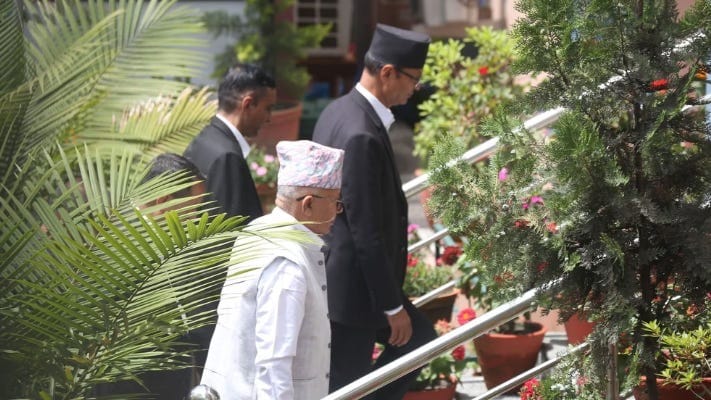
For a man accused of orchestrating one of the biggest land scams in Nepal’s democratic history, Madhav Kumar Nepal walked out of court with a relatively light burden: a NPR 3.5m ($26,000) bail. The special court’s decision on June 25th to release the former prime minister—pending trial in the so-called Patanjali land deal—was met with a cocktail of legalese and déjà vu. Once again, the political class appears to be held accountable, but only just.
The court’s ruling came after a three-hour detention hearing in which Mr Nepal, leader of the Communist Party of Nepal (Unified Socialist), maintained his innocence. Prosecutors from the Commission for the Investigation of Abuse of Authority (CIAA), the country’s anti-graft body, had asked for far more: 14 years in jail and the recovery of NPR 185.85m in alleged damages. They claim Mr Nepal abused his position as head of government between 2009 and 2011 to facilitate the illegal transfer of land—exempted from ownership ceilings under the guise of public welfare—to Patanjali Yogpeeth Nepal, a local arm of the Indian wellness empire. That land was later resold to private developers.
The episode has become a litmus test for whether corruption in Nepal is merely condemned or actually punished. Granting bail to a former prime minister may seem like a routine matter of due process. But here where political trials tend to collapse under the weight of procedural ambiguity and shifting blame and tactical forgetfulness, it also raises the stakes for what the case—and Mr Nepal’s eventual fate—could mean for the broader accountability regime.
The defence called the prosecution overreach. Mr Nepal’s lawyers argue cabinet decisions are political rather than criminal and that they lie outside the CIAA’s purview. In their telling, Mr Nepal’s government merely followed precedent: land ceiling exemptions had been granted before and were even upheld by the supreme court in 2003. Besides, they say, how can the state have incurred a loss from land that was never officially owned by the government to begin with?
The CIAA, however, disagrees. Their legal team, led by senior advocate Sushil Pant, argues this was not a matter of policy but of procurement which was plainly illegal. The land, though not titled to the state, fell under provisions requiring nationalisation if it exceeded statutory ownership limits. Forgoing this nationalisation, then approving its sale, effectively transferred a public asset into private hands at knockdown rates. The cabinet’s blessing, Pant said, should not give immunity to malfeasance faking as governance.
At the root of the case is a question that has long haunted transitional democracies: when does bad policy become criminal? Most countries draw a fine line between executive discretion and legal culpability. In Nepal, where decisions tend to emerge from closed-door horse-trading rather than open deliberation, that line is especially blurry. But in this instance, the paper trail appears unusually precise. The sale was approved just weeks after the land was granted. Bureaucrats who dissented were quickly replaced. Records show the cabinet acted “as per instructions from the prime minister”.
That clarity may prove damning. Whereas other corruption cases often hinge on hearsay or implied favouritism, this one is documented—down to the memos, signatures and land valuations. If prosecuted to the full extent, it could establish a rare precedent: that a policy-level act, when demonstrably self-serving and orchestrated, is not above the law.
Still, few in Kathmandu are holding their breath. The judiciary has a reputation for untimely delays and pliable rulings. The CIAA itself is seen as selective in its zeal, pouncing on soft targets while ignoring more politically inconvenient ones. Why, critics ask, has the Patanjali deal been pursued with such vigour while other dubious land allocations from the same period remain untouched?
Then there is the timing. The charges come as Mr Nepal’s party jostles for relevance ahead of elections. Some suspect the revival of the case is less about judicial reform than political marginalisation. Prosecution in Nepal has tended to serve as a proxy for purging rivals rather than cleansing institutions.
Even so, Mr Nepal’s bail is no guarantee of a smooth ride. The damage is already done. Once the elder statesman of the left, he now finds himself entangled in what is fast becoming a byword for elite impunity. It is not only the legal charges but the reputational costs that may define his twilight years. For a man who styled himself a clean break from the chaotic 1990s, his alleged complicity in a land grab seems especially cruel.
Whether the case leads to a conviction or dissipates, it has already exposed structural rot: the ease with which cabinet power can be used to reclassify assets; the fragility of bureaucratic resistance; the inertia of watchdog institutions. It shows corruption in Nepal is no longer a matter of under-the-table dealings. It is institutionalised, notarised and until now largely consequence-free.
That Mr Nepal is out on bail rather than behind bars may not be surprising. But it does leave the public asking whether justice, once again, is being negotiated rather than delivered. ■