
Image: IMAGO/NurPhoto
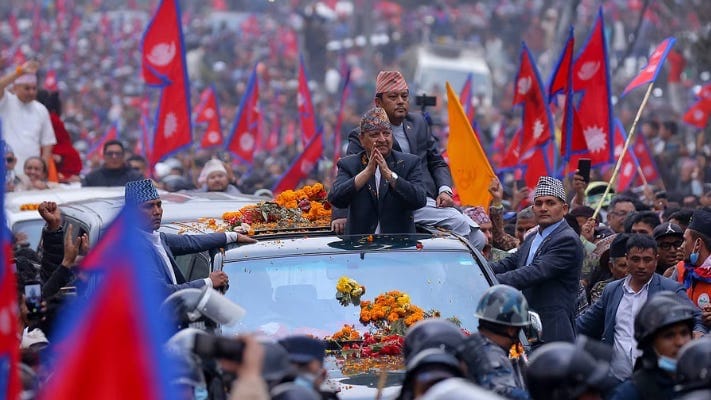
In Nepal, as in much of South Asia, the gods are never far from politics. But lately some politicians have been getting rather closer than usual. On May 29th the Rastriya Prajatantra Party (RPP), a royalist outfit with a soft spot for saffron, will take to the streets of Kathmandu. The stated aims: peace, piety and the restoration of a Hindu kingdom. Its tactics will be civil disobedience and Satyagraha, a term borrowed from Mahatma Gandhi—though the target is less colonialism than constitutionalism.
These protests are not without irony. Nepal’s embrace of secularism, republicanism and federalism was hailed as a triumph of democratic modernity in 2008, after a decade-long Maoist insurgency and the ignominious end of a monarchy sullied by fratricide and public distrust. Yet less than two decades on, monarchists and Hindu nationalists are once again in open revolt—not through rifles and revolution but with garlands and slogans.
The revival has less to do with nostalgia than arithmetic. The RPP and its ideological cousins have sensed a shift in cultural undercurrents. A growing section of the electorate, disenchanted by corruption, economic drift and party musical chairs, appears susceptible to the consolations of tradition. Sanatan Dharma, the ancient order of Hindu life, is being refashioned as a political anchor in an age of flux. Civilisational angst is being recycled as campaign fodder.
The protestors are not alone. Kamal Thapa, head of RPP-Nepal and a veteran of royalist politics, has openly mused about reinstating monarchy—perhaps with Hridayendra Shah, the teenage scion of the old dynasty, as king. For Mr Thapa, monarchy is not about lineage but “ideology”—though it is unclear what ideological vision a teenager might provide. Still, symbolism matters: the very prospect of royal revival gives shape to a movement otherwise lacking in policy.
Behind the flutter of saffron flags is a broader political recalibration. Within the Nepali Congress (NC), the biggest democratic party, some senior leaders have begun to question the secular consensus. Figures like Prakash Sharan Mahat and Minendra Rijal now argue secularism was foisted on Nepal under Maoist pressure and is culturally incongruent. Others, such as Shashank and Shekhar Koirala, have gone further, endorsing the idea of a Hindu state outright. A report circulated within Congress’ own think tanks recommended a strategic reconsideration of secularism. The party is split: old-guard secularists like Bimalendra Nidhi resist, whereas president Sher Bahadur Deuba is enigmatically uncommitted.
Even within the communists, unease simmers. Pradeep Gyawali of the CPN-UML concedes secularism is often conflated with religious conversion, a sore point in a society where foreign-funded evangelism has sparked unease. Prime Minister KP Sharma Oli, though no theocrat, has not shied away from religious gestures—gold-plating the Pashupatinath temple or asserting Lord Ram was born in Nepal, not India. Yet the UML has not adopted a religious plank formally, and Gyawali insists they will not seek constitutional changes on the matter. The CPN (Maoist Centre), meanwhile, is staunchly secular, warning any party embracing the Hindu state agenda risks public backlash.
Public opinion, however, is not so easily mapped. Many Nepalis are more aggrieved by bad governance than by godlessness. DP Aryal of the Rastriya Swatantra Party (RSP) argues the state’s real failure is not in undermining religion but in mismanaging everything else. For now the RSP sees no reason to abandon secularism. But that could change if the cultural mood continues to darken.
It is tempting to view all this as a localised spasm of religious revivalism. Yet the parallels with India are too striking to ignore. There, too, a formally secular republic has seen the rise of a muscular Hindu nationalism, fuelled by frustration with pluralism and the promises of modernity gone unmet. The electoral success of the Bharatiya Janata Party has given confidence to copycats across the region. Nepal’s own Hindu revival may be less organised, but it is no less real.
For now the centre holds—just. But the fact that Nepal’s largest democratic party is flirting with theological nationalism is a sign of ideological decay. When secularism, enshrined as a democratic virtue, becomes a negotiable talking point, the foundations of the republic begin to wobble. The gods may yet return—not through divine intervention, but through political opportunism.
And should Hridayendra Shah ever mount a throne, it will not be a coronation of charisma, but of nostalgia dressed as necessity. ■




