Image: The Kathmandu Post
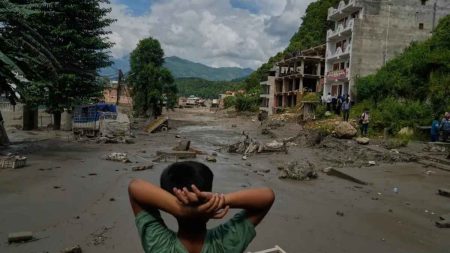
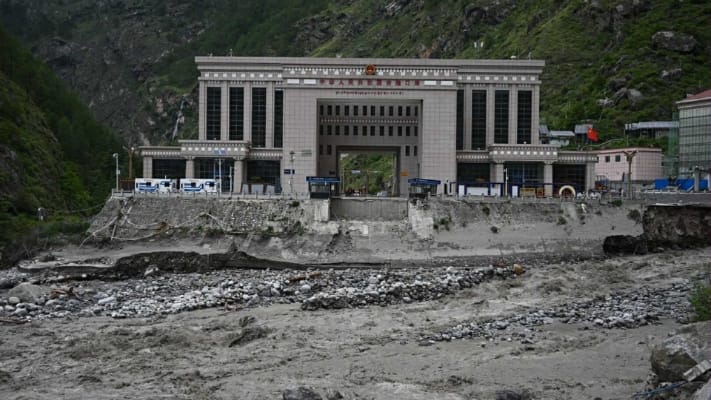
It takes one bridge to link nations. It takes one river to sever them. The Miteri Bridge, Nepal’s key trade artery with China at the Rasuwagadhi-Kerung border, was swept away on June 8th by a flash flood from the Lhendey River. What followed was a logistical disruption and an economic parable. In relying heavily on a single, fragile mountain corridor, the country has exposed its development strategy to the whims of water.
Until its sudden collapse, the Miteri Bridge had become one of the most important pieces of infrastructure in Nepal’s trade puzzle. Rasuwagadhi accounted for nearly 5% of all imports into the country this fiscal year, up from 3.8% the year before. Nearly half of the hike in total trade with China passed through this alpine crossing, boosted by electric vehicle (EV) imports, toys, textiles and household goods. The bridge supported more than 60% of its vehicle imports from China. Now customs agents have little to declare except damage reports.
The flood has left more than twisted metal and waterlogged warehouses in its wake. Rasuwagadhi’s dry port has been incapacitated. Dozens of EVs awaiting clearance have been destroyed. Roads on both sides of the border are unusable. With trade flows suspended indefinitely, Nepali exporters of tea, wool and handicrafts are stuck in the highlands with nowhere to go. The government is scrambling to restore connectivity: it has asked China to help install a temporary Bailey bridge and ordered ministries to accelerate domestic repairs and insurance claims. Prime Minister KP Sharma Oli’s site visit did little to ease the logistical bottleneck.
The disaster has underlined an uncomfortable truth for policymakers: the country’s northern trade infrastructure, heralded as a diversification coup, is perilously underbuilt. Its tilt towards China in recent years—motivated by geopolitical hedging and soaring consumer demand—has outpaced the physical capacity of its corridors. Much of the northern border is stitched together by roads vulnerable to landslides, floods, customs points running on paper and bridges too few to count. The Lhendey River, with scant warning, has exposed the folly of this asymmetry.
Rasuwa had become the poster child of Nepal’s trade with China. Imports through the corridor rose by 45.9% this fiscal year. Exports, such as they are, increased by 20.6%. The broader China-facing trade relationship has grown briskly: total imports from China hit NPR 314.6bn in the first eleven months of this fiscal year, up 15.3% from the same period a year prior. Exports, at NPR 2.5bn, barely moved. This yawning trade imbalance—China accounts for over 19% of Nepal’s imports but receives less than 1% of its exports—has repeatedly been seen as a cost of access. Few expected the access itself to vanish.
The alternative routes do not inspire confidence. Tatopani, once the main overland gateway to Tibet, has seen its fortunes dwindle. Earthquake damage in 2015 and bureaucratic malaise since then have rendered it unreliable. It handled a mere 2.85% of imports this year. Exports through Tatopani, always minimal, have now fallen to zero. The Tribhuwan International Airport, the main hub for air cargo from China, is levelling off. Imports there actually fell by 0.4%, likely due to high freight costs and traders shifting to land routes—until nature closed the gate.
The Ministry of Physical Infrastructure and Transport has been tasked with exploring alternative border crossings. This is easier said than done. Mountain geography and Chinese security preferences as well as budgetary constraints make diversification difficult. Experts warn Nepal cannot afford to build its economic future on a single pass through the Himalayas. Redundancy is not a luxury but a necessity.
Calls are mounting for climate-resilient trade infrastructure. This includes all-weather roads; multiple land customs points; and digitalisation of port operations. The Rasuwagadhi debacle has also revived interest in insurance reform. Dozens of stranded importers now face delayed or inadequate payouts, pointing to structural weakness in the country’s logistics-finance nexus. The Ministry of Finance, under pressure to soothe aggrieved businesses ahead of the festival season, has promised faster processing. Whether promises can be delivered faster than EVs remains to be seen.
Domestic planners have always dreamed of becoming a bridge between India and China. Yet the more Kathmandu deepens ties with Beijing, the more it relies on infrastructure over which it has limited control. China’s own response to the Rasuwagadhi disruption has been muted. The damaged roads on its side remain unaddressed. Beijing’s help with the Bailey bridge, if forthcoming, would be a temporary solution to a long-term vulnerability.
The flood offers a moment of clarity. Nepal’s ambitions to integrate into Chinese supply chains and trim dependence on India are understandable. But trade routes without structural resilience are less pathways than dead ends. Bridges, like alliances, require more than concrete: they need foresight and maintenance.
The Miteri Bridge may yet be rebuilt. But unless Nepal rethinks its northern trade strategy, it risks rebuilding the same fragility. The next flash flood may not wait for a summit or a council meeting. In the Himalayas the water always flows downhill. So too, it seems, do the consequences. ■