IMAGE: Johann Kisaame
GDP GROWTH in Nepal rarely provokes much excitement, either domestically or abroad. The projection for the last fiscal year 2024-25 ended mid-July—4.61%—falls neatly into the country’s typical economic pattern: subdued and uneven. Services and energy are stirring; farms and factories are not.
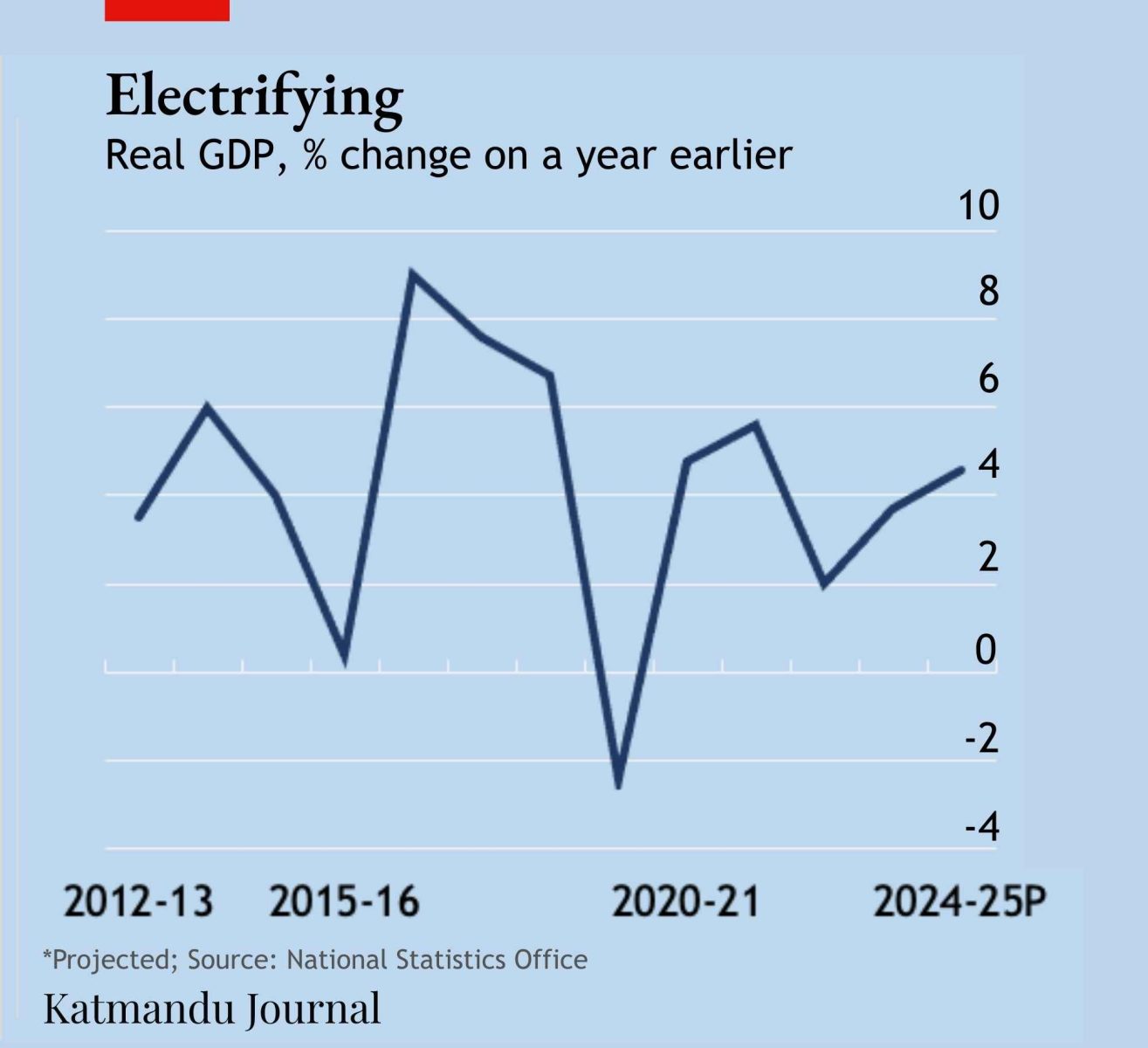
The post-pandemic rebound is real. But it has come lopsided. Electricity generation expanded by nearly 14% last year. The service sector, accounting for nearly 60% of economic output, has regained its footing in segments like finance, transport and hospitality. Tourism, battered by border closures in the pandemic years and sluggish infrastructure, is gradually recovering, though still reliant on Indian visitors. Banks and insurers are growing, albeit cautiously. Their recent gains—just above 6%—mask vulnerabilities including soaring non-performing loans and exposure to climate-induced risks such as flooding.
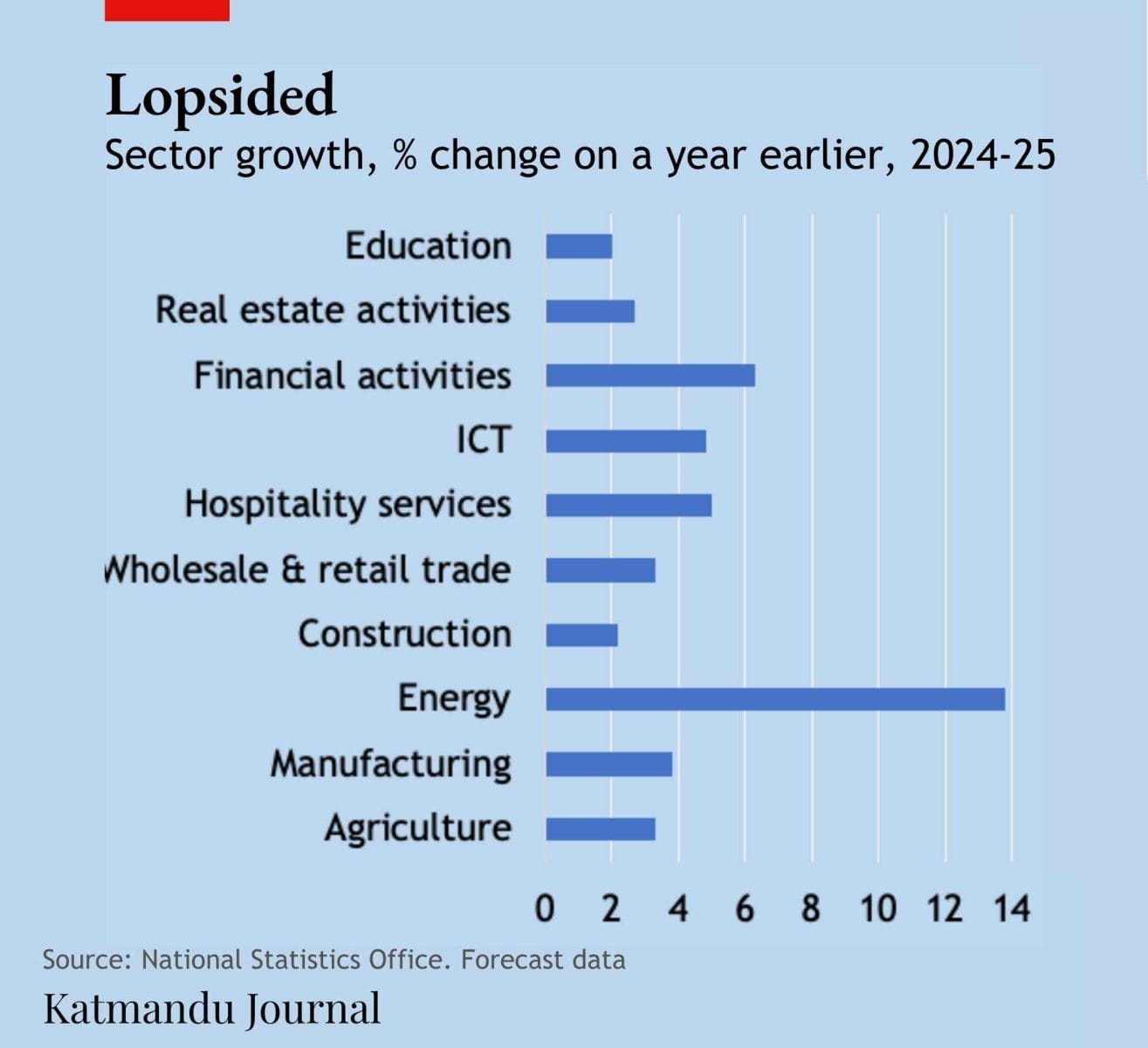
Energy has emerged as the economy’s most dynamic booster. Nepal, once chronically dependent on foreign power supplies, has become a net exporter, thanks largely to the maturation of its hydropower sector. Expanded capacity and new cross-border infrastructure have enabled the country to sell electricity to India, with more regional deals on the horizon. Hydropower has shifted from national ambition to operational reality, generating revenue and geopolitical relevance.
Other sectors are less illuminating. Agriculture, which still employs most of the population and generates over a quarter of GDP, remains stuck in a low-productivity rut. Output growth is tepid, hovering around 3%, and dependent on monsoons, migration and remittances. Efforts to commercialise the sector—through improved logistics, aggregation and mechanisation—have so far delivered more paperwork than productivity.
Industry fares a little better. Manufacturing grew by less than 4% last year, a weak recovery after a contraction of nearly 9% during the pandemic. The sector suffers from chronic infrastructure bottlenecks and high input costs as well as regulatory inertia. Nepal’s industrial policy remains aspirational, geared toward attracting investment in value-added production, but lacking the physical and institutional underpinnings to support it. The fallout is a kind of pre-industrial deindustrialisation: a shrinking base that was never fully built.
Construction, historically buoyed by remittance income and state spending, is also stalling. Annual growth has slumped to 2.2%, reflecting lower public capital expenditure and waning demand. Urban expansion has saturated in some areas, leaving behind housing stock without matching employment prospects. Many buildings have been erected; few businesses have followed.
The digital economy, frequently touted as Nepal’s next frontier, remains underwhelming. Information and communication services expanded by 4.8%, a decent pace but hardly transformative. Internet access is spreading slowly; digital payments are fragmented; and the country’s tech ecosystem lacks scale or depth. Regional peers—India, Bangladesh and Vietnam among them—have pulled further ahead in software exports and ICT-enabled services.
Public services, including education and health, show sluggish growth, hinting at stagnation in government hiring and reform. Education, in particular, expanded by less than 2%, a worrying signal in a country where human capital development is central to any long-term development strategy.
Yet some indicators point to shifts. Tax revenue has been climbing faster than GDP, suggesting either improved compliance or increased consumption. Either trend would help stabilise public finances, provided they are matched by commensurate investment in productive sectors. More concerning is the growing reliance on indirect taxation, which may outpace household income growth and suppress spending.
Nepal’s economic structure is lopsided: a service-heavy economy without the industrial or agricultural foundations typically seen in countries at a similar stage of development. That imbalance reflects structural constraints (like geography, infrastructure and capital scarcity) but also policy drift. Successive governments have promoted hydropower, tourism and digital connectivity. These efforts are beginning to yield results, though mostly in narrow bands.
The bigger trouble is lifting the performance of sectors with the potential to absorb large-scale labour. Agriculture needs targeted investment in areas like irrigation, mechanisation and aggregation (not simply organic enthusiasm). Manufacturing must pivot from top-down incentives to targeted support for clusters with export potential (textiles, food processing, light assembly).
Remittances remain a vital stabiliser, equivalent to 25% of GDP. They continue to prop up domestic consumption and construction. But they also represent an underlying crutch: income generated abroad compensates for limited job creation at home. The workers go, the money returns. Most do not.
Energy, however, presents a rare comparative advantage. With the right grid infrastructure and stable cross-border arrangements, Nepal could carve out a niche in clean energy exports in South Asia. Agreements with India and Bangladesh provide a foundation. Sustaining them will mean as much diplomatic finesse as engineering competence.
Transformation will be incremental. Geography will not change, nor will the challenges of scale or investment. But with strategic policy alignment and regional integration, modest growth may be anchored more solidly in productive activity. A 4.6% growth rate is unremarkable in itself. If it signals a more export-oriented and service-based path, it may be worth watching.
That is, provided the rivers keep flowing and the lights stay on. ■