
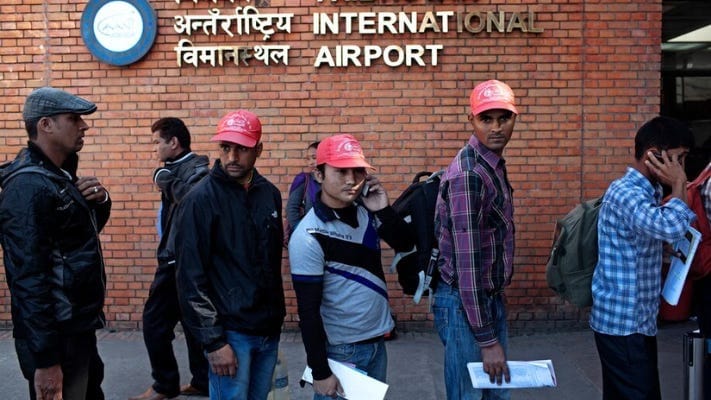
It is not common for a country’s leading export to be its people. Yet in Nepal, more citizens now leave for work abroad each year than the nation produces in manufactured goods. In the fiscal year that ended in mid-July, 505,957 Nepalis departed under foreign employment contracts—more than the number who entered university and equivalent to nearly 1.5% of the total population. This is a labour market where mobility, external rather than internal, functions as the central mechanism of opportunity.
Nepali migration is not a novelty, nor is Nepal alone in using remittances as economic ballast. What is changing is where its workers are going. While the Gulf states are still dominant, the balance is shifting. Malaysia, once the largest recruiter, has sharply curtailed its intake. The United Arab Emirates now welcomes over 200,000 Nepalis a year. Japan is becoming a fantastic destination. Poland, once expected to rise, has nearly vanished from the map. The reasons are not cultural or climatic. Labour flows, like trade, respond quickly to changes in policy friction and administrative ease.
Malaysia’s fall has been particularly steep. As recently as 2022–23, it took in 219,357 Nepalis, or 44% of all deployments. By 2024–25 the figure had plunged to 10,219. The collapse was caused by a thicket of recruitment agents, slow visa processing as well as outdated bilateral agreements. Nepal’s Department of Foreign Employment (DoFE) began restricting approvals while Malaysia’s Ministry of Home Affairs issued fewer permits. The result was self-cancellation.
The outflow, however, did not slow—it diverted. In the same two-year period, the UAE’s intake of Nepali workers jumped from 59,152 to 201,148, a 240% increase. Saudi Arabia and Qatar followed suit, reaching 77,247 and 49,178, respectively. Taken together, the Gulf now accounts for more than two-thirds of all Nepali overseas workers. The relationship is transactional: oil-rich economies need a steady supply of low-cost labour; Nepal offers an abundant pool of underemployment.
These are not entirely unskilled workers. Most undergo brief training in construction, logistics, security or care work. Contracts are short, often two years, but remittances persist well beyond their expiry. Wages in the Gulf are modest by global standards, typically $300–$400 a month, but they exceed what most Nepalis could earn at home.
East Asia’s role is expanding, albeit on a smaller scale. Japan, through its Specified Skilled Worker (SSW) programme, admitted 18,744 Nepali workers last year, up from 5,839 two years earlier. South Korea, using its own Employment Permit System, took 13,735. These pathways are more structured and better paid, though harder to enter. Caregivers in Japan earn around ¥180,000 ($1,200) a month, nearly four times the average wage in Qatar. The barriers, though, are significant. Language training is required, and the jobs attract primarily literate, urban applicants.
Europe is watching from the wings. Demographic decline and tight asylum policies have created a labour shortage in ageing countries keen to import skills but reluctant to absorb refugees. Romania, surprisingly, has emerged as Nepal’s largest European partner, admitting 22,373 workers last year. The jobs are concentrated in hospitality, care work and agriculture. Enforcement tends to be stricter than in the Gulf, and contracts more formalised. Poland, once regarded as a promising entry point, has gone cold—intake has shrunk from 4,915 to 313. Rising wages and political uncertainty offer a partial explanation.
European migration, though smaller, is viewed strategically in Kathmandu. It provides a hedge against overdependence on the Gulf, and a possible route toward longer-term integration. The model is less extractive, though less expansive.
The economic importance of migration is difficult to overstate. Remittances account for 25% of GDP, more than construction or manufacturing. They support household consumption, fuel property markets and stabilise the rupee. This macroeconomic dependence has discouraged policy innovation. Migration is treated as an inevitability rather than a strategy. The Ministry of Labour plays a nominal role; decisions are largely driven by recruitment firms and destination-country requirements.
Critics point to the absence of a national migration framework. There is little in the way of skills mapping, destination targeting or legal support for outbound workers. Contracts are signed without counsel. Reports of wage theft and abuse receive limited follow-up. Reform efforts exist, but rarely escape the pilot phase.
Supporters argue that the system functions well enough. In the Terai region, where employment among young men is especially low, overseas placements are often the only viable option. Domestic job creation remains sluggish outside agriculture. Labour migration may not be ideal, but it is effective.
Nepal’s negotiating power is negligible. It lacks the consular infrastructure of the Philippines and the regulatory clout of Bangladesh. Its labour attachés are few and poorly resourced. What it offers, however, is clear: a steady supply of dependable, low-wage manpower. Employers understand this. Recruiters build their businesses around it.
The flow is unlikely to slow. Should Malaysia reopen Nepalis will return. If new corridors open in Central Europe or Northeast Asia, they will adapt. Migration, for all its imperfections, remains Nepal’s most reliable employment programme. Whether that reflects a strategy, or the lack of one, is a question Kathmandu continues to leave unanswered. ■





