IMAGE: Wikimedia Commons
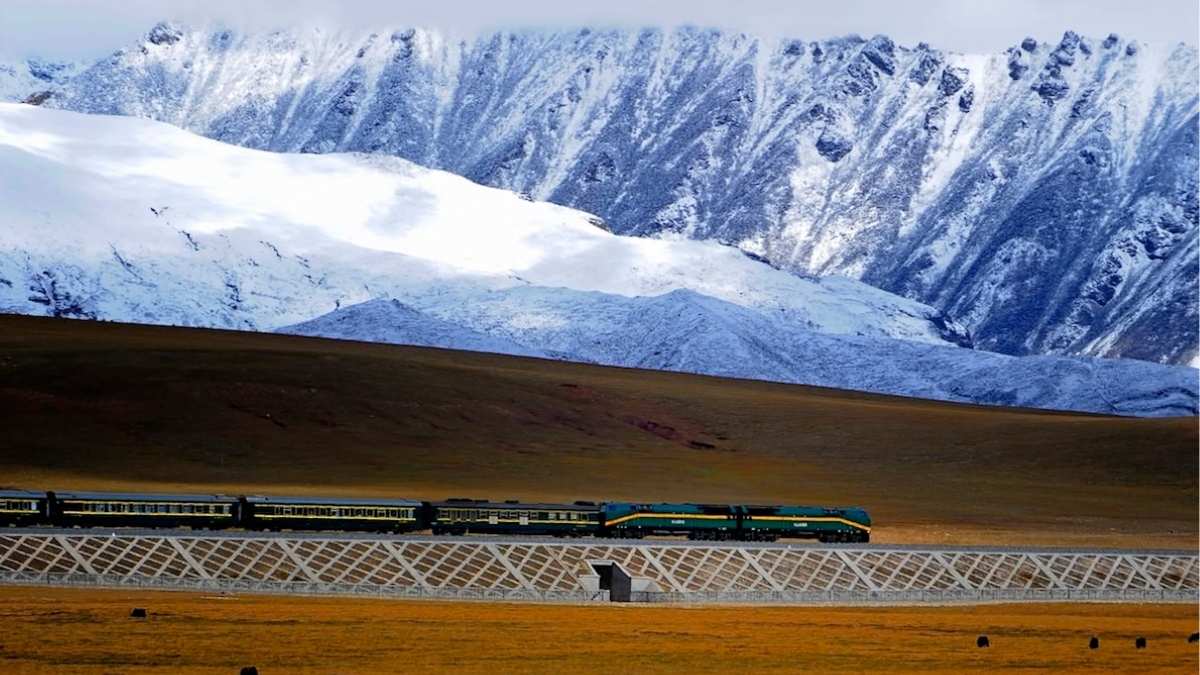
On a craggy edge of the world, where oxygen is thin and tempers are thinner, China is building a railway through the clouds. More than $40bn is being poured into a single line that will one day whisk passengers—and, possibly, soldiers—from Chengdu in Sichuan Province to Lhasa, the capital of the Tibet Autonomous Region, in 13 hours rather than the current 34. The project slices through some of the world’s harshest terrain. It also cuts to the heart of an increasingly fraught geopolitical rivalry.
That railway is just one strand in a vast web of new infrastructure China is spinning across its frontier with India. Along the roughly 2,000-mile contested border, known as the Line of Actual Control (LAC), Beijing has been laying roads, expanding airports, building heliports and constructing hundreds of high-altitude villages. The stated rationale is development. But few in New Delhi view it that way. For them the railway is not so much a miracle of civil engineering as a reminder that China can now move troops and matériel to the border far faster than it could a decade ago, and far faster than India can today.
Tensions between Asia’s two nuclear powers are not new. The border dispute dates back to colonial cartography and erupted into war in 1962. But the balance of physical capability in the Himalayas is changing dramatically. In the 1990s analysts estimated China would need up to a month to mobilise forces in Tibet for conflict. Today they say it could take less than a week. That acceleration owes much to China’s growing lattice of roads and railways, especially those near the LAC, many of which serve a “dual use” function: commercial as well as military.
India is not idle. It has built tunnels across mountain passes and is planning a 1,000-mile highway in Arunachal Pradesh, a state China claims as its own. But its efforts are slower and smaller. In rail infrastructure, India lags far behind. The Chinese military’s Western Theatre Command—the force responsible for Tibet and the Indian frontier—now operates across an area larger than the contiguous United States, but with a transport network that is growing denser by the year. India’s ability to match this pace is constrained by terrain and politics.
Where tarmac and tracks go, people follow. Between 2018 and 2023 the registered population in China’s border areas grew by 10.5%. The government insists these are economic development initiatives; critics say they are cartographic gambits, placing civilians in disputed zones to reinforce Beijing’s territorial claims. India has launched its own “Vibrant Villages” scheme, though it remains nascent. In effect both countries are using civilians to draw new maps.
Meanwhile India has more airbases close to the frontline, and its air force remains numerically superior in the region. But China is catching up, and with a distinctly different doctrine. Whereas India leans on air power, China emphasises missiles, many of them nuclear-capable. It now possesses over 600 nuclear warheads, more than five times India’s estimated stockpile. The disparity has not yet changed strategic deterrence, but it has introduced new uncertainties in any escalatory ladder.
A case in point came in 2020, when a deadly clash in Ladakh killed dozens of soldiers. The spark was a new Indian road. That incident revealed the peril of over-interpreting infrastructure as intent, but also the speed with which small provocations can spiral. It is that risk of miscalculation (exacerbated by new roads, railways and radar installations) that most worries military planners today.
Beijing maintains that its approach is defensive, part of a long-standing doctrine of “active defence” designed to secure its periphery. Yet its actions suggest more than mere passivity. Through “salami-slicing” tactics—small, incremental moves that fall below the threshold of war—China has tested its neighbours’ resolve elsewhere, from the South China Sea to Bhutan. Few doubt it could attempt the same in the Himalayas.
Economic logic ought to favour de-escalation. India could absorb much of China’s industrial overcapacity, and Chinese investment would be welcome in India’s vast infrastructure deficit. Both countries stand to gain from stability. Yet nationalism, once stoked, is hard to contain. In China the portrayal of Tibet as a core national interest fuels the urgency of development. In India recent memories of Chinese encroachment have hardened public opinion.
The Himalayan frontier is inhospitable to both armies and diplomacy. But while neither side may desire war, the region is becoming ever more combustible. A speeding train through the mountains is an impressive feat. It is also a metaphor for the trajectory of two Asian giants—hurtling forward, with fewer off-ramps than either might prefer. ■