
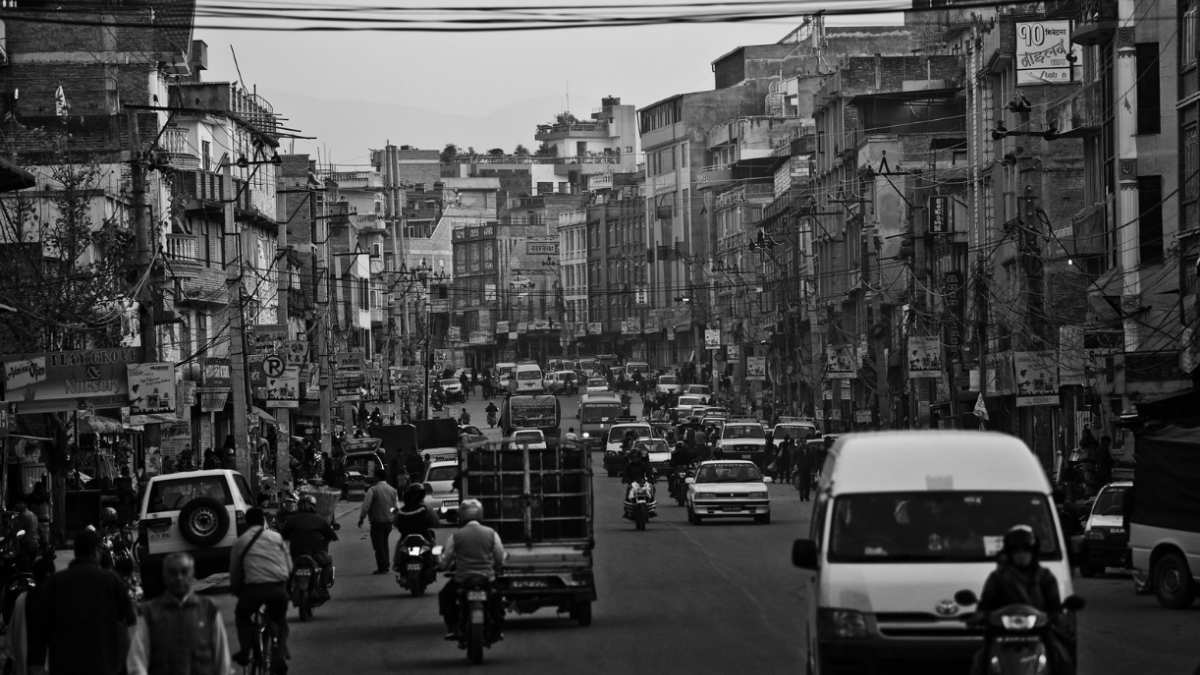
IMAGE: DELUN CHEN
For a city that never really mastered traffic, Kathmandu has acquired an impressive number of rules to regulate it. Amongst the most pervasive is its liberal use of one-way streets, a strategy imported from Western urban planning in the mid-20th century and retained long past its expiration date. Conceived as a way to speed up traffic and unclog intersections, unidirectional roads have become a defining feature of the capital’s mobility problem, rather than a solution to it.
As the city expands and the number of vehicles rises, reaching over 1.7m in the Kathmandu Valley alone, the maze of one-way streets makes daily life harder for commuters, businesses and the environment alike. Their costs are mounting. Their benefits are increasingly hard to find.
Kathmandu’s old town was not built for cars. Its tangled alleyways, many dating back centuries, reflect the logic of foot traffic and animal carts, not internal combustion engines. Yet even as the city grew outward into gridded suburbs and ring roads, its traffic policy leaned heavily on the one-way model, hoping to impose order on chaos with paint and signage.
The theory was borrowed, like much of Nepal’s traffic regulation, from America. Cities such as Los Angeles and New York spent the 1950s and 1960s converting two-way boulevards into one-way arterials, on the belief they could lessen congestion and speed up vehicles. And for a time, they did. But cities evolve, and what benefits throughput for cars often punishes everyone else.
Kathmandu is stuck with a traffic system that is out of date. Its one-way streets force drivers into circuitous loops, adding time, distance and fuel to every journey. A simple trip across town can become a dizzying detour. For a city already suffering from toxic air (ranked amongst the worst globally by the WHO) this added mileage is not trivial. More driving means more emissions, slower commutes as well as a greater dependence on fossil-fuelled transport.
Pedestrians fare worse. One-way roads tend to increase vehicle speed, making crossings riskier in this city, which is already hostile to foot traffic. Zebra crossings are rare. Sidewalks, when present, double as shopfronts or parking space. In the absence of enforced pedestrian zones or cycle lanes, the one-way system amounts to a prioritisation of cars over people: an odd choice given that most residents here do not own private vehicles.
Tourists, too, are left disoriented. Kathmandu is a hub for Nepal’s lucrative trekking and heritage tourism industries, but the street system can feel more like an obstacle course than an invitation. The city wants to appear welcoming, but its traffic layout makes that difficult.
Cities elsewhere have started to reverse course. Louisville, Kentucky, saw pedestrian activity and property values soar after reintroducing two-way traffic to previously one-way corridors. In Portland, Oregon, reversion led to lower crash rates. European cities, which largely resisted the one-way craze, now lead on walkability and mixed-use streets alongside traffic calming measures.
The appeal of the two-way model is not ideological. It is practical. Two-way streets reduce driving distances and slow down traffic naturally. It also makes navigation easier for locals and visitors alike. Moreover they encourage retail footfall and street-level engagement, giving businesses more reason to stay open and streets more reason to feel safe.
Kathmandu, by contrast, is locked into a defensive approach to traffic management. With limited public transport and a growing population of motorcyclists and car owners, planners have tended to treat movement as a zero-sum game: any gain for pedestrians is framed as a loss for drivers.
But the data suggest otherwise. Walkable cities tend to be more productive and healthier, for example. They require less imported fuel; generate less carbon; and support more inclusive forms of mobility. Kathmandu’s reliance on one-way streets may be politically expedient—it avoids the messy politics of reallocating space—but it is economically and environmentally shortsighted.
Reforming Kathmandu’s street system will not be easy. Fixing traffic flow means updating signs, intersections, signals and how people drive. Public resistance is likely, especially from those accustomed to the status quo. Yet the alternative is worse: an immobile capital where the cost of doing business or simply getting to work becomes intolerable.
Pilot projects could help. Cities such as Barcelona and Seoul have used limited trials to test pedestrianisation and lane reductions and two-way reintroductions without committing wholesale. Kathmandu could do the same, starting with central commercial areas where walking is already common. Public consultation, sparse in previous transport projects, will be essential to ensure local support.
As policymakers look ahead, the goal should not be faster traffic but better streets. That means safer crossings and a street grid that respects both geography and human scale. Bidirectional roads are not a silver bullet. But they may be the best place to start.
In the meantime, commuters will continue to zigzag through Kathmandu’s regulated chaos, inhaling fumes and recalculating their routes. The city will grow, as it must. Whether it will ever move well is another matter. ■




