IMAGE: REUTERS
Editor’s note (September 9th 2025): Prime Minister KP Sharma Oli resigned on Tuesday.
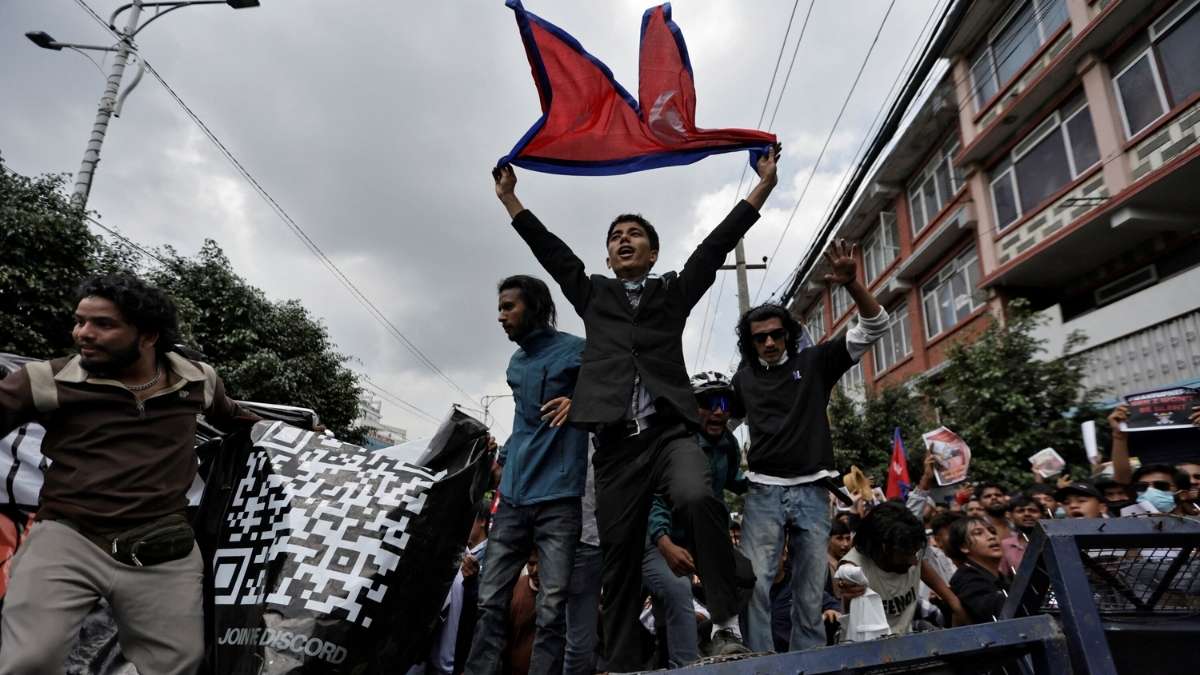
Nepal’s ruling elite has survived kings, coups and civil war. It may not survive TikTok. On Monday security forces killed 19 demonstrators, mostly in their twenties, in an attempt to quell a protest movement that began as a demand for better governance. It has since turned into an uprising against the very architecture of power. By Tuesday crowds were torching the homes of ministers and hurling stones at the residences of the current and former prime ministers. Curfews have been declared across the Kathmandu Valley, but the mood is mutinous, and the movement appears far from spent.
Such turbulence would once have prompted swift consolidation of elite control behind closed doors. Instead the political class is fragmenting under pressure. Ministers have begun to resign, seemingly to avoid being held responsible by protesters. The ruling coalition—an awkward marriage between the Nepali Congress (NC) and the Communist Party of Nepal–Unified Marxist-Leninist (CPN-UML)—is unravelling in slow motion. Prime Minister KP Sharma Oli has called an all-party meeting in an attempt to stem the bleeding. His coalition partner, Sher Bahadur Deuba, is fending off a mutiny in his own party. Protesters are unlikely to be impressed by either gesture.
The government’s response has been remarkably consistent with Nepal’s post-1990 playbook: delay, deflect and deploy force as a last resort. This time the tactics are proving counterproductive. The resignation of Home Minister Ramesh Lekhak, intended to defuse anger, only inflamed it further by confirming culpability. The departure of two more ministers on Tuesday lent the impression of a government hollowing itself out in real time. Civil society, opposition leaders and even junior coalition figures are now calling for the entire government to step down and for early elections to be held. What started as a protest against corruption and incompetence is rapidly becoming a referendum on regime legitimacy.
The core of the grievance is structural. Nepal’s post-conflict settlement—intended to bring peace after a decade-long Maoist insurgency—created a federal, multiparty democracy. But in practice it entrenched dynastic politics and elite patronage, as well as factional horse-trading. Youth unemployment is staggering; more than 2,000 Nepalis leave the country every day to work abroad, by some rough estimates. Infrastructure is threadbare; education underfunded; and the economy heavily dependent on remittances. In a country where the state has become a ladder for private enrichment, the state itself is now under siege.
The Gen Z demonstrators bring no formal leaders, nor fixed ideology. Their demands are diffuse—ranging from job creation to systemic overhaul—but their analysis is lucid: the political establishment serves itself, not them. Unlike earlier movements, this one is digitally native, decentralised and unmediated by party or caste loyalties. The comparison often drawn to the 2006 Loktantra Andolan, which ended absolute monarchy, is imprecise. That uprising sought to reinstate political parties. This one may be aiming to render them obsolete.
Few in Kathmandu’s corridors of power seem to grasp the depth of the shift. Oli, ever the tactician, still clings to a power-sharing deal with Deuba that was scheduled to hand over the premiership in 2026. Such choreography now looks delusional. The public is not asking for new stewards of the same system: it is demanding the system’s replacement. Even if the government survives the week, its authority has been fatally compromised. Institutions that cannot maintain a monopoly on legitimacy tend eventually to lose their monopoly on force as well.
Nepal’s neighbours are watching nervously. China has invested heavily in Nepal as part of its Belt and Road Initiative; India, ever wary of instability to its north, is deeply entangled in Nepal’s political ecosystem. Both may be tempted to back whichever faction promises order. But this is no ordinary power struggle. A generational reckoning is underway. It is no longer a matter of who governs Nepal, but of whether Nepal can be governed by the old rules at all.
There is no shortage of would-be saviours. Some protesters are calling on populist mayors like Balen Shah or Harka Sampang to lead a new dispensation. Neither has the mandate, nor perhaps the appetite, to do so. Yet their rise illustrates legitimacy in Nepal is no longer inherited, but earned—and earned increasingly outside the confines of traditional politics. If the country’s elite cannot adapt to that reality, they may soon find themselves not only out of power but out of time. ■