
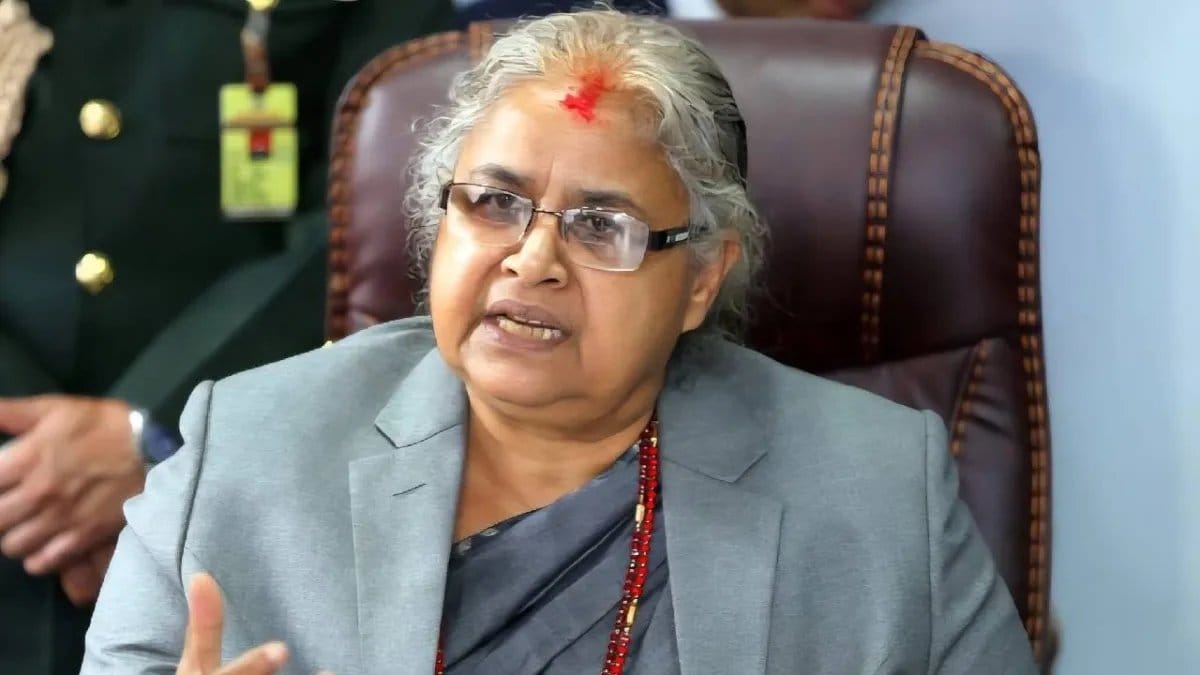
Nepal’s newest prime minister did not campaign for office or lead a political party. She did, however, survive a politically orchestrated impeachment and block an unconstitutional police appointment, as well as wrote a novel about her imprisonment during the 1990 pro-democracy movement. On 12th September Sushila Karki—former chief justice and self-described servant of justice—was sworn in as interim head of government in Kathmandu, becoming the first woman to hold the post. She arrives at the helm of a damaged republic, appointed by youth-led protest and political necessity. Parliament was dissolved shortly after she was sworn in.
The week that led to her rise was catastrophic. A government-imposed ban on major social media platforms, intended to curb dissent, provoked a mass protest movement spearheaded by young Nepalis—loosely organised and united by fury at corruption and elite privilege. When security forces opened fire on demonstrators, anger turned into violence. At least 51 people were killed and more than 1,300 injured. Parliament was set alight and the presidential palace ransacked. Most major state institutions in Kathmandu were left physically or functionally paralysed.
By Tuesday Prime Minister K.P. Sharma Oli had resigned, taking responsibility for the bloodshed. Into this institutional vacuum stepped the Nepal Army. General Ashok Raj Sigdel, the army chief, met with both protest leaders and party officials. His message was unambiguous: find a consensus candidate or risk a prolonged period of military governance.
Ms Karki’s name emerged quickly. Though retired from public life, she remained a symbol of judicial independence and clean governance. As chief justice from 2016 to 2017, she was known for refusing to toe party lines, an approach that earned her both respect and a near-dismissal. Her reputation has aged well. The Gen Z movement, as the protesters styled themselves, demanded her appointment as a condition for ending the unrest. President Ramchandra Paudel, through his advisers, agreed.
Her mandate is narrow. Ms Karki must restore basic order and oversee investigations into protest-related violence as well as organise national elections for the lower house of parliament by March 2026. She is expected to form a caretaker cabinet within days. These are procedural tasks, but in Nepal where due process is frequently ornamental, they are politically fraught. Protesters want accountability; party leaders want amnesty; the military wants stability. Ms Karki must provide all three without the institutional authority of an elected government or the coercive tools of the armed forces.
The scale of the challenge is huge. Since the monarchy was abolished in 2008, Nepal has cycled through 13 governments, each plagued by infighting and endemic corruption, for example. Infrastructure projects have stalled and youth unemployment is persistently high. Remittances, accounting for 25% of GDP, have become the primary escape valve. On average 2,000 Nepalis depart the country daily for low-wage jobs abroad. For a generation raised on smartphones and stranded in stagnation, political disruption has come to seem like a requirement.
Public reaction to Ms Karki’s appointment has ranged from elation to ambivalence. Many young activists see it as a temporary win. “But we did it!!!! For them! For New Nepal!” posted Manjita Manandhar, a protester, on social media. Others are more cautious. The costs of mobilisation were high. Ashab Alam Thakurai, a 24-year-old newlywed, was among those killed in the crackdown. “He had dreams,” said a relative. “They killed a future, not just a man.” Whether such sacrifices will yield structural change is to be seen.
Critics argue that Ms Karki’s strengths such as legal integrity and personal rectitude are ill-suited to the messiness of transitional politics. Her supporters counter that such qualities are precisely what the moment demands. In a system where rules are commonly rewritten and power traded behind closed doors, the presence of someone unwilling to play the game may provide a useful disruption.
Her track record provides some grounds for guarded optimism. As chief justice, she stood up to the ruling coalition on matters of institutional overreach, including police appointments and judicial interference. She survived an impeachment motion widely seen as retaliatory, and later chronicled her experience in a memoir. That she is now tasked with stabilising the very institutions that once tried to remove her suggests either a remarkable redemption arc, or the poverty of alternatives.
Nepal’s crisis has shown how fragile the country’s trust in its leaders is, and how handouts cannot replace real jobs or hope for the future. That a 73-year-old former judge is now the consensus figure of national renewal is a sign of exhaustion. Still, in Nepal where the past tends to repeat itself noisily, any break in the cycle may be worth pursuing.
What happens next depends on the pace and credibility of reform. Elections may restore democratic formality, but unless paired with institutional overhaul, they will offer little substantive change. Ms Karki’s government may be interim by design but the expectations surrounding it are anything but. Few transitional leaders are afforded such symbolic capital at the outset. Fewer still are permitted to spend it wisely.
Nepalis have heard promises of change before. They are now waiting to see if anyone remembers how to deliver it. ■




