IMAGE VIA GOOGLE
Perhaps no country displays uglier pictures on cigarette packets than Nepal. The warnings, splashed across 90% of the packaging, are a gallery of gangrene and rotting flesh that would make a horror director blush. Public smoking is prohibited. Advertising is banned. Statutes bristle with penalties. The architecture of deterrence appears complete. The result, however, is no change at all.
The 2022 National Demographic and Health Survey shows that 28% of Nepali men aged 15 to 49 smoked tobacco, a rate effectively flat since 2016. Male smoking in India has edged down to 23%. Pakistan and Afghanistan report figures below 22%. Only the Maldives performs worse. The stubbornness of Nepal’s smoking rate, notwithstanding some of the fiercest anti-tobacco legislation in Asia, suggests its laws are fierce in ink, but feeble in practice.
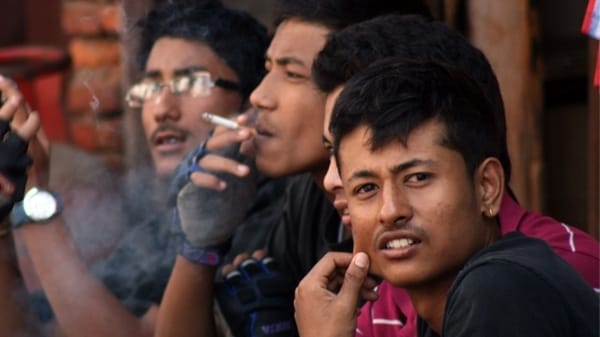
Demographics explain part of the standstill. Younger men smoke at higher rates than their elders. Education matters: men with no schooling are more than twice as likely to smoke as those with higher qualifications. Occupation adds another gradient. Drivers, masons and carpenters are 2.5 times more likely to light up than the unemployed. Tobacco has embedded itself in the rituals of working-class masculinity. It is a marker of identity rather than an act of desperation.
Wealth compounds the trend. The richest Nepali men are 40% more likely to smoke than the poorest. That reverses the global pattern, in which tobacco is increasingly a poor man’s poison. In Nepal it behaves like an emerging-market indulgence: rising incomes deliver the cigarette before stigma or health literacy intervene. Public-health messaging has not yet penetrated the strata setting trends.
Alcohol magnifies the risks. Male drinkers are nearly four times more likely to smoke than abstainers. The combination accelerates non-communicable diseases, from cancers to cardiovascular failures, which health systems with weak diagnostic capacity detect only at costly stages. Such delays wreck outcomes and strain budgets.
Men who describe themselves as in “good” or “moderate” health smoke more than those who report being unwell. Health, in practice, is defined by symptoms rather than science. If lungs draw easily and wages arrive on time, a cigarette scarcely registers as a hazard.
Geography contributes too. Smoking rates are lowest in remote mountain districts, where markets and supply chains struggle to reach. In the more accessible hills and Terai plains, prevalence rises by around 30%. Infrastructure and availability determine demand more reliably than slogans or statutes.
The statutes themselves have grown ornate. The 2011 Tobacco Control Act was hailed as a landmark. In reality enforcement has been cursory. Public smoking remains ubiquitous. Health warnings, though vast, are undermined by low literacy and desensitisation. Taxes cover only 38% of the retail price of tobacco, far below the 75% threshold recommended by the World Health Organisation. Surrogate advertising flourishes, as tobacco firms bankroll concerts and sporting events under alternative brand names.
The consequences are measurable. Tobacco is blamed for 15% of annual deaths in Nepal. The economic toll is greater still. Smoking drains household savings into medical expenses, trims labour productivity and devalues the remittance flows that underpin the economy. The opportunity cost ripples across generations.
Other states have demonstrated exit routes. Thailand slashed male smoking by a third through relentless tax rises and enforcement. Uruguay curtailed use by mandating plain packaging and prosecuting violators. Nepal prefers awareness campaigns to monetary disincentives. The price of that preference grows steeper by the year.
The timing is awkward. Its working-age population is peaking, a supposed “demographic dividend” meant to propel growth. Yet the dividend is undermined before it compounds. Future productivity is consumed in present smoke. The treasury collects a modest excise. The health system absorbs the rest.
The remedy is fiscal and administrative. Tobacco must be taxed heavily, stripped of visibility and made inconvenient to obtain. Cessation services need scaling. These policies are proven and economically prudent. Tobacco control is not a cultural quarrel or an abstract liberty. It is an exercise in intertemporal accounting. Nepal already knows the formula. What it lacks is political will. A generation is lighting up. The state appears content to watch it burn. ■