
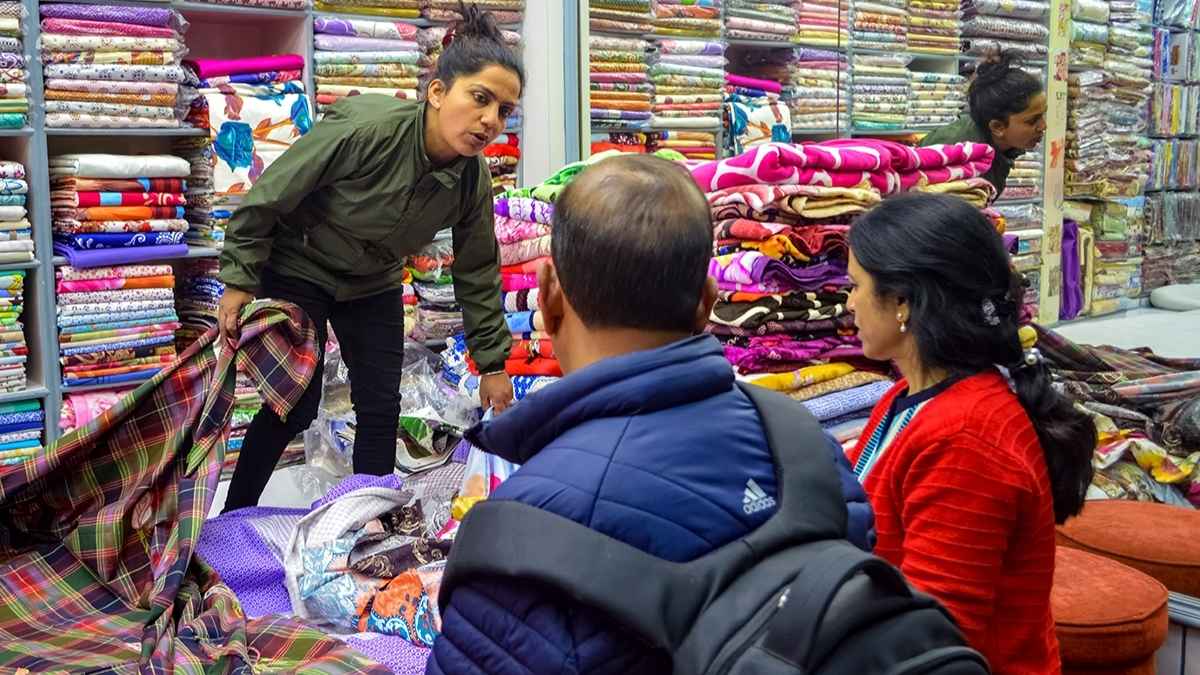
Image: Yam Kumari Kandel
From chemical fertilisers to steel and garments, China’s fingerprints are everywhere in Nepal’s markets. In the past decade imports from the northern neighbour have surged by 240%, from 12% of Nepal’s total imports in 2014 to nearly 20% today. Kathmandu’s shops, once stocked with Indian products, now brim with Chinese toys, electronics, batteries and solar panels. Even the garlic in local kitchens is likely to be from Yunnan, not the Terai.
Nepal’s trade with China has tended to be lopsided. What is new is the pace and breadth of Chinese penetration. Imports from China reached Rs227bn ($1.7bn) in the fiscal year 2024–25, up from Rs171bn just two years earlier—a growth rate of roughly 15% a year. The trend cuts across sectors: electrical goods rose 16% year on year, cosmetics 19% and solar panels an astonishing 101%. Garlic imports trebled. What once trickled through the fragile passes of Rasuwagadhi and Tatopani now flows like a river.
The Rasuwagadhi–Kerung border, once a remote Himalayan post, has become a symbol of Nepal’s economic tilt. Following years of post-earthquake repair and Chinese road-building, it now serves as a bustling conduit for hundreds of trucks carrying furniture, plastics and telecom gear. This transformation is not purely logistical. It reflects a shift in the gravitational pull of Nepal’s trade and infrastructure—from south to north, from India to China.
Yet much of China’s commerce reaches Nepal discreetly via India. Goods shipped from Chinese ports often land in Kolkata and travel by rail to Birgunj, Nepal’s main dry port. Official data may list India as the supplier, but the contents are often from Guangdong rather than Gujarat. Chinese products enter Nepal both overtly through the Himalayas and quietly through the Gangetic plain.
What they carry is not merely consumer choice but structural dependence. In clothing, China has eclipsed both Indian and domestic rivals. Imports of readymade garments rose 22% last year to Rs28bn, dwarfing the Rs1.5bn imported from India. Nepal brought in Rs8.3bn worth of Chinese shoes and sandals. Electrical goods, mobile accessories and toys are overwhelmingly Chinese-made.
The same pattern holds in the hardware of development. Imports of solar panels doubled last year. PVC compounds rose 148%; steel rods nearly tripled. These are not trivial items. They shape how Nepal builds cities, powers factories and equips telecom towers. Their origin ties the country’s construction and energy sectors more tightly to Chinese supply chains.
The imbalance is stark. Nepal’s bilateral trade deficit with China now stands at Rs296bn—more than its entire export earnings last year (Rs277bn). In return, Kathmandu sells little: carpets, herbs, agarbatti (incense). “Export diversification” is frequently cited in government plans but rarely achieved in practice. Nepal remains a one-way market for Chinese goods.
This trend echoes patterns across South Asia, where Chinese manufacturing has steadily outcompeted local industry. But Nepal is uniquely exposed. Its industrial base is fragile and infrastructure unreliable. Small factories in Biratnagar that once made garments or batteries are shutting down. Government officials invoke “import substitution”, but tariffs on Chinese goods remain low and smuggling common along mountain trails.
Several forces converge to explain China’s growing grip. First, price. Chinese goods are cheaper even after transport across the Himalayas. Second, scale and technology. No Nepali (or Indian) firm can rival China’s mass production of solar panels, plastics or electronics, for example. Third, logistics and credit. Chinese suppliers now offer delivery to the shop floor in Kathmandu. E-commerce platforms and Chinese-funded intermediaries handle the rest. Fourth, policy drift. Nepal’s trade regime is passive, geared more towards collecting customs revenue than managing strategic exposure.
Consumers have gained. Prices are lower, variety wider. But producers are being squeezed out. Workshops in Bhaktapur and Pokhara complain of being “priced out” of the market. Shoe manufacturers and furniture makers face the impossible economics of competing with an $18trn industrial juggernaut.
The consequences are not merely economic. China is now Nepal’s second-largest trading partner; a major investor and creditor; and a builder of key infrastructure from roads and hydropower dams to digital networks. Trade deepens this leverage. Each lorry that rumbles through Rasuwagadhi strengthens Beijing’s economic footprint while Kathmandu’s policymakers insist on “balanced diplomacy”.
Nepal is not alone. Southeast Asian nations have wrestled with similar dilemmas. But many, such as Vietnam and Indonesia, have deployed industrial policy, imposed anti-dumping measures or cultivated export capacity in response. Nepal, by contrast, has no coherent strategy. Its budget for industrial support is meagre. Its agencies are fragmented. And its politics, shaped by fragile coalitions and short-termism, resists reform.
Trade alone does not doom a country to dependency. But the combination of structural trade deficits, industrial decline and policy inertia does. Left unchecked, Nepal may find itself increasingly integrated into China’s economic orbit, with little to sell and even less bargaining power.
For the moment Kathmandu’s markets hum with activity. But the noise masks a growing silence in the country’s factories and workshops. The Himalayan flood has brought cheap goods, and an erosion of economic autonomy.
If current trends persist, one in every five rupees Nepal spends on imports will go to Chinese firms. That makes economic sense—for now. But dependence, once entrenched, is difficult to unwind. Unless Nepal begins to produce, not merely consume, the country could trade one form of dependency for another.
The garlic may be cheap. But the bill is coming. ■





