Image: Si Wei/VCG/Getty Images
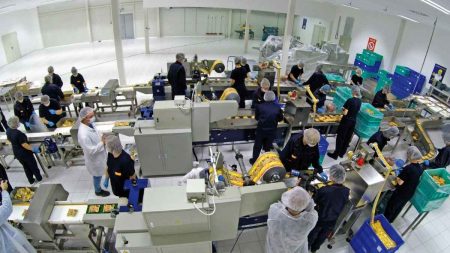
WHEN CHINESE planners unveiled “Made in China 2025” a decade ago, the reception in global boardrooms was politely dismissive. Here was another exercise in bureaucratic wishfulness, a ten-year plan to dominate ten “strategic industries” from semiconductors to electric vehicles. At the time the country was still the world’s workshop for cheap goods and copycat gadgets. Today its electric-vehicle makers outsell those of every other country combined. It leads in clean-energy manufacturing, battery production and industrial robotics. The question for everyone else is if they can still make anything at all.
The easy explanation points to subsidies and scale. The government has certainly poured money in—by some estimates 1–2% of GDP each year in tax breaks, cheap loans and direct support. Yet this misses a harder truth. Industrial policy worked in China because it rested on an extensive infrastructure of competence built across decades.
Consider the physical layer. Over three decades China strung 160,000km of expressways across its territory, twice the length of America’s interstate system. Its high-speed rail grid is the world’s largest. Shanghai’s port handles more containers each year than all American ports combined. These networks are arteries: they move goods, people and ideas with minimal friction, cutting costs and synchronising production across vast distances.
The electrical and digital layers matter just as much. China generates more power each year than America and the EU combined, and moves it through ultra-high-voltage lines spanning the country. Nearly 30% of its energy use is electricity, against 22% in America, a share still rising. Industries needing constant, cheap power—chip fabrication, artificial intelligence—can therefore flourish. Meanwhile Beijing’s decision to tightly control but massively expand the internet created an unusually integrated digital economy. The same tools enabling censorship enable commerce: the mobile-pay system linking Tencent’s WeChat, Ant Group and state banks now reaches almost every consumer and small firm.
The human layer is hardest to replicate. China’s 70m industrial workers carry collective memory of making and scaling things. They move easily from smartphones to drones to electric vehicles, bringing iterative expertise textbooks cannot encode. This embedded know-how explains why American firms trying to “reshore” production struggle to find cheap labour and workers who understand production processes end-to-end. It also explains why Chinese companies pivot so fast.
Foreign governments have tried to copy the results. Most have failed, partly because they misunderstood how China did it. Its industrial policy is messy but persistent. Beijing did not pick a few “national champions” and shelter them indefinitely. It created conditions for redundant experimentation, letting dozens of firms enter a sector and allowing the market—or at least the more competent ministries—to sort out the winners. Waste and corruption were endemic, but so was learning. Failed firms left behind engineers and lessons others could use.
Western industrial policy tends to be neat but timid. America’s CHIPS Act and Europe’s Green Deal Industrial Plan focus on a narrow list of sectors and disburse funds through lengthy application processes designed to avoid scandal. The result is clean accounting but slow execution. In Washington subsidies can take years to flow; in Beijing weeks. The difference is bureaucratic speed and political philosophy. China treats industrial policy as continuous national capability-building, not as a short-term fix for job losses or geopolitical anxiety.
Developing countries, meanwhile, try to imitate visible outputs—industrial parks, special zones, export targets—without replicating the institutional backbone. What made China unique was cheap labour and authoritarian control, and the state’s capacity to coordinate thousands of actors towards a technological goal. Provincial governments competed for investment; state banks financed infrastructure with national backing; research institutes trained engineers at scale. The machinery of implementation mattered as much as the policies.
Yet even this model has limits. Subsidy-fuelled competition has produced gluts and deflation across many industries. Dozens of solar-panel makers, electric-vehicle brands and chip foundries jostle for razor-thin margins. The government’s tolerance for inefficiency, vital in the learning phase, has become a drag. Local debts exceed 90% of GDP; private investment has slumped; youth unemployment is high.
For other countries these flaws are instructive. China’s success in creating capacity does mean it has created prosperity. Industrial policy without consumer confidence risks producing surpluses without demand. Rich economies trying to “out-China China” with subsidies alone could end up with the same problem: advanced factories making things no one buys.
The second lesson concerns political control. China’s ability to mobilise resources rests on a system that prizes obedience over openness. When the state turned its gaze from industrial policy to social management—tightening rules on education firms, internet platforms and property developers—it shattered confidence among the entrepreneurs who powered growth. Asian democracies cannot emulate that authoritarian efficiency. But they can learn from its strategic patience: the willingness to sustain an industrial agenda across decades through policy missteps and leadership changes.
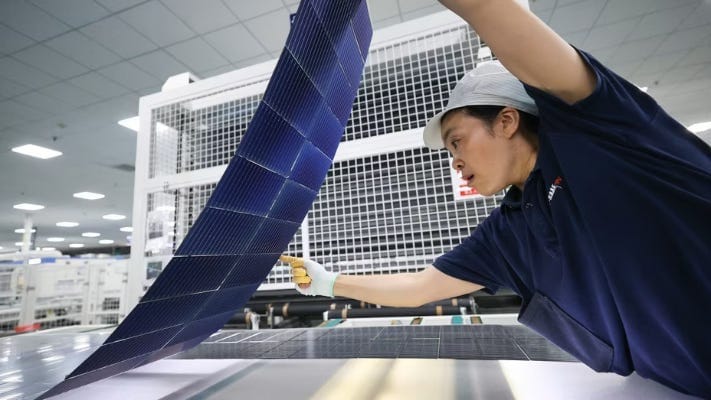
China’s rise has already redrawn global trade. Its share of world manufacturing exports has climbed above 30%, more than America, Germany and Japan combined. In green industries dominance is near-total: Chinese firms make three-quarters of the world’s solar panels, 70% of its EV batteries and 60% of the electrolysers used for hydrogen production.
For countries in the global South this presents a template and a trap. China has shown that late industrialisation is still possible in a world once thought closed to new manufacturing powers. Yet its sheer scale and speed have made it nearly impossible for smaller countries to compete head-on. Vietnam, India and Indonesia have all benefited from supply-chain diversification, yet they remain downstream: assembling components, rather than designing technologies.
To escape that fate, others must learn what China built and how. The first principle is to build deep before building high. High-tech industries depend on low-tech reliability: steady power, fast logistics, cheap credit and competent engineering. China’s clean-energy dominance grew out of decades of investment in steel, cement and railways. Policymakers obsessed with “innovation” forget that it must sit on functioning foundations.
The second principle is to think in ecosystems, rather than sectors. Beijing’s success in electric vehicles came from linking battery chemistry, grid upgrades, rare-earth processing and digital platforms into a coherent chain. America and Europe treat each as a separate problem, handled by separate agencies with separate funding streams.
The third is to maintain redundancy. China’s tolerance for overlapping factories and regional rivalry looks chaotic but fosters resilience. Competing local models become national experiments. Western governments tend to centralise funding and crown a few winners. That makes failure catastrophic.
The final principle is political. China’s rulers can impose sacrifice on their citizens; democracies cannot. But democracies can mobilise consent through clarity of purpose. Roosevelt’s New Deal and France’s post-war reconstruction were acts of confidence. Industrial policy works best when it feels like nation-building, rather than corporate welfare.
Ironically, China now faces its own version of the problem that once plagued the West: a loss of imagination. Having conquered manufacturing, it struggles to generate demand. The infrastructure that powered its rise—massive factories, centralised control and cheap electricity—now risks trapping it in overcapacity. As households save more and spend less, the state builds new supply without new customers.
This is the final, unspoken lesson for others. Industrial policy is a phase, rather than an end. China’s success shows what can be achieved when a state decides to build, and also what happens when it cannot stop. America, Europe and India need their own version of China’s determination—but without its compulsion to overproduce. ■