Image: Google
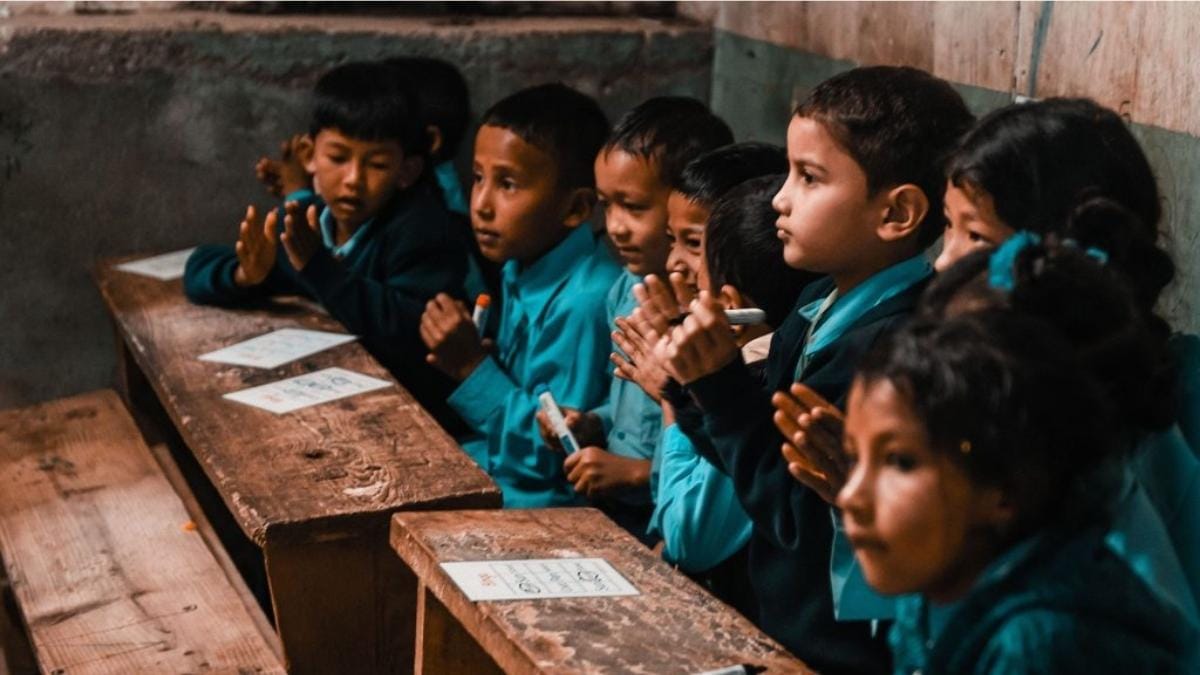
AT A primary school tucked into the hills of Ilam, a good 470km by road from Kathmandu, the walls glow with colourful charts and the children turn up in tidy uniforms. The teacher, a young graduate from a local college, talks earnestly about lesson plans and learning outcomes. And yet, by Grade 3, most of his pupils still cannot read a simple sentence in Nepali. By Grade 8, only a handful can handle basic maths. This school is not unusual. Like much of Nepal’s education system, it brims with ambition and delivers disappointment. It neatly captures a national predicament—what the World Bank calls a “human-capital trap”. Nepal is failing to build skills, and doing an even better job of wasting the ones it does manage to create.
The numbers make for awkward reading. Nepal’s score on the Human Capital Index, which estimates how productive today’s children will be based on their health and education, stands at 0.51. In plain terms, a child born today will grow up only half as productive as she could be with full schooling and good health. That is bad enough. Worse is the Utilisation-adjusted Human Capital Index, which asks whether adults actually get to use their skills in productive work. On that measure Nepal manages a miserable 0.18. Strip away the jargon and what that means is that four-fifths of the country’s human potential goes to waste.
This is not just about too few classrooms or understocked clinics. It is about jobs—or rather, the lack of them. More than a third of Nepalis aged 15 to 24 are neither studying, nor working, nor training for anything. Among young women the share is higher still. Of those who do work, 82% scrape by in the informal sector, mostly in subsistence farming or casual labour, without contracts, security or benefits. They earn roughly 29% less than formal workers with similar skills. “We are educating a generation for [an] economy that does not exist,” notes a former government planner in Kathmandu.
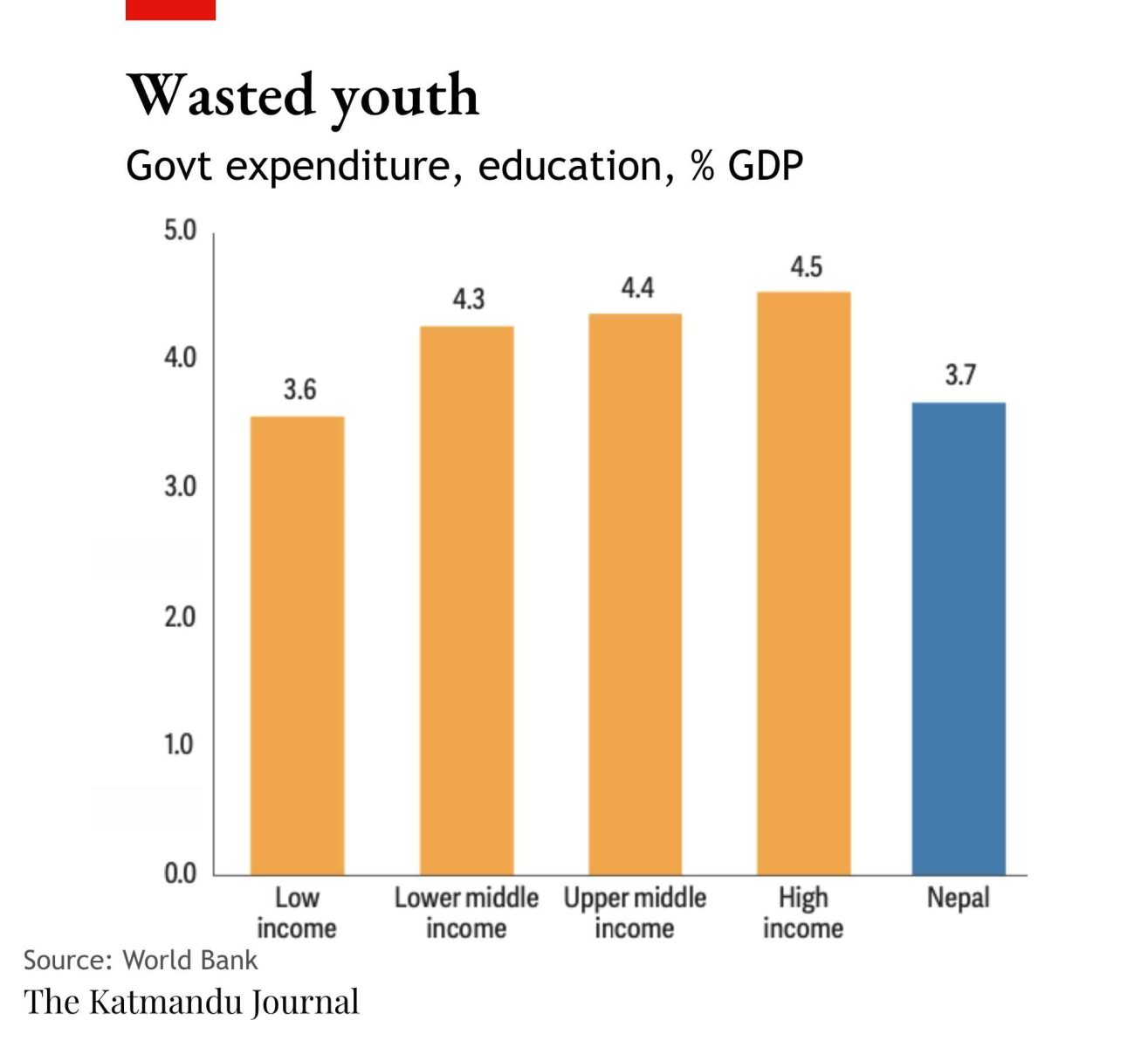
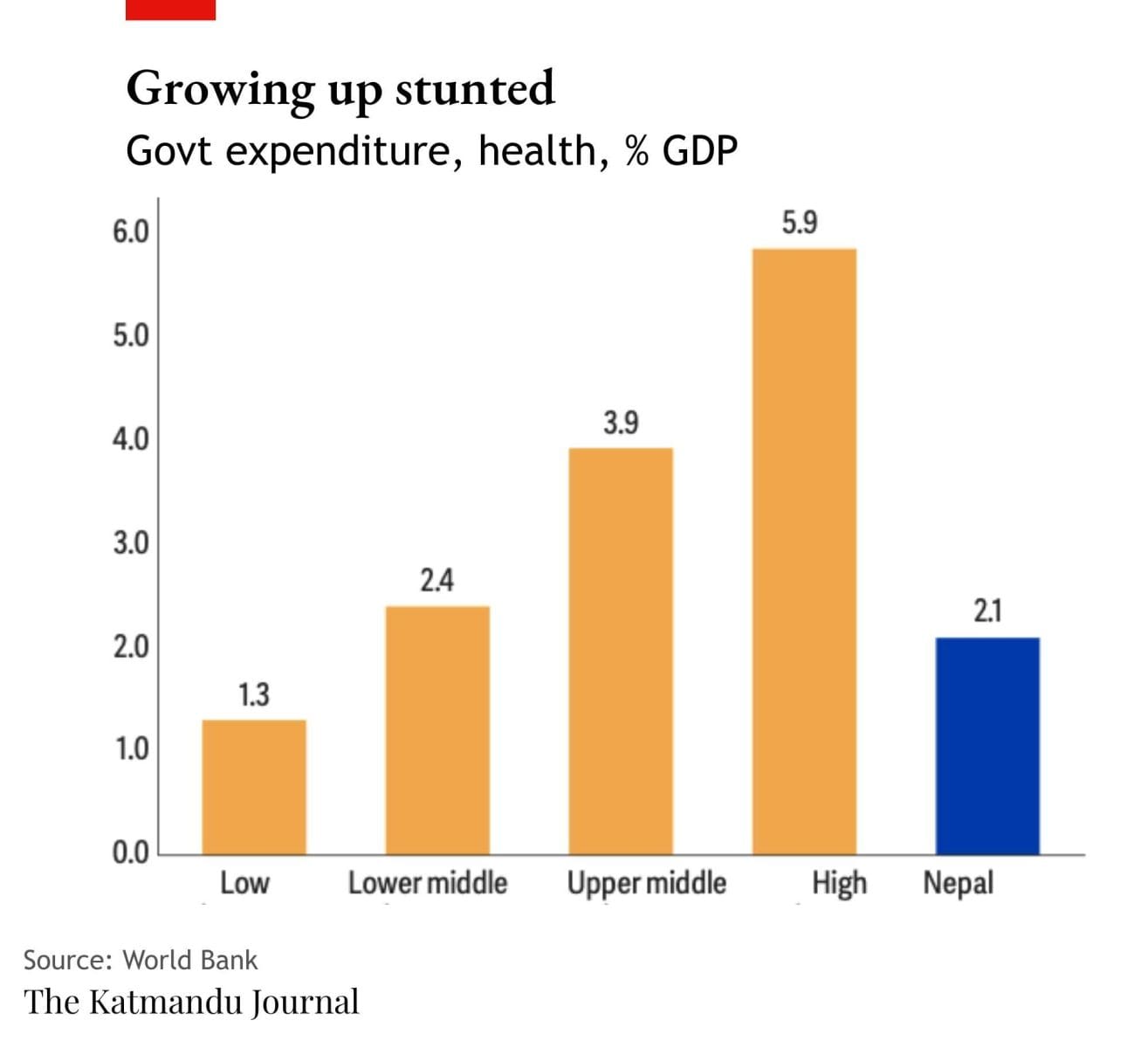
Why is it so hard? Three factors help explain: poor investment, muddled governance and stubborn social constraints. Public spending on education and health comes to just 3.7% and 2.1% of GDP respectively, well below international norms. A shift to federalism, meant to bring government closer to the people, has instead blurred lines of responsibility. At a health post in Koshi province, a worker reels off three separate agencies that fund his clinic, each demanding its own reports. “We’re better at paperwork than patient care,” he jokes, not entirely joking.
The trouble begins early. One in three Nepali children under five is stunted by chronic malnutrition, which permanently damages cognitive development. Rates are highest in the plains of Madhesh and the western hills of Karnali and Sudurpaschim. A modest “child grant” sends cash to poor families, but it barely dents the problem. The World Bank urges a “cash-plus” approach, combining money with nutrition counselling and supplements. On the ground, the gap between theory and practice is obvious. At a sub-health post in Saptari, boxes of supplements sit untouched, gathering dust. “Mothers come for the cash, not the counselling,” a nurse says.
Schools fare little better. Teaching is dominated by rote learning, driven by an obsession with exam scores. Children are trained to memorise rather than to think. The government has rolled out “structured pedagogy” to shore up basic literacy and numeracy, but in remote schools—where teachers are poorly trained and frequently absent—it has barely registered. One donor-backed programme that offered extra reading support delivered encouraging results, only to fade away when funding ended. “Good pilots, bad follow-through,” notes an education official in Kathmandu.
All of this might be less alarming if the economy offered a second chance later in life. It does not: job creation is feeble. The few formal positions that appear—in government, banks or telecoms firms—are fought over fiercely. For many young Nepalis, the obvious answer is to leave. Remittances from the Gulf and Malaysia now account for nearly a quarter of GDP. They keep households afloat, but they also siphon off the country’s most energetic workers. In Jhapa, Ramesh Limbu, a farmer, leans on his hoe and explains it simply. “My sons are in Qatar and Malaysia,” he says. “They have degrees. Here, there is nothing for them.”
The waste of talent is most glaring when it comes to women. Girls now match boys in school enrolment and attainment yet fewer than one in three women is in paid work. Social norms, scarce childcare as well as unsafe transport keep many at home. Those who do work are usually confined to unpaid family labour or subsistence farming. The World Bank calculates that closing the gender gap in labour-force participation could lift GDP per head by more than 30% over the long term. Nepal is leaving that money—and momentum—on the table.
Time is not on Nepal’s side. Its working-age population is still expanding and is expected to peak at around 21m by 2050. Handled well, this could deliver a classic demographic dividend, as it once did for South Korea or Thailand. Mishandled, it becomes something darker: a swelling cohort of frustrated young people. The World Bank’s prescription is no secret. Invest hard in early childhood; fix foundational learning; match skills training to what markets actually need; expand childcare so women can work; and build a social-security system that can cope with shocks, from pandemics to climate disasters.
The to-do list is admirably clear. The worry is whether anything will be done. Nepal’s politics are noisy and divided, and state capacity is slim. In a municipal office in Ilam, a local official gestures at a pile of donor reports. “They all say the same thing,” he says. “We need to do more and do it better. But how?” Nepal understands its illness well enough. The tragedy is that diagnosis was never the difficult part. ■