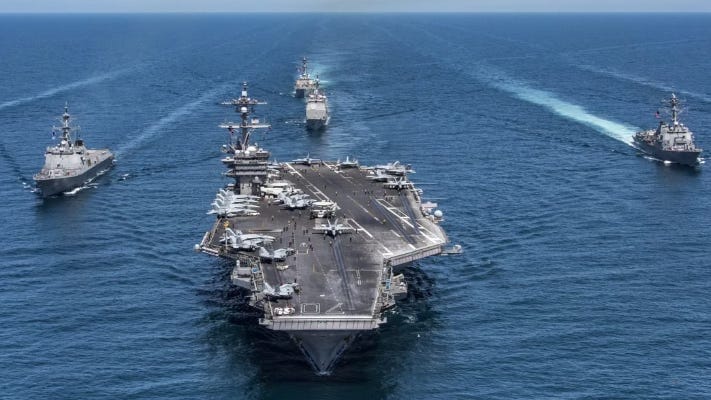
Image: Bloomberg
IT IS A conflict that would end civilisation. Yet in think-tanks and war-rooms, military planners are gaming out nuclear war. The antagonists are America and China. For decades the world’s two biggest economies were bound by trade. Now they see each other as primary strategic rivals. A localised clash in the Pacific could spiral into a confrontation where one side, facing conventional defeat, reaches for a nuclear weapon. The grim conclusion of recent analyses is that such a war is not only possible, but that its logic may favour the first strike.
The most likely flashpoint is Taiwan, which China claims as its own territory. The island produces most of the world’s advanced semiconductors. Its fall would shatter American credibility in Asia. For China, its “reunification” is a national imperative. A full-scale invasion would be a bloody, logistical nightmare. A smarter, more gradual option for China would be a blockade—a slow economic strangulation that would test American resolve without an immediate, all-out war. America would face a dilemma: intervene militarily and risk escalation or stand by as an ally is choked into submission.
This slow-burn crisis could easily catch fire. After weeks of conventional fighting, both sides would deplete their stocks of precision missiles. Last year a war game by the Center for a New American Security imagined a 45-day conflict over Taiwan in 2032. It ended with China using a nuclear weapon first. This violates China’s declared “No First Use” policy, but strategists suspect that doctrine is flexible. In the game, China used a low-yield, “theatre” nuclear weapon against an isolated American military base or a warship at sea. The goal was to force America to back down.
This scenario is chillingly plausible. Geography makes limited nuclear use conceivable. The vast Pacific has isolated military targets, far from dense civilian populations. Modern low-yield nuclear weapons can be precisely targeted. Their destructive radius is not vastly different from that of large conventional bombs, blurring the line between the two. For a commander running out of conventional options, a single, small nuclear weapon could appear a rational, if monstrous, way to break a stalemate.
In such a limited exchange, some analyses suggest China might “win”. Its advantage lies in the number of American bases and ships it could threaten across Asia. America’s dilemma would be acute. To retaliate proportionally, it would need to hit a comparable Chinese military target. But most of those are on the Chinese mainland. Striking there could be seen as an escalation towards an all-out nuclear war. America currently lacks low-yield nuclear options suited for a Pacific fight, a gap it is only now moving to fill. In the war game, this asymmetry tended to force an American de-escalation.
Yet no one truly wins a nuclear war. Even a “successful” limited strike would shatter China’s global reputation, triggering severe economic isolation. The global economy, which China depends on, would collapse. America would suffer tens of thousands of military casualties and see its Pacific power projection crippled. The conflict could draw in other nuclear powers, like Russia, turning a regional crisis into a global catastrophe. The real victor, as one analyst dryly noted, would be “nuclear winter”.
The lesson for statesmen is that deterrence must be reinforced, but so must diplomacy. America is pursuing “integrated deterrence”, bolstering military readiness with allies and building economic resilience. This is necessary, but insufficient. The irreducible objective is to prevent a war that, once begun, may be impossible to control. The logic of escalation is merciless. The first nuclear strike, however limited, could be the last decision anyone makes. ■