Image: Xinhua
China’s leaders have made no secret of their ambition to bring Taiwan under their control. Xi Jinping, the country’s most powerful ruler in decades, has described unification as the “essence” of China’s national rejuvenation, a mission he expects to fulfil by 2049, the centenary of the People’s Republic. Yet while Beijing’s rhetoric grows more assertive, its path to that goal remains fraught. Unifying Taiwan by force would be among the most complex and costly military operations in modern history.
For all China’s economic might and military expansion, it has never governed Taiwan. The island of 23m people operates as a self-governing democracy with its own army, constitution and foreign policy. Most of its citizens identify as Taiwanese, not Chinese. Support for unification has collapsed, while backing for the ruling Democratic Progressive Party—whose leaders reject Beijing’s “one China” principle—has hardened. The likelihood of peaceful integration has thus receded, tempting Chinese leaders to consider more coercive means.
That temptation is amplified by Taiwan’s symbolism. The island’s success as a prosperous, liberal democracy is a standing rebuke to the Chinese Communist Party’s claim that political freedom and stability are incompatible. Its location is even more strategic. Taiwan sits in the middle of the “first island chain”, a string of American allies from Japan to the Philippines that hems in China’s navy. Control of the island would give Beijing a gateway to the Pacific and weaken America’s ability to defend the region. Economically, Taiwan’s dominance in semiconductors—through firms such as TSMC, which produces most of the world’s advanced chips—makes it an industrial prize of global consequence.
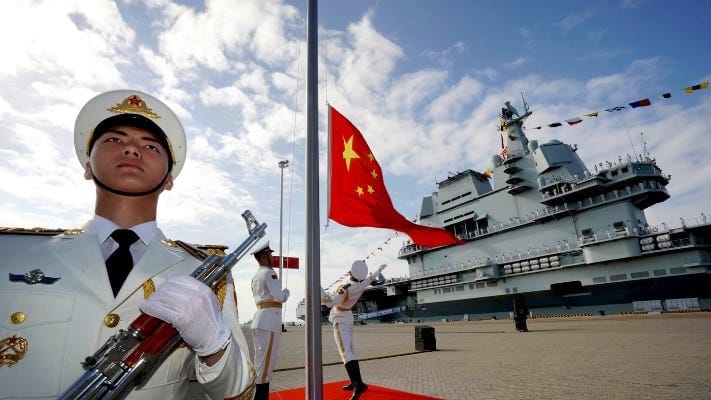
Over the last two decades China has invested heavily to make that ambition seem plausible. The People’s Liberation Army (PLA) has become the world’s largest military force by personnel and ship count. It has developed long-range missiles capable of striking American bases, fleets of modern fighter jets and bombers, and an expanding arsenal of cyber and electronic weapons. The PLA now conducts regular drills encircling Taiwan, simulating blockades and strikes meant to display strength and readiness. Yet it has not fought a war since a brief, bruising conflict with Vietnam in 1979. Its modernisation has been rapid but untested.
If Beijing ever sought to invade, geography would prove its first adversary. The Taiwan Strait, roughly 160 kilometres wide, is a rough and unpredictable body of water whipped by monsoon winds and typhoons. An amphibious assault would need to move hundreds of thousands of troops across it—a crossing that would take hours and expose them to Taiwan’s missiles and artillery. The PLA’s amphibious fleet, though expanding, remains too small to carry such a force. Civilian ferries could supplement the invasion, but they are slower, unarmoured and vulnerable to attack. Any massing of troops and ships along China’s coast would be visible to satellites and foreign intelligence, depriving Beijing of the element of surprise.
Even if the crossing were achieved, the landing would be treacherous. Taiwan offers few suitable beaches or deep-water ports. Its west coast is shallow, forcing big ships to anchor far offshore; its east coast is dominated by cliffs and mountains. Taiwan could destroy its ports at the outset of a conflict to prevent their capture. The few viable landing sites lie near Taipei, the capital—where Taiwan has concentrated its defences.
Those defences are formidable. The island has lined its shores with mines, anti-landing obstacles and mobile missile launchers. American-supplied Harpoon missiles and locally built systems form part of what Taiwan calls its “porcupine strategy”: the idea that it need not defeat China outright, only make invasion unbearably costly. Even if China secured a foothold, it would face a hostile landscape. Around 70% of Taiwan is mountainous, its terrain dense and easily defensible. Few highways connect the north and south; bridges and tunnels can be destroyed at short notice. Any invading army would find itself funnelling into narrow routes under heavy fire.
The political and symbolic heart of the island, Taipei, would be the ultimate prize—and the hardest to capture. The city lies in a bowl surrounded by hills that offer natural defensive positions. Access is limited to a handful of roads and tunnels. Should Chinese forces reach the outskirts, they would confront the nightmare of urban warfare. With seven million residents packed into dense neighbourhoods, every street and high-rise could become a battleground. The PLA could seize the city only at immense human cost.
Taiwan’s government knows this and is preparing accordingly. Its military has intensified urban combat drills and expanded civil-defence training. Since Russia’s invasion of Ukraine, ordinary citizens have flocked to shooting courses and first-aid classes. The sense of vulnerability has hardened into resolve. In a prolonged struggle, the population’s willingness to resist could matter as much as any weapon.
China continues to rehearse for the possibility. After President Lai Ching-te took office in May 2024, Beijing conducted two days of large-scale exercises around the island, encircling it with ships and aircraft. American commanders described the manoeuvres as a “rehearsal” for invasion. Washington watched closely, adjusting its own plans for deterrence and defence.
China’s desire to reclaim Taiwan is real and unyielding; its capacity to do so by force is less certain. Geography, logistics and the will of the Taiwanese people combine to make invasion perilous. Even a successful landing could mire China in months of bloody combat, international condemnation and economic isolation. For Mr Xi, the dream of unification may yet prove achievable—but not, perhaps, by arms. ■