
Image: The Kathmandu Post
IN THE WAKE of popular fury, a country’s constitution can seem at once supremely important and utterly irrelevant. It is the foundational text that must be followed to the letter. It is also a worthless document if it fails to reflect the popular will. Nepal is now facing this tension head-on.
Last month youth-led protests against corruption and political sclerosis forced the resignation of the prime minister, KP Sharma Oli. In response the president, Ramchandra Paudel, took two extraordinary steps. He appointed Sushila Karki, a former chief justice, to lead an interim government. He then dissolved the House of Representatives, promising fresh elections within six months. Both moves appear to violate the country’s constitution, which was adopted only in 2015. The question now is whether that document will bend or break.
The “Gen Z revolt”, as the protests that erupted on September 8th and 9th are known, was not a rejection of the constitutional order. The young activists demanded cleaner government and a less self-serving political class, not a new system. Yet the means they employed—street pressure to force a change of government—and the president’s response have created a crisis of legitimacy.
One camp, which includes the interim government, the leaders of the youth movement and seven of the main political parties, believes that legitimacy can be restored only through a fresh mandate. They want elections to proceed as planned on March 5th. The other camp, led by Mr Oli’s party, the Communist Party of Nepal (Unified Marxist-Leninist), or UML, argues that the House must be reinstated before any election. Its dissolution was unconstitutional, this group contends, so any vote held under an illegal government would be invalid.
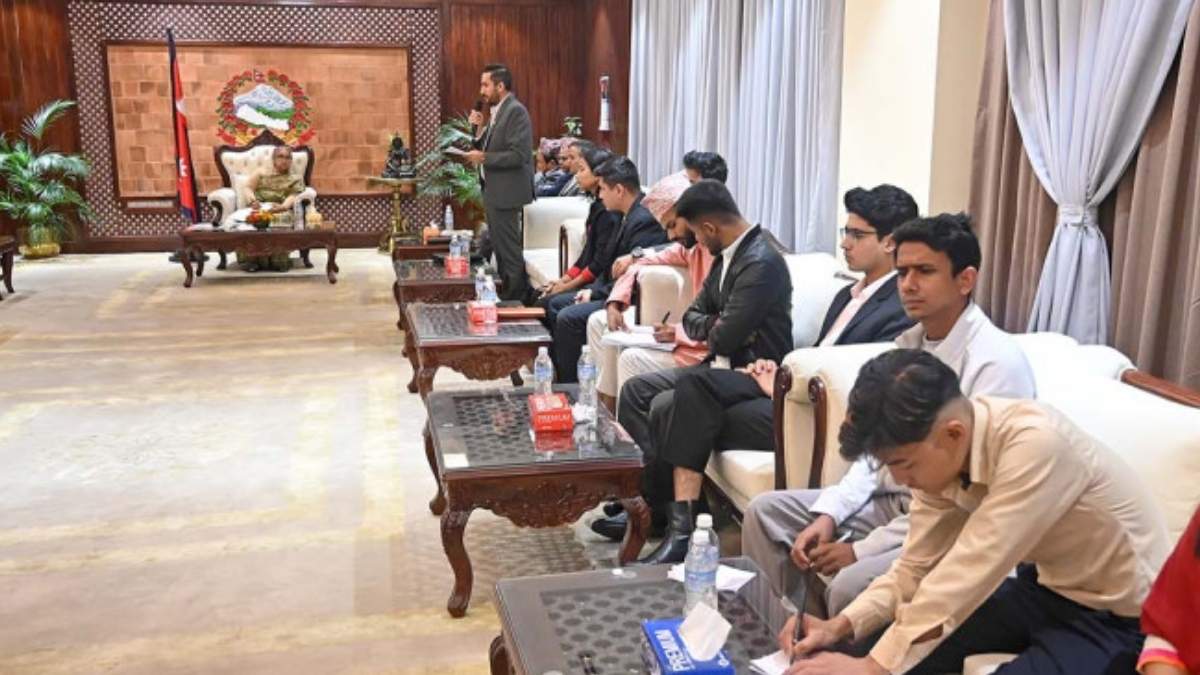
The first formal dialogue between the interim government, political parties and representatives of the youth movement, held on Wednesday at the prime minister’s residence in Baluwatar, was an attempt to build consensus. The talks yielded broad agreement to proceed with elections. The main opposition came from the UML, which boycotted the meeting. The Nepali Congress, a centrist party, raised logistical concerns about holding a vote in March. The Rastriya Prajatantra Party, which favours restoring the monarchy and a Hindu state—Nepal is now a secular republic—found its demands rejected by the youth leaders. Ms Karki framed the meeting as a new beginning, an effort to rebuild trust. It de-escalated tensions but did not resolve the underlying constitutional dilemma.
That question rests with the Supreme Court. While politicians were talking in Baluwatar, the court was holding a preliminary hearing on 16 petitions challenging the formation of the Karki government and the dissolution of the House. The court refused to issue an interim order to block the government’s activities, allowing Ms Karki to remain in her post for now. But it asked for written clarifications from the president and prime minister within seven days, a faster-than-usual deadline that signals the seriousness of its concerns.
The petitioners argue that the constitution bars a former chief justice from holding a government post, that only a member of Parliament may be appointed prime minister and that the president’s role is to protect the constitution, not override it. Past Supreme Court rulings have held that the House cannot be dissolved before completing its five-year term. If the court later rules against the government, it could invalidate Ms Karki’s appointment and reinstate the dissolved House. That would throw the electoral timetable into disarray and potentially reignite political chaos.
This is a classic crisis pitting constitutionalism against popular legitimacy. The youth revolt forced political change through street pressure, not parliamentary procedure. The president, in trying to respond to mass anger, broke the letter of the constitution to uphold what he saw as its spirit—accountability and renewal. The Supreme Court must now decide whether popular legitimacy justifies constitutional deviation. Ms Karki’s government is attempting to project unity and order, organising elections and calming markets and the bureaucracy, while knowing its existence depends on a pending court verdict.
The stakes are high. If all goes well, elections will be held in March, the youth movement will gain political legitimacy, traditional parties will adapt to new energy and Nepal will transition peacefully into a renewed democratic phase. If it goes wrong, the court could reinstate Parliament, the UML would return as a blocking force, the interim government would collapse and street protests would reignite, deepening the legitimacy crisis. Nepal’s establishment is betting that a dose of revolution can avert a full-blown revolt. It is a dangerous wager. ■




