Image: S.Y. Panel
Industrial firms in Nepal rarely go public. The country’s stock exchange is dominated by banks, insurers, hydropower companies and so on: businesses that promise steady returns but little in the way of innovation.
Manufacturing, on the other hand, is still too small and too risky (and certainly too forgotten to attract big capital). So when S.Y. Panel Nepal Ltd., a maker of prefabricated building materials, announced its intention to sell 40% of its shares to the public, eyebrows lifted. The firm is hardly a household name. Yet its debut offering may signal that something is afoot in one of South Asia’s most sluggish economies.
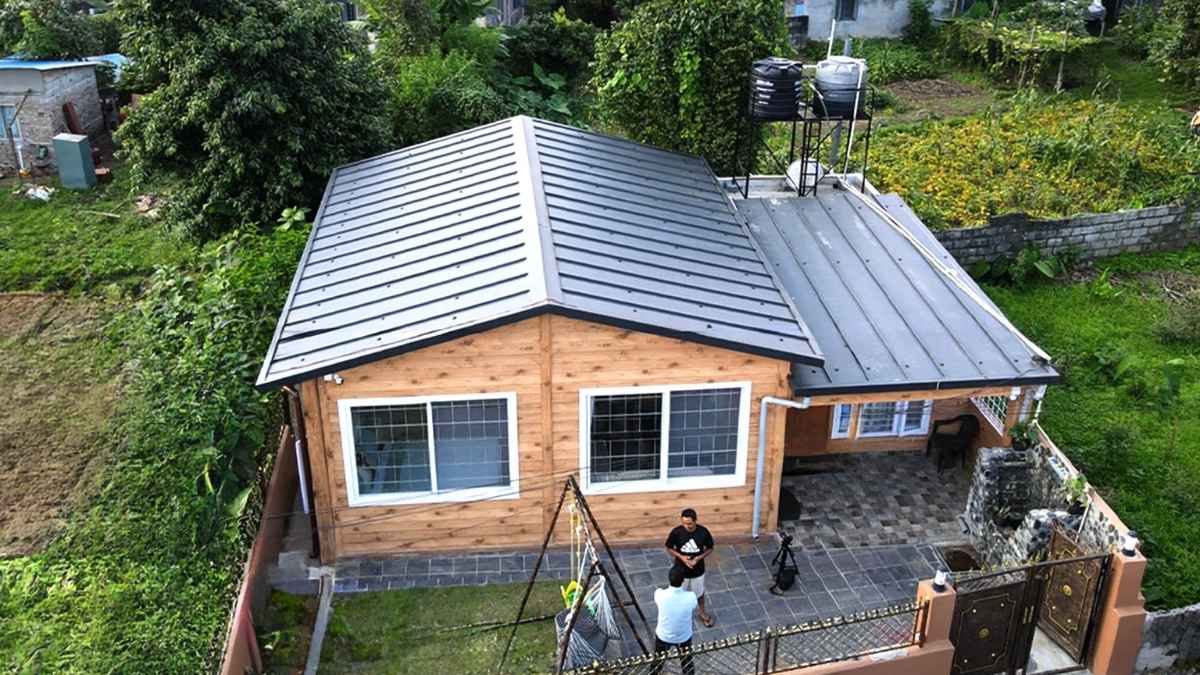
S.Y. Panel was born from catastrophe. After the 2015 earthquake, demand for earthquake-resistant housing surged, exposing how reliant Nepal had become on imported construction materials. A few enterprising engineers, with backing from Korean investors, saw a gap. They began producing insulated sandwich panels and uPVC doors and windows, lightweight components that can make structures more flexible and durable. From a small factory in Chitwan, the firm built a network of 50 distributors spanning Kathmandu to Dhangadhi. Eight years on, it claims annual revenues of Rs2.35bn ($17 million) and a net profit of roughly Rs13.8m. Its results are ordinary, but the fact it exists is less so.
The company’s initial public offering, worth Rs523m, comes at a time when Nepal’s capital market is both deepening and distorting. Retail investors, lured by speculative profits, have little appetite for slow, industrial ventures. Yet the regulator, the Securities Board of Nepal (Sebon), has lately urged diversification: more listings from firms that make tangible goods. S.Y. Panel’s float, small though it is, aligns neatly with that agenda.
Moreover, behind the IPO is a global story. The firm’s production lines are equipped with Korean machinery; its newest venture—a factory for uPVC profiles—is a joint investment with S.Y. Co. Ltd. of South Korea. The partners have poured in around Rs100m to localise production of materials that Nepal once imported almost entirely from China and India. Such industrial collaborations are small in scale but symbolically large. They show how foreign capital, once confined to hydropower dams or telecom towers, is trickling into manufacturing. For this country with a chronic trade deficit and a shrinking base of factory workers, that matters.
Not that investors should swoon. Margins are thin, and exposure to imported raw materials leaves it at the mercy of exchange-rate swings. Its disclosures list an earnest catalogue of risks: volatile resin prices, liquidity constraints, construction slowdowns and labour shortages as workers depart for Gulf jobs. Yet S.Y. Panel has done something few Nepali manufacturers manage: expand capacity and avoid industrial strife. It employs 93 staff, none unionised, and reports no labour disputes in recent years.
The firm’s diversification hints at ambition, too. It has taken a 46% stake in an IT startup, S.Y. Bazaar, an online marketplace that could one day connect contractors and suppliers. It has begun exporting panels to India and plans to reach Bhutan next. It even runs a training scheme to familiarise Nepali builders with modular construction techniques—part marketing, part market creation. True, such ventures will not transform the balance sheet overnight; but they show an instinct for adaptation rare among small industrial houses.
More broadly, S.Y. Panel’s listing exposes the lopsided nature of Nepal’s growth. Since the 1990s, the country’s economy has relied on remittances from abroad and imports from its neighbours. Factories have withered under high logistics costs, erratic power supply and cheap foreign competition. Manufacturing output accounts for barely 6% of GDP. Policymakers talk endlessly of “import substitution” and “export promotion”, yet offer little beyond tax breaks. In that environment, a mid-sized manufacturer opting for public capital (subjecting itself to disclosure rules, credit ratings and market scrutiny) is rare as well as revealing. It suggests that the barriers to industrial finance, though formidable, are not insurmountable.
Whether investors will bite is another question. Nepali retail shareholders have learned to chase scrips that double in a week, not factories that earn 5% margins. The appeal of a BB-rated construction-materials firm may thus depend on narrative—on the sense that industrial self-reliance is once again fashionable. S.Y. Panel’s promoters are betting that patriotism, or at least prudence, might sell.
Still, even a small listing can have outsized effects. By raising public capital, the company will gain visibility and a cheaper source of funding for its expansion into uPVC profiles—a product with steady demand and limited local competition. If it performs well it could nudge regulators and investors alike to reconsider manufacturing’s place in the financial system. After all, a capital market that funds real factories, not just licences and ledgers, would be a sturdier foundation for growth.
S.Y. Panel’s IPO will not revolutionise the economy. But it does hint at a maturation: an industrial firm seeking market discipline rather than government patronage; a regulator willing to bless something other than hydropower; investors offered a chance to own a slice of the real economy. For a country still rebuilding from its literal and fiscal earthquakes, that is progress enough. ■