
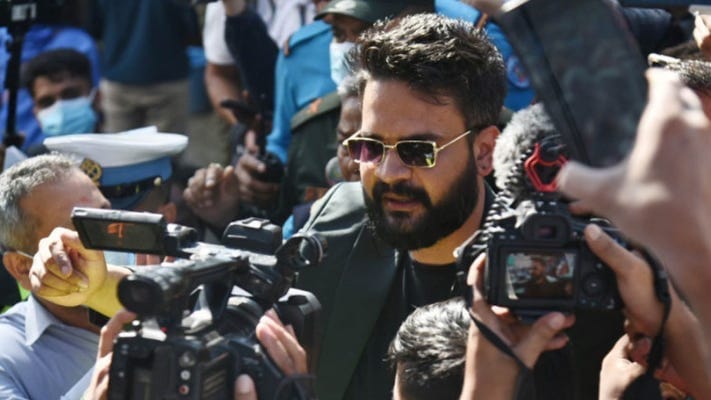
Image via The Katmandu Post
ON A Saturday night in early November, the mayor of Nepal’s capital, Kathmandu, took to social media. Balendra “Balen” Shah, a 34-year-old rapper and structural engineer who swept to power in 2022 on a wave of youth discontent, posted a message that was as succinct as it was incendiary. In a single sentence, he managed to insult three global powers—America, India and China—and four of Nepal’s main political parties. “Fuck America, Fuck India, Fuck China, Fuck UML, Fuck Congress, Fuck RSP, Fuck RPP, Fuck Maobaadi,” he wrote, concluding, “you guys all combined can do nothing”.
The post was deleted within minutes, but not before it had been widely seen, and caused widespread outrage. Mr Shah offered no explanation or apology. It was far from his first such outburst. In the past he has threatened to “burn down” Singha Durbar, the country’s main government complex, and accused the Supreme Court and government of being “slaves of India”. Another time, he banned Indian films from Kathmandu’s cinemas, a move later overturned by the courts.
To many, such behaviour seems like political suicide. Insulting powerful nations that provide Nepal with vital aid and investment could chill diplomatic relations. Deriding the country’s main parties risks uniting them in legal or parliamentary retaliation. The social-media mockery that follows each episode (with accusations that Mr Shah was drunk or worse) hardly suggests a serious national leader. Yet these provocations are not random. They follow a pattern: a loud, attention-grabbing stunt, followed by silence as the furore grows. This is not mere buffoonery. It is a high-risk political strategy. Mr Shah is testing the boundaries of Nepal’s young democracy, and the patience of its people.
The strategy has so far been successful, at least in making Mr Shah the country’s most talked-about politician. His election as mayor of Kathmandu was a shock to the established parties. He ran as an independent, capitalising on widespread frustration with the corruption and incompetence of the political old guard.
His supporters see him as a breath of fresh air, a man untainted by the backroom deals of Kathmandu’s political elite. His promises to clean up the city, both literally and metaphorically, have won him a devoted following, particularly among the young. But the very anger that propelled him to office now threatens to consume his political future.
Mr Shah’s public rage is only one side of his political persona. The other is a calculated, strategic silence. After his threat to burn down Singha Durbar, he said nothing when the building was, in fact, set alight months later during the September’s “Gen Z” protests. When parliament was dissolved after he had called for its dissolution, he remained publicly mute. This combination of inflammatory rhetoric and strategic retreat appears designed to keep his opponents off-balance and his options open. It allows him to rally his base with fiery words, while avoiding the legal and political accountability that might follow a more sustained campaign.
This approach was starkly illustrated in mid-2024, when Kathmandu city police used batons to evict street vendors in the Sundhara area, seriously injuring at least six. As videos of the violent crackdown spread online, causing public outrage, Mr Shah did not apologise.
Rather he defended the police, claiming self-defence, and alleged that some vendors were political cadres from the CPN-UML, a major party. On Instagram he posted a photo of an injured policeman, accusing critics of bias. In response, a coalition of most prominent rights activists (including Kanak Mani Dixit, Dinesh Tripathi and Ila Sharma) issued an open letter. They condemned his “authoritarian”, “inhuman” and “cruel” behaviour, and detailed how the evictions violated the country’s constitution and international human-rights law.
The incident was a microcosm of Mr Shah’s governance: a popular, if brutal, push for order in a chaotic city, followed by a defiant, uncompromising response to criticism. It underlines a central tension in his political project. The same voters who applaud his efforts to clean up Kathmandu’s streets and hack its bureaucracy may blanch at the strong-arm tactics used to achieve those ends. The mayor’s supporters see a decisive leader getting things done; his detractors see an aspiring autocrat, impatient with democratic niceties.
This tension will define Mr Shah’s next move. With national elections less than five months away, the question is whether, should he decide to contest, he can convert his personal popularity into a viable national force. The obstacles are immense. Nepal’s parliament has 275 seats. To win a majority, a party must secure 138. The country’s politics are dominated by deeply entrenched local networks, built over decades of patronage. Mr Shah has no national party machine. Forming one from scratch in a matter of months is a Herculean task. His recent insults against the major parties will make it harder to lure the defectors and local power brokers he would need to stand a chance.
His diplomatic outbursts carry a different, but equally serious, risk. Nepal is a small, landlocked country, wedged between two giants, India and China, and dependent on foreign aid and investment. The mayor of its capital casually insulting its most important partners is not a trivial matter. While foreign embassies may dismiss his comments as the ramblings of a provincial politician for now, a pattern of such behaviour could lead to a diplomatic freeze, with real consequences for the economy and Mr Shah’s own political prospects.
Mr Shah now faces a choice. One path involves damage control: a more restrained tone and outreach to potential political partners. This would be the conventional route, an attempt to build a broad coalition. The other path is to double down, to embrace the role of the anti-establishment firebrand, and hope that the public’s anger at the old order is enough to carry him to power. This is a much riskier strategy, likely to split the protest vote and unite his opponents against him.
The smart money would be on a continuation of his current tactics: occasional provocations to keep his base energised, followed by long periods of silence to keep his opponents guessing. He may be waiting for Nepal’s ongoing political investigations to weaken the established parties, creating an opening for a new movement. But time is not on his side. The election clock is ticking, and each new outburst makes it harder for other political figures to align with him.
Mr Shah’s rise reflects a global phenomenon: the ascent of the anti-politician, who channels public fury against a discredited elite. His methods—social-media tirades, a cult of personality, a disdain for institutional norms—will be familiar to observers of politics elsewhere. The danger for Nepal is that the very anger he harnesses is a volatile force. It can sweep an outsider to power, but it is far less effective at building a stable government, crafting policy or negotiating with foreign powers. Mr Shah’s rage may be a sign of his ambition, but it is a poor foundation for a national platform. For the sake of his own prospects, and for those of Nepal’s fragile democracy, he would be wise to temper it with prudence. ■




