Image: Himalaya Television
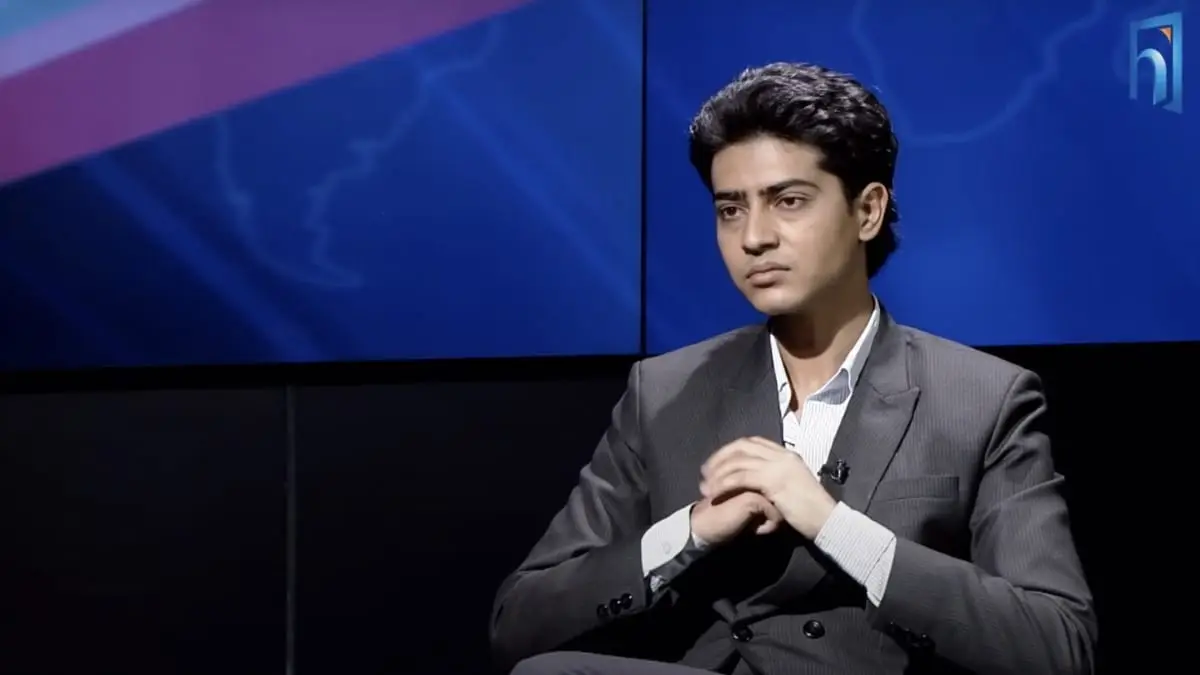
When Nepal’s government blocked several social media platforms on September 4th for failing to register locally, it inadvertently sparked the country’s biggest youth protests since the republic’s creation. Yet the apps were only a spark: the tinder was wider discontent with rampant corruption and a dearth of opportunities. Thousands of urban twenty-somethings poured into the streets of Kathmandu. Security forces responded with live ammunition, leaving scores dead. The next day Prime Minister K.P. Sharma Oli resigned. Among the organisers, or rather anti-organisers, was a young man with an unusually self-aware name: Miraj Dhungana, who became, by accident, the conscience of a generation.
Mr Dhungana argues he never sought to lead anything. “Leaderless movements cannot be beheaded,” he says. His social-media posts, mild in tone but crisp in indignation, spread faster than tear gas. When clashes with police turned deadly, he found himself both celebrated and blamed, a reminder that in Nepal reputation travels faster than reform.
Born around 2000 in Hetauda, an industrial town south of Kathmandu, Mr Dhungana belongs to the earthquake generation: children who revised for their school-leaving exams beneath tarpaulins after 2015’s tremors. His father’s government salary paid for private schooling but not indulgence; his mother prized obedience. He calls himself “a child of the kingdom”, old enough to remember a monarch, young enough to see republican promises curdle. By his teens he had moved to Kathmandu, a city then swelling on remittances from abroad. Prosperity was visible, planning invisible. “We modernised without management,” he says, pointing to the city’s traffic jams as proof that asphalt alone does not constitute progress.
His political awareness began in whispers. Around dinner tables adults sighed that “Nepal’s politics is finished”. Smartphones gave the phrase evidence: corruption scandals, fuel queues, ministers abroad for treatment their hospitals could not provide. “The internet taught us scepticism,” he says. To his cohort, connectivity became both livelihood and lifeline. When the government switched off social media, he felt “cut off from the world—like living in North Korea.” His small online-advertising firm lost clients overnight. But the loss, he says, was existential before it was financial: “They weren’t banning an app; they were banning us.”
The anger metastasised online. Facebook groups and Discord channels filled with laments over unemployment and censorship. Out of the noise came a slogan: “Garikhana deu”—let us earn a living. Mr Dhungana and a handful of peers proposed two protest slots, 11 a.m. and 6 p.m., timed to avoid police shifts. There would be no leaders, no party colours, no headquarters. “If there’s no head,” he reasoned, “you can’t cut it off.” Within days, short clips of chanting crowds ricocheted across social media. His own follower count jumped twentyfold. Digital spontaneity had produced a movement before its architects could draft rules.
On September 8th a barricade near Everest Hospital collapsed amid confusion; police fired into the crowd. Several young people fell. One, a national-level athlete, survived with permanent injuries. “That was the moment I realised it had gone too far,” Mr Dhungana said softly on a recent podcast. The triumph of mobilisation dissolved into mourning. When Mr Oli resigned soon after, the victory felt hollow. “No words can comfort a parent who has lost a child,” he says. “Not even God’s.”
Interrogated by police but never charged, he now spends his days explaining rather than inciting. The state, he believes, made two errors: underestimating youth anger and misunderstanding the digital age. “They thought we were children making noise online,” he says. “But online is our world. We don’t separate it from life.” That blurring of realms—between protest and post, citizen and content creator—marks Nepal’s first true Gen-Z awakening.
The experience has tempered him. He admits to having once been quick-tempered, “the kind who kicked doors when angry.” These days he preaches patience: “If someone is late, I don’t get angry. In Nepal, traffic happens.” The change is more than personal. Many young Nepalis, he notes, are learning to translate frustration into civic discipline. “Channel your anger; don’t waste it,” he tells them.
His politics is managerial rather than ideological. He favours keeping Nepal’s seven provinces but trimming bureaucracy—“keep the provinces, cut the fat.” He wants ministers replaced by technocrats, district coordination committees abolished and overseas Nepalis allowed to vote through embassies. With more than four million citizens abroad, he argues, disenfranchising them is both unfair and uneconomic. “These are not youth demands; they’re national ones.”
Mr Dhungana’s worldview owes more to the airport business lounge than to the barricade. He admires Singapore’s Lee Kuan Yew and Bhutan’s hydropower pragmatism. “You can’t ask a truck driver to fly a plane,” he says of Nepali politicians. Competence, not charisma, should decide who governs. He speaks of “raising living standards” and “making Nepal a place where people want to stay rather than flee”. His is the patriotism of opportunity cost.
That pragmatism extends to his economics. Entrepreneurs, he says, are not enemies but engines of growth; an economy that works would reduce migration and fund welfare. He measures patriotism in megawatts exported and jobs created rather than slogans shouted. Yet moral clarity survives beneath the technocracy. “If I ever become like them,” he says of corrupt officials, “arrest me.”
The trauma of the protests has also deepened his empathy. Visiting Kathmandu’s Teaching Hospital, he saw patients sleeping on floors and operations conducted on ordinary beds. “For them, pain has become the new normal,” he says. It was there, not online, that his politics acquired gravity. “A journalist told me to read books. I decided to read people instead.” From tea-stalls in Dolpo to roadside vendors on the East-West Highway, he seeks conversation over citation. “You learn more in 30 minutes at a pakoda shop than in months of social-media debate.”
Older mentors have taken notice. One confided, “My generation failed.” Mr Dhungana listens respectfully but refuses to mimic his elders’ fatalism. The advice he treasures most is deceptively simple: travel widely and “don’t let unqualified hands fly the plane”. He repeats the line like a mantra. For him competence is the new revolution.
Power, he believes, has lost its meaning. “When you’re busy keeping a coalition alive, you forget to develop the country.” Rumours of ministerial offers do not tempt him. “Power isn’t a government car; it’s the ability to build.” That inversion—seeing office as service rather than status—is rare in Kathmandu, where politics is often a family business and resignation letters are bargaining chips.
He shows little concern for personal comfort. When friends urge him to rest, he shrugs. “If I focused on mental health, I wouldn’t even be here,” he says. “Let mental health go. If the country is fixed, that’s all that matters.” The remark sounds reckless in an age of self-care yet it captures a generational fatalism: the sense that private wellbeing must wait for national repair. His mother worries but consents. “Do what you must for the country,” she tells him.
Rebuilding a nation, he knows, means more than slogans. Money, manpower and stamina are in short supply. Still, he refuses to emigrate. “I didn’t take leave from home to return empty-handed,” he says. If prison awaits, “that’s in God’s hands.” The mixture of defiance and devotion is vintage Nepali: half-spiritual, half-stubborn.
In quieter moments he wonders whether Nepal’s cynicism will ever lift. “Every new jogi is accused of having torn ears before he even arrives,” he says, quoting a local proverb. The tendency to mock reformers before they act, he believes, is more corrosive than corruption itself. “We are too critical, too little hopeful.”
Yet hope, however fragile, persists. Mr Dhungana’s phone buzzes with messages from volunteers eager to join his next civic campaign. He urges them to study first, to learn governance before politics. “You can’t fly the plane without training,” he repeats. If elections ever reward competence over kinship, he may one day try for office. For now he writes, organises and waits.
His story is less about one man than about the mood of a country. Nepal’s Gen Z are neither revolutionaries nor conformists. They are pragmatic cosmopolitans trapped in a parochial state—fluent in memes and markets, yet governed by men who still distrust the internet. Their uprising was not for ideology but for dignity: a demand to be heard, connected and capable. In that sense Mr Dhungana is less a leader than a mirror, reflecting a generation that refuses to leave even when leaving would be easier.
At the end of one conversation an older adviser told him, “Do not carry all the burden alone, brother.” Mr Dhungana smiled. “I’ll keep trying,” he said. For now that modest promise is the closest thing Nepal has to a manifesto. ■