Hellraiser Image: ArthaSarokar
In the hushed offices of Nepali bankers, few names evoke as much anxiety as Durga Prasai. The businessman and political rabble-rouser owes the financial system some Rs5.8bn in defaulted loans. His proposed solution to this personal predicament, however, threatens to become a national crisis. He has taken to urging the public to stop repaying their own debts, a call that could destabilise the country’s already fragile banks (see this). For Mr Prasai, this is merely one front in a wider war against the modern Nepali state. His escalating confrontation with the government, his capacity for violent mobilisation and his unconstitutional ambitions mark him out as Nepal’s most prominent and perplexing security risk.
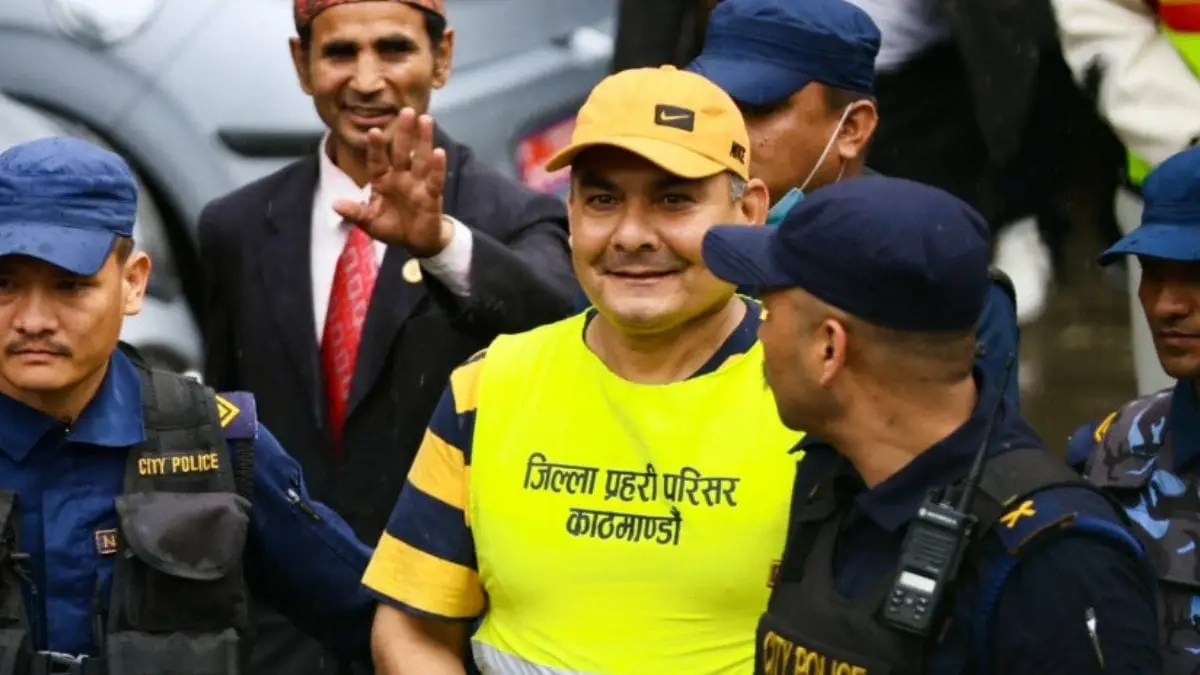
The state’s assessment of the threat was made clear when police arrested Mr Prasai at his residence in Bhaktapur this week. The move came after weeks of provocative speeches in which he claimed he could bring Nepal to a standstill. Authorities acted just before he was to launch a nationwide agitation on November 23rd, a preventive measure suggesting they feared a repeat of past unrest. A security committee at the Home Ministry had already authorised strict legal action against individuals inciting violence, placing Mr Prasai in the category of a high-risk figure not a normal political opponent.
His classification as such rests on a demonstrated pattern of mobilising protests that turn violent. In March this year, a pro-monarchy rally he organised descended into chaos, resulting in two deaths and extensive damage to property. On another occasion, Nepal Police used hundreds of tear-gas shells and rounds of ammunition to disperse his supporters, indicating the scale of the confrontations he sparks. Mr Prasai may later deny any role in the violence, but the consistent chain of events—inflammatory speeches followed by mass mobilisation and then bloodshed—leads police to view him as a central catalyst.
The intent behind these actions appears explicitly disruptive. Mr Prasai’s public warning that he could paralyse the country is not mere rhetorical flourish. In fact it signals a genuine aim to halt government functions and economic activity. His list of 27 demands includes radical proposals such as the restoration of the monarchy, the reinstatement of Nepal as a Hindu state and the nationalisation of certain industries. These goals cannot be achieved within the framework of the country’s 2015 constitution. The protests, therefore, seem not to negotiate policy but to force a constitutional crisis. This is compounded by his personal threats against elected officials, including the prime minister and the home minister, which fuel political polarisation.
To pursue this agenda, Mr Prasai has moved beyond loose agitation to formal political organisation. His vehicle, the Nagarik Bachau Dal Nepal, is registered as a political party with him as its patron and ideological anchor. The party states it is dedicated to “achieving Prasai’s ideas, goals, and objectives”. This institutionalisation provides a parallel command structure and a systematic platform for mobilisation across Nepal’s provinces. It is a political machine built around a single radical leader, making state confrontation more organised and durable.
The radicalism of his stated goals cannot be overstated. Advocating for the abolition of federalism, the return of the monarchy and a Hindu state amounts to a call for the dismantling of the entire constitutional order established after the bloody civil war. Any movement that seeks to alter the political order outside constitutional mechanisms is, by definition, a national security concern. It challenges the legitimacy of elected institutions and raises the risk that fringe groups may resort to force.
Mr Prasai’s most immediate threat, however, may be to economic stability. His campaign urging citizens to stop repaying loans to banks and microfinance institutions strikes at the heart of the financial system. He demands the cancellation or restructuring of private loans above Rs2m and the nationalisation of industries owned by the Marwari business community. This rhetoric not only risks a crisis of confidence in banks but also inflames communal tensions by targeting a specific ethnic group. Given his own substantial loan defaults, his anti-bank crusade is widely interpreted as a self-interested attempt to pressure the political and regulatory establishment. The moral hazard is profound, encouraging financially stressed citizens to politicise their obligations and possibly triggering a systemic collapse.
Complicating matters further is his willingness to inject geopolitical tension into domestic politics. Mr Prasai has falsely implied that India supports his royalist and Hindu-state movement. This has forced India to issue formal denials, warn him against political activities on its soil and express irritation at being dragged into his narrative. For Nepal, a country perennially navigating a complex relationship with its giant neighbour, such behaviour is dangerous. It risks creating bilateral misunderstandings and fuels conspiracy theories, as well as undermines trust between Kathmandu and New Delhi. India’s arrest and deportation of Mr Prasai after violent protests was a telling indicator of its concern.
Perhaps the most troubling aspect of his rise is his apparent proximity to elements of the state itself. During the recent Gen Z political uprising, the army chief publicly named Mr Prasai as a “stakeholder”, a move that caused young leaders to walk out of negotiations. Mr Prasai then released photographs of himself meeting the army chief during this volatile period. This fostered widespread suspicion that parts of the security establishment might be using him as a proxy, or that he was inserting himself into state decision-making. The prospect of an unelected radical figure being positioned as a crisis negotiator with the military raises profound questions about the integrity of Nepal’s democratic institutions.
A history of weapon-related controversies adds another slice of worry. A Home Ministry committee investigated his weapons permits in 2024. In a separate incident, two of his aides were arrested on the premises of the Supreme Court with a semi-automatic rifle and 100 rounds of ammunition. Although they were later released by a court order, the event points to the potential militarisation of his political movement and the risk that street mobilisations could escalate into armed confrontation.
His persistent legal troubles—including defamation cases, cybercrime allegations and accusations of money laundering—paint a picture of a man who consistently challenges or bypasses state institutions. This pattern validates the view that he poses a fundamental risk to governance and the rule of law. His ideological shifts, from Maoist supporter to insider of the mainstream UML party to royalist firebrand, suggest a drive based more on political expediency than principle. This unpredictability makes him a difficult figure for security agencies to anticipate or manage.
Ultimately, Mr Prasai’s method is classic populist destabilisation. By framing politics around “nation, nationalism, religion, and culture”, he taps into ethno-religious sentiment for mobilisation. His Hindu-state rhetoric risks alienating minorities and polarising a multi-ethnic society, undermining the secular republican identity that the modern constitution sought to forge. He meets every classic criterion of an internal security risk: he mobilises violent crowds; threatens constitutional order; challenges financial stability; and interferes with state institutions.
Nepal’s democratic journey has been neither easy nor linear. It remains a young republic, its institutions still fragile. Figures like Durga Prasai test the resilience of that republic with a sustained assault on its multiple pressure points—from the streets to the banks to the barracks. For the government in Kathmandu, the challenge is to fix the legitimate public grievances he exploits, while ensuring that his destructive campaign does not achieve the national standstill he so openly promises. ■