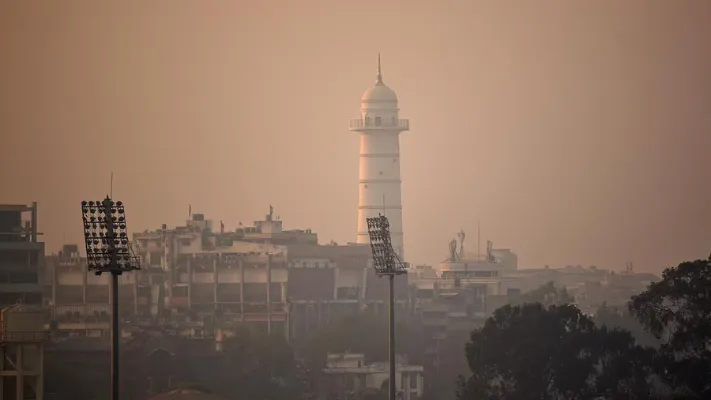
Image via The Kathmandu Post
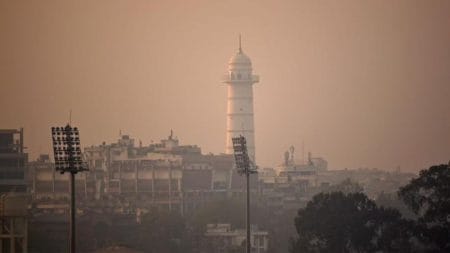
A CLOUD OF particulate matter hangs over Nepal, so dense that it trims years from the lives of those who breathe it. Nepal ranks among the world’s most climate-vulnerable countries, placed 139th out of 182 on global indices, notwithstanding its citizens having among the lowest per-person emissions. Its geography is a recipe for climatic punishment: from the swampy plains of the Terai in the south to the soaring Himalayas in the north, the country is exposed to a brutal assortment of hazards. Now, breakneck and unplanned urban expansion, particularly in the Kathmandu Valley, is forging a crisis. A city is being built directly in the path of mid-century extremes.
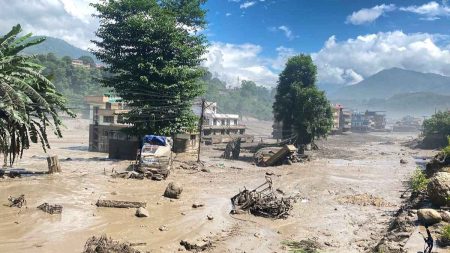
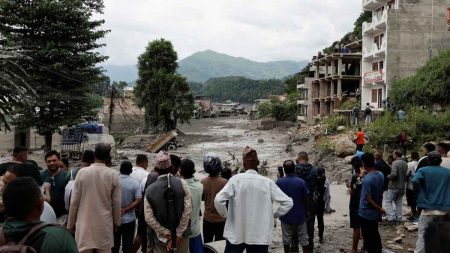
The hazards themselves are not new. River floods and landslides have been the most frequent disasters over the last four decades. Landslides concentrate in the northern mountains, whereas floods inundate the southern Terai and river valleys. What is changing is their intensity and the number of people in harm’s way. Temperatures are expected to rise by roughly 1°C between 2016 and 2045, accelerating glacier melt and compounding flood risks. Heat exposure is rising sharply, especially in the southern lowlands, and droughts are becoming more frequent. These patterns are set to harden. Between 2041 and 2060, heat stress will worsen significantly across all climate scenarios. Extreme rainfall will intensify, particularly in western provinces that were historically less affected.
The most immediate threat to human health, however, may be the air. Nepal ranks third globally in years of life lost due to air pollution. On average, it shortens life expectancy by four years; in the Terai, the figure can reach seven years. High-resolution satellite mapping shows municipalities along the southern border with PM2.5 levels of 60 micrograms per cubic metre, nearly double the World Health Organisation’s standard. This toxic smog is driven by industrial clusters, brick kilns, vehicular congestion and cross-border pollution from India. While not strictly a climate hazard itself, air pollution is profoundly worsened by climate change. Soaring temperatures and more frequent droughts magnify the chemical reactions that create pollutants and increase dust and smoke from wildfires.
Nepal’s profound vulnerability comes not only from exposure to these hazards but from a lack of defences, too. Some 62% of the workforce depends on agriculture, mostly on small, rainfed subsistence farms highly exposed to drought and floods. Urban jobs, in services and manufacturing, are typically small-scale, informal and vulnerable to heat stress. Weak social protection and limited disaster-relief capacity leave households with few coping mechanisms. This is measured in what economists call “well-being loss”, the impact on consumption and livelihoods after a disaster strikes. The poor suffer larger well-being losses because they lack savings, credit access, insurance or safety nets.
A map of socio-economic resilience shows a country of brutal contrasts. Kathmandu and other urban centres in the south have the highest ability to cope with shocks. The northern mountains, however, have resilience nearly three standard deviations below the national mean. When asset losses occur there, they translate into far deeper human suffering. This divergence means climate policy cannot be one-size-fits-all. The north needs long-term structural support to manage landslides and isolation. The south needs adaptation in agriculture, irrigation and heat protection. The urban valleys desperately need air-quality control and water management.
Compounding these problems is a settlement pattern that seems almost sure to maximise risk. As valley land becomes scarce, human settlements are expanding onto steeper slopes, dramatically raising landslide risk. Built-up area grew significantly from 2000 to 2019, mostly in the Kathmandu, Pokhara and Terai corridors. This urban sprawl has replaced cropland, grassland and forest, stripping away natural buffers against hazards. Between 2000 and 2019, over 17% of municipalities lost more than a fifth of their cropland. The fallout is that cities are becoming traps.
Nowhere is this more evident than in Kathmandu. The city drives most of the discrepancy in national flood-mortality estimates, a sign of how poorly its rapid growth is understood by modellers and planners. Expected annual flood deaths calculated using different population datasets can vary by thousands, because urban-area estimates in such rapidly growing, unplanned cities remain methodologically noisy. The built environment is expanding so chaotically that it defies accurate mapping, which in turn distorts risk assessments. The models are best interpreted as indicative rather than definitive, but they consistently point to the Kathmandu Valley as an epicentre of danger.
The future will test this precarious system. Drought patterns are projected to remain largely stable, with western Nepal staying the driest region. But shorter, more intense dry spells will increase, especially in the east and centre under high-emissions scenarios. The real threat is heat. Projections for the Wet Bulb Globe Temperature, a measure of heat stress, show rising anomalies nationwide. This threatens labour productivity and health, particularly for agricultural workers in the Terai who perform prolonged outdoor work. Urban areas, with their heat-island effects and dense populations, will face compounded risks.
Nepal’s ability to navigate this future depends on building a greener, more resilient economy. Here the outlook is grim. Only about 1% of the labour force works in green or potentially green occupations. These jobs skew male and require tertiary education, creating barriers to inclusive growth. The agricultural workforce, which will face the brunt of climate change, is least connected to green-transition opportunities. An analysis of job types suggests the average agricultural job has a 79% chance of being non-green and a 0% chance of being a new green occupation. The regions already struggling with poverty and low resilience will face disproportionately rising impacts.
Without targeted investment in climate-smart agriculture, green-skills development and regional resilience, Nepal risks locking millions of workers into livelihoods that become progressively less viable. The pall over Kathmandu is more than pollution: it is the shadow of a difficult future. The city’s growth, once a sign of aspiration, is now a measure of exposure. As the climate warms, the trap is being set. ■