Photographer: Pablo Porciuncula/AFP/Getty Images
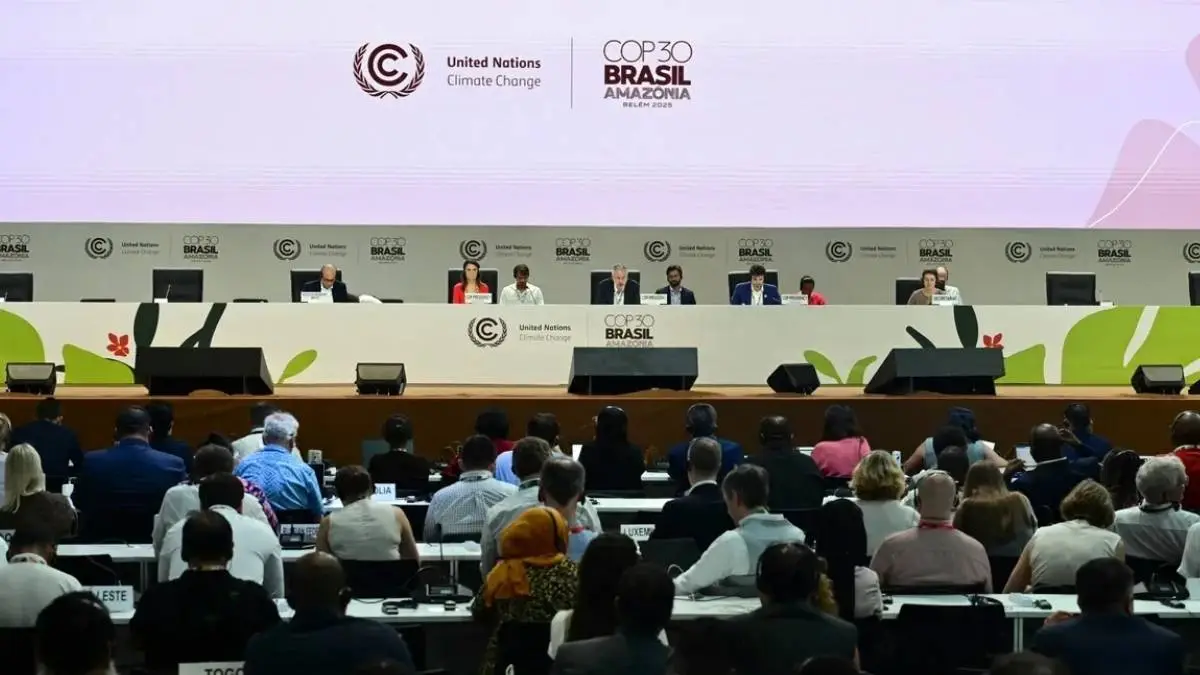
It was meant to be the summit that confronted the ugly truth. In Belém, a Brazilian city on the edge of the vast Amazon rainforest, delegates from nearly 200 countries gathered for the latest United Nations climate conference, COP30.
The location was a powerful symbol. The Amazon is one of the world’s great natural defences against global warming, a colossal store of carbon. Its fate is tied to that of the planet. The world is in the grip of record-breaking heat, ferocious wildfires and devastating floods. The task for the conference was to formulate a collective response commensurate with this emergency. After two weeks of intense negotiation, the result was an eight-page document, the Global Mutirão decision. It makes small, hesitant steps forward. But on the central question of the climate crisis—the future of fossil fuels—it is silent.
The most contentious issue was the one many deemed the most important. A coalition of over 80 countries, including Britain, Germany, Kenya and Colombia, arrived in Belém demanding a clear plan for phasing out the oil, gas and coal that power the world economy. Fossil fuels are the source of over three-quarters of global greenhouse-gas emissions. Without a strategy to slim down their use, the goal of limiting global warming to 1.5°C above pre-industrial levels, agreed in Paris in 2015, becomes unattainable.
Also read: The world is no longer fighting climate change
Yet the final text contains no such roadmap. Brazil’s initial draft, seeking consensus, had already stripped out direct references to a fossil-fuel phase-out. It was further weakened by opposition from several large fossil-fuel producers and consumers, including China, Russia and Saudi Arabia, which blocked any language that could be construed as a binding commitment.
The summit’s president, André Corrêa do Lago, promised a separate “just transition roadmap” to be developed over the next year. But this will not be part of the official COP30 agreement. The failure to tackle the core driver of climate change directly represents an ugly shortcoming. It is as if a doctor, confronted with a patient suffering from a severe illness, chose to treat the symptoms while ignoring the pathogen.
One symptom, however, did receive unprecedented attention. The concept of “adaptation”—helping countries prepare for the floods, droughts as well as heatwaves that are already unavoidable—moved from the periphery of climate talks to a position of prominence. The final agreement pledges to triple financial support for adaptation efforts by 2035. This is a recognition that climate change is not a future threat but a present danger, particularly for small island states and less-developed nations in Africa and Asia, which are already suffering from eroding coastlines and failing crops. Developing countries had pushed for the target to be met by 2030, but were resisted by wealthier nations. Even so, the commitment shows a belated understanding that the world must invest heavily in resilience, for the impacts will intensify long after emissions begin to fall.
Another new front in the climate debate opened in Belém: international trade. The European Union’s new carbon border adjustment mechanism, which imposes charges on imports from countries with weaker climate rules, was a source of friction. China and others argued it was a protectionist measure disguised as environmental policy. The final COP30 text includes a warning against “unjustifiable trade discrimination” stemming from climate action, and a global dialogue on trade and climate is scheduled for 2028. This skirmish is a precursor of future battles as economies realign.
A related issue, that of critical minerals, also surfaced. Lithium, cobalt and nickel are essential for batteries and other clean-energy technologies. Early draft texts noted the environmental and social risks of mining these minerals, such as water pollution and labour abuses, but this language did not survive the final edit. Its brief appearance, however, signals a nascent fear: that the world may simply exchange a dangerous dependency on fossil fuels for a messy dependency on mineral extraction, creating a new set of problems.
The city of Belém itself provided a crucial, non-negotiated element: the vibrant return of civil society to the climate process. Tens of thousands of people marched through its streets. Indigenous activists, until granted an audience, blocked the entrance to the official “Blue Zone” negotiating area. This public pressure, largely suppressed at recent COPs in the United Arab Emirates and Egypt, revived a tradition of activism that has historically been vital for progress. The contrast with the next host, Turkey, where free expression is heavily curtailed, is worrying.
As host, Brazil had grand ambitions. It hoped to broker a global deal on fossil fuels and to launch the Tropical Forests Forever Facility, a major new fund to protect the world’s great rainforests. The results were small. The forest fund secured pledges of just $6bn, from countries including Norway and Germany, far short of the tens of billions envisioned. A proposed global roadmap to end deforestation was excised from the final agreement, leaving many negotiators to wonder privately where, if not in the Amazon, such a pledge could ever be made.
The dynamics of the talks were also shaped by a powerful absence. The United States, under President Donald Trump, has again withdrawn from international climate agreements and sent no delegation to Belém. This created a leadership vacuum. It meant there was no American pressure on big emitters like China and Saudi Arabia to be more ambitious. European negotiators felt isolated in pushing for stronger commitments. China for its part maintained a low-profile and defensive posture, focused on shielding its exports from climate-related trade measures and submitting an underwhelming new climate pledge. It showed no appetite for global leadership.
COP30 therefore leaves the world in a precarious state. The good news is that the need for adaptation finance is now centrally acknowledged. New issues linking climate, trade and mineral supply chains are on the agenda. Civil society has shown it can still make its voice heard. Brazil, though it secured a weak final text, has promised to spend the next year building support for its twin roadmaps on fossil fuels and forests.
The bad news is more fundamental. The world still lacks a credible, collective plan to phase out the fossil fuels that are overheating the planet. Global leadership is absent. Financial commitments for vital projects like forest conservation are insufficient. The risks are obvious. Without rapid cuts to emissions, the costs of adaptation will become crippling. Trade disputes could fracture climate cooperation. The restrictive environment expected at next year’s COP31 in Turkey could stifle the public pressure that is essential for ambition.
The conference in the Amazon did not move the world backward. The fragile project of global climate co-operation remains alive. But it did not move the world forward fast enough. The next twelve months will determine whether the incremental progress made in Belém can be converted into the transformative action the climate system demands. The patient is still sick, and the doctor is still hesitating. ■