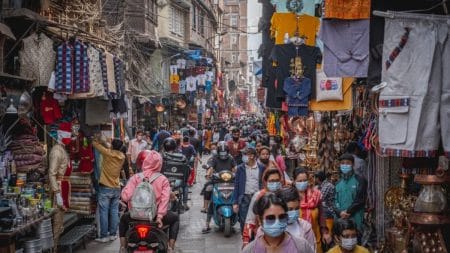
Illustration: Katmandu Journal
Every budding entrepreneur in Kathmandu learns the same lesson. When the economy is bustling, banks are suddenly eager to provide loans. When times are tough (as it is now), loan officers grow cautious, muttering about risk and liquidity (which is abundant now). This points to a basic rule of how the financial system runs in Nepal. Credit doesn’t lead growth here: it follows and often lags behind. For a country hoping to develop, that is a problem. You cannot fuel an engine that has not been started.
One study from the Nepal Rastra Bank lays this bare. Neelam Timsina, a director at the central bank’s research department, crunched four decades of data to find out what really drives lending. The results turn textbook economics on its head. The usual tools—interest rates and reserve requirements—barely register. Instead just two things matter: the growth of the overall economy, measured by GDP, and how much spare cash banks have on hand. In other words, banks lend when business is already good and when they feel flush. They are spectators, rather than players, in the drama of development.
The analysis is methodical, using standard regression and causality tests on data from 1975 to 2014. The central finding is that causality runs one way, from GDP to private credit. Growth pulls loans out of the banking system. The reverse—loans creating growth—isn’t supported. This leaves the financial sector closely tracking whatever happens in the real economy. When growth is strong, lending expands. When it is not, credit contracts. It’s a passive, reactive role.
The second lever is the liquidity ratio. This is the portion of safe, easily sellable assets banks hold. Counterintuitively, more liquidity doesn’t mean more lending. Banks often sit on extra cash to meet regulations or because they’re cautious. But when liquidity dries up, lending falls off a cliff, no matter what else is happening. This was brutally clear during the credit crunch of 2010-2013. Loans seized up overnight, crippling businesses even in otherwise productive sectors. The banks’ internal comfort, rather than the economy’s potential, dictated terms.
What about the other factors? Deposits, which make up more than 90% of banks’ loanable funds, are less decisive than you’d think. The system runs on a steady drip of remittances from workers abroad, so deposits are a constant. The key is how bankers manage that pool not its size. Interest rates have little punch because Nepal’s market is shallow: loans are secured against land rather than priced on risk. The cash reserve ratio is adjusted so rarely it’s irrelevant. Inflation and the exchange rate nudge things at the margins—a weaker rupee helps by boosting remittance value—but they don’t drive the car.
This leaves policymakers in a tricky spot. If banks won’t lend their way to growth, what’s the point of monetary policy? The central bank’s traditional instruments are blunt. Fine-tuning the cash reserve ratio is a waste of effort. Instead the Nepal Rastra Bank should focus on its one powerful task: managing systemic liquidity. It must ensure that when growth does appear, banks aren’t too starved of cash to support it. That means becoming a better forecaster and a more active manager of the banking sector’s lifeblood.
For commercial bankers the lesson is about strategy. They must tie their lending plans to GDP forecasts and manage their liquidity buffers proactively. Chasing market share in a downturn is reckless. Hoarding cash during an upswing is wasteful. They need to watch economic indicators as closely as their own balance sheets.
But the real implication is wider and sobering. The financial system, as it stands, cannot break the country out of a low-growth trap. It only amplifies the cycle that already exists. Therefore, the drive for development must come from elsewhere—from the hard, unglamorous work of fixing infrastructure, simplifying regulations, upgrading farms and boosting productivity. The banks will provide the money but only after the real economy shows it is moving.
That garment factory owner waiting for his loan is a sign of Nepal’s predicament. His future, and his country’s, depends not on the whims of bankers but on forces far beyond their offices: roads, power lines, sensible laws and fertile fields. Get those right and the banks will finally have something to follow. ■